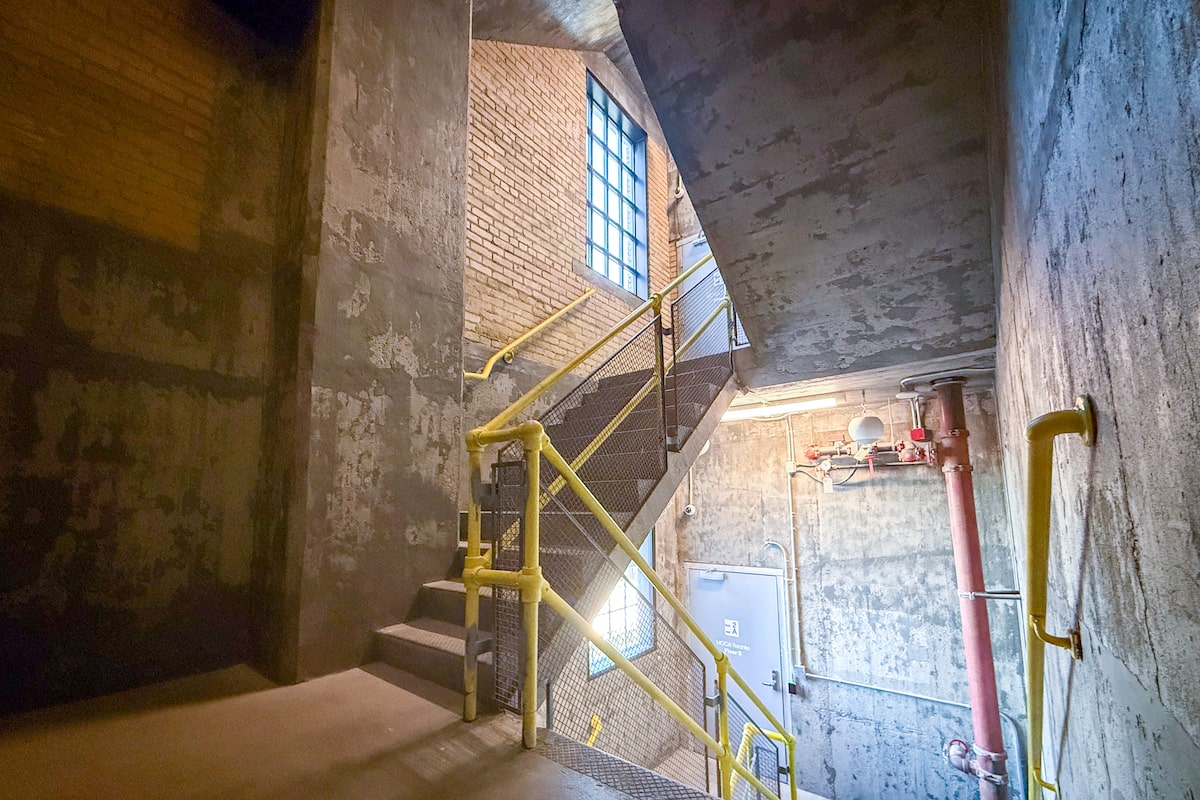
A sound installation by Canadian artist Kelly Mark plays I Really, a repetition of a to-do list, accompanied by the electronic beats of Sandrien in the stairwell at MOCA Toronto.
Listen closely while visiting the sprawling Jeff Wall exhibition up now at the Museum of Contemporary Art in Toronto and you might hear thumping beats, as if there’s an all-hours nightclub nearby.
The source of the sound? The museum stairwell, playing a techno track by Sandrien featuring the late Toronto-based artist Kelly Mark. The recording invites both dancing and deep contemplation.
For the past five years, MOCA has curated sound installations in its southern stairwell that connects the three floors of the museum.
South Stairwell Sound Series originated from an idea by Portuguese artist Carlos Bunga, who noticed the exceptional acoustic quality in the stairwell during the installation of his 2020 show, A Sudden Beginning. He asked if he could show a sound piece in the museum stairwell concurrently. The answer was yes. MOCA installed an audio recording of Bunga dismantling his own work; visitors could hear the artist’s footsteps on cardboard as he took down one of his exhibitions in Europe.
Speakers placed throughout the stairwell play vocals of a mundane to-do list layered with electronic music.Sarah Espedido/The Globe and Mail
“After that, we thought, why don’t we continue to put sound pieces in the stairwell,” said Rui Mateus Amaral, MOCA’s artistic director. “It was in the last two or three years that we decided to start commissioning works for the stairwell, as well as showing works that already exist because there are so many artists who work in sound, and it is an underrepresented medium.”
The stairwell is a transit point in a museum that presents an unexpected viewing – or perhaps more accurately, listening – experience for visitors. The sound series at MOCA is a novel and inventive use of a space often overlooked for art installations, constrained by building codes that rarely permit hanging in the area.
MOCA’s current sound installation, which can be found on YouTube, is by artist Kelly Mark, who passed away earlier this year. I Really takes the mundane task of creating a to-do list and how it can become Sisyphean in nature, and pushes it to its apex with club beats, sampled by Dutch techno-artist Sandrien. The repetition, accompanied by constant bass thumping, aptly recreates the feeling of being unable to escape one’s own thoughts, so instead you simply get lost in them.
Mark had been working on the stream-of-consciousness text since 1996. In 2002, she recorded the list as an audio CD edition of 1,000 things she “really should do.” The track was meant to be played out loud in a gallery. She was contacted by Sandrien’s record company in 2010 about using her vocals on a “little electronic piece.”
When it was first released, it made a mark on the world outside of art, and was a hit song in Europe that summer, which MOCA’s Amaral calls a bizarre crossover.
“Kelly Mark is a conceptual artist with a capital C,” Amaral said. “The work was so smart and well-conceived, it also had such an emotional texture. There’s such a strong sense of life and death, and the range of emotions that come with being alive and thinking about the human condition.”
Sound art often isn’t the first thing that comes to mind when thinking about contemporary art. Despite the success of British Columbia artist Janet Cardiff’s sound installations, notably Forty-Part Motet, which has a permanent location at the National Gallery of Canada, the flashiness and instant gratification of paintings, sculpture and photography often prevail when artists compete for exhibition space.
At MOCA, sound art has included the haunting repetition of Berlin-based conceptual artist Ceal Floyer’s ‘Til I Get it Right and the undulations of African-American sonic and visual artist Jennie C. Jones’s Year of Construction: 1970.
The audio installations have a quality that invites metaphor. For example, Floyer’s melancholic repetition of a single line from a Tammy Wynette love song evokes the feeling of moving toward something, not unlike the action that takes place on a staircase. The avant-garde soundscape of Jones’s work modulates in the same way it feels to go halfway up a set of stairs, only to forget something and have to immediately go back down.
The Whitney Museum of American Art in New York has also used a stairwell to showcase audio art, notably in 2019 with Ascent/Dissent by Marcus Fischer and in 2024 with Holland Andrews’s Air I Breathe: Radio. What in other contexts might be mundane, or even dreaded, becomes delightful, giving museum visitors a good reason to take the stairs.
If a staircase is an access point, so is music. The accessible genre gives a soft opening to engage further with works by an artist. Or, perhaps you just enjoy the melody and that’s enough.
“People can either come at it through conceptual art and then be exposed to the club, or come through the club and be exposed to conceptual art, and they both kind of alter how we read both of them,” Amaral said.
Earlier this year, MOCA introduced another site of transition: their elevator. The artist Justin Ming Yong quilted the elevator, cocooning people as they made their way between floors. By making the boundaries of art-viewing fluid, MOCA is challenging the conventional notions of where art can be found and how we experience it.