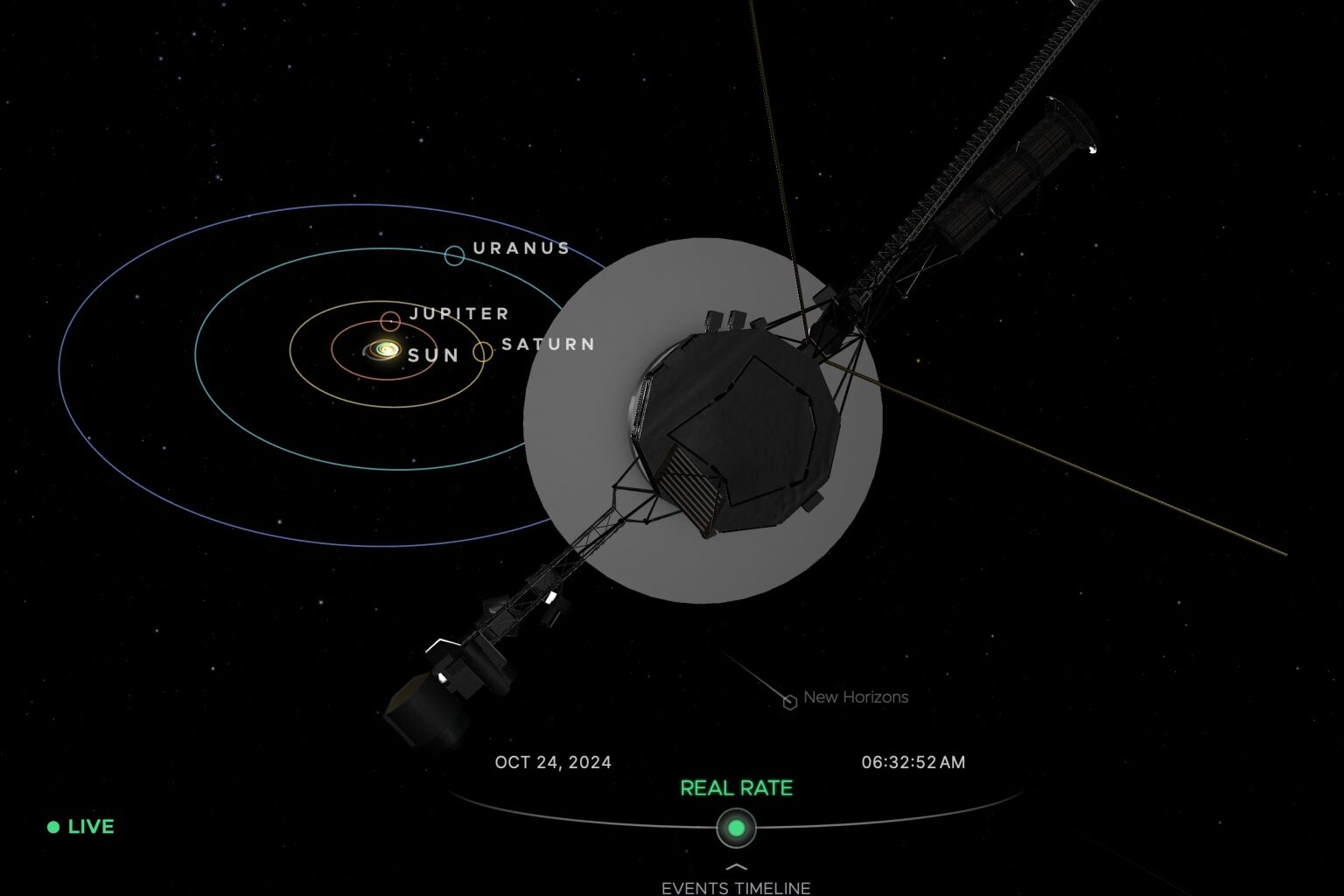
NASA’s Voyager 1 probe is preparing to cross an extraordinary threshold. By mid-November 2026, the veteran spacecraft is expected to become the first human-made object so far from Earth that a radio signal will take a full day to arrive.
Right now, Voyager 1 sits about 15.7 billion miles (25.3 billion km) from home. NASA says a message needs “around 23 hours, 32 minutes, and 35 seconds” to make the trip. Within a year, that gap will stretch to 24 hours as the spacecraft drifts to roughly 16.1 billion miles (25.9 billion km) from Earth.
Communications Slow To A Crawl
Reaching such an immense distance brings new challenges. Every instruction sent through NASA’s Deep Space Network will take a day to reach the probe and another day for a reply. That means even simple commands will unfold on a two-day cycle.
How Voyager Reached This Point
Voyager 1 has been travelling since 1977, launched during a rare alignment of the outer planets that only happens once every 176 years. Together with Voyager 2, it carries a computer with about three million times less memory than a modern smartphone, which is a detail NASA often highlights to show how remarkable their longevity is.
During its early journey, Voyager 1 flew past Jupiter and Saturn, capturing the famous “pale blue dot” image at Carl Sagan’s suggestion. Its path then carried it out of the Sun’s influence. Voyager 1 crossed into interstellar space in 2012, followed by Voyager 2 in 2018. They remain the only spacecraft to have travelled beyond the heliosphere.
Powering On After Nearly Five Decades
NASA expects Voyager 1’s nuclear power source to last for roughly another year. Even so, it continues to hold its title as the most distant spacecraft ever launched. Voyager 2 trails behind, sitting about 19.5 light-hours from Earth but still ranking as the second-most distant human-made object.
 Published by Kerry Harrison
Kerry’s been writing professionally for over 14 years, after graduating with a First Class Honours Degree in Multimedia Journalism from Canterbury Christ Church University. She joined Orbital Today in 2022. She covers everything from UK launch updates to how the wider space ecosystem is evolving. She enjoys digging into the detail and explaining complex topics in a way that feels straightforward. Before writing about space, Kerry spent years working with cybersecurity companies. She’s written a lot about threat intelligence, data protection, and how cyber and space are increasingly overlapping, whether that’s satellite security or national defence. With a strong background in tech writing, she’s used to making tricky, technical subjects more approachable. That mix of innovation, complexity, and real-world impact is what keeps her interested in the space sector.