Topline
Skywatchers will this weekend be treated to the sight of Saturn close to a bright moon. The ringed planet — close to its brightest of the year — will appear to the right side of the moon, as seen from the Northern Hemisphere on Friday, Nov. 28, sit very close to it on Saturday, Nov. 29, and appear on its left side on Sunday, Nov. 30. The close conjunction occurs because the moon orbits Earth on roughly the same plane — the ecliptic — as planets orbit the sun.
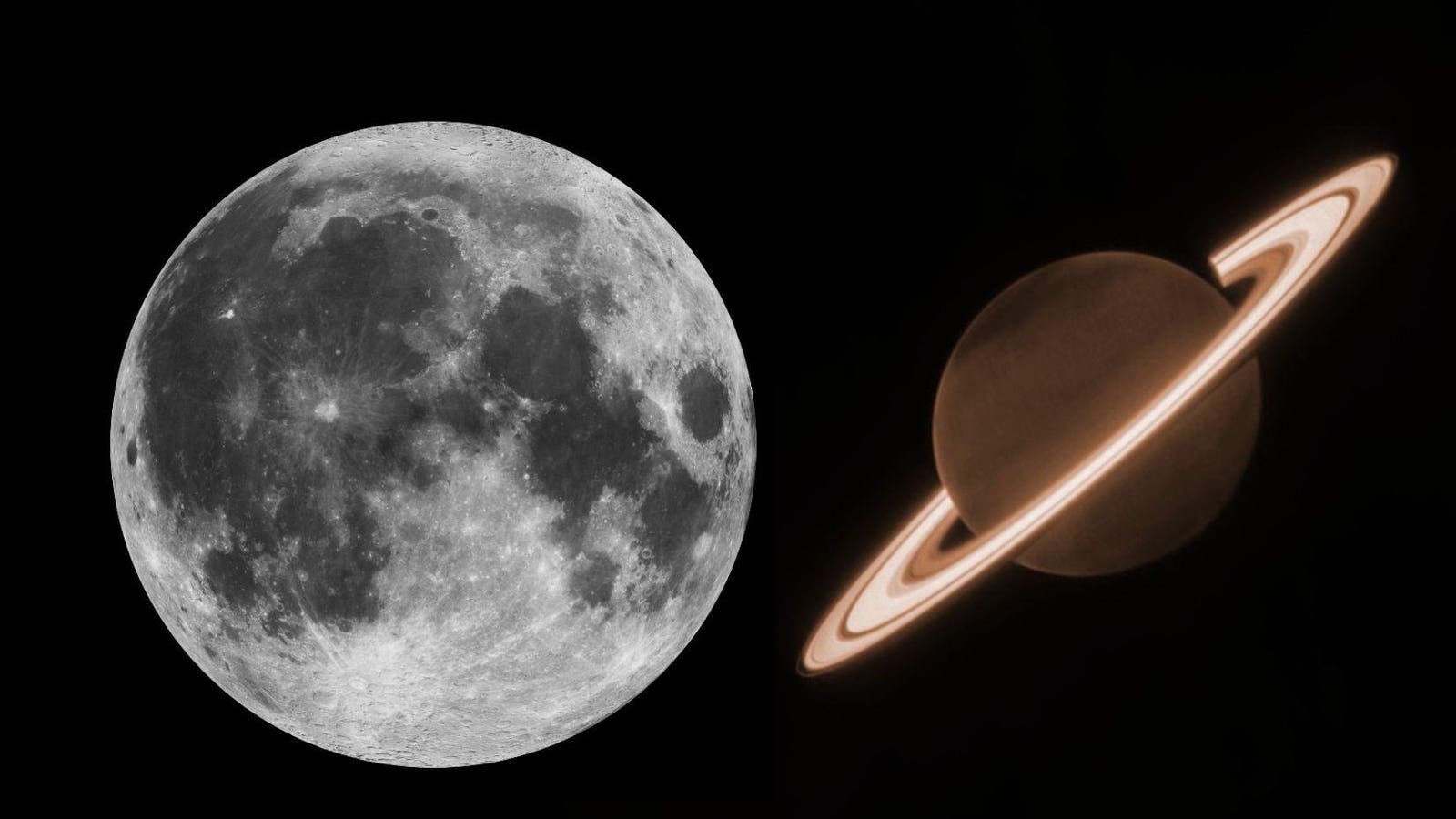
The moon and Saturn will be in a close conjunction this weekend. (Composite image of two separate NASA images)
Saturn: Image: NASA, ESA, CSA, Matthew Tiscareno (SETI Institute), Matthew Hedman (University of Idaho), Maryame El Moutamid (Cornell University), Mark Showalter (SETI Institute), Leigh Fletcher (University of Leicester), Heidi Hammel (AURA) Image Processing: Joseph DePasquale (STScI). Moon: NASA/GSFCKey Facts
About an hour after sunset each evening between Nov. 28-30, face south and look up. The closest pairing will occur on Nov. 29 when the 68%-illuminated waxing gibbous moon will be less than five degrees above Saturn, according to WhenTheCurvesLineUp.com.
Saturn will appear as a golden, steady point of light near the moon. Although it’s not as bright as Jupiter, this conjunction will be especially striking to the naked eye because Saturn is shining relatively brightly shortly after its bright opposition in September.
Through a small telescope, skywatchers can catch a glimpse of Saturn’s rings, though they are currently tilted at their narrowest from Earth’s perspective.
During the close conjunction on Nov. 29, Neptune will be just below the moon, roughly between it and Saturn, though the eighth planet from the sun is too dim to be seen with the naked eye.
When Is The Next Full Moon?
The next full moon will occur at 8:20 a.m. EST on Thursday, Dec. 4, 2025. Called the “Cold Moon,” the “Long Nights Moon” and the “Moon Before Yule” by various cultures, it will be the second-biggest full moon of 2025 — a “supermoon” — the third of four supermoons that round out 2025 and begin 2026. It will also be the third and final full moon of fall in the Northern Hemisphere, and spring in the Southern Hemisphere.
Read More