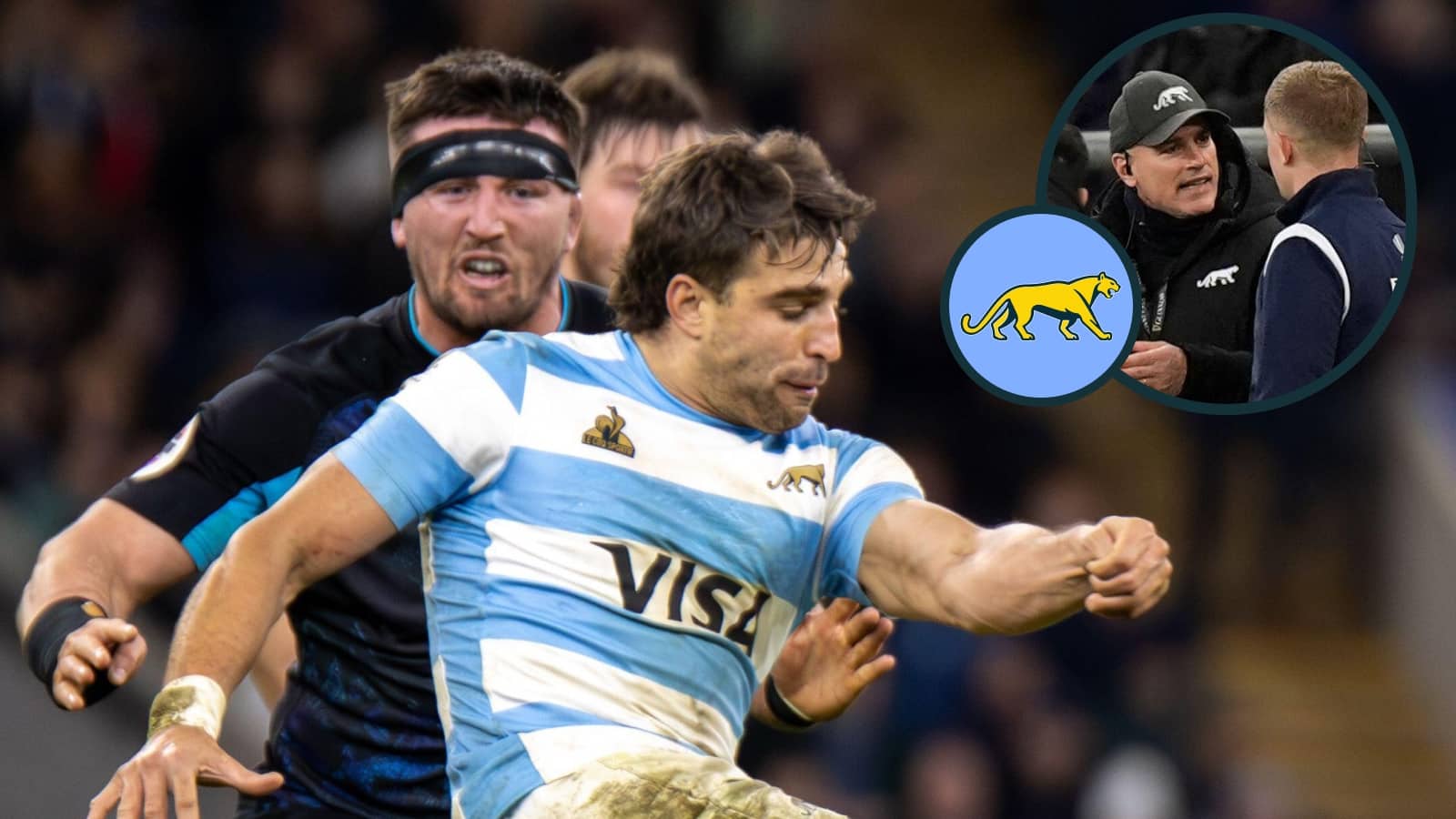
Argentina boss Felipe Contepomi was clearly frustrated as his side fell agonisingly short of an epic come-from-behind victory over England last Sunday.
The Pumas erroneously finish the match with 14 men, former referee Nigel Owens has confirmed, after the head coach had emptied his bench before Tom Curry flew out of the England defensive line and hammered into Juan Cruz Mallia after the full-back had executed a marvellous 50:22.
Referee Pierre Brousset deemed that the flanker’s actions simply warranted a penalty and no more, but the tackle meant that Mallia had to hobble off the pitch.
With England leading 27-16 at the time of the incident, it left Los Pumas chasing two late tries, and at least one conversion, with the time ticking away on the clock in order to win.
Contepomi fumed on the sidelines, arguing with officials and was seemingly annoyed that Curry remained on the pitch and Argentina played the final few minutes down a man.
Curry’s tackle
To their credit, Los Pumas made a good fist of an insane come-from-behind victory with Joaquin Oviedo spilling the ball over the line in the act of scoring. England were reduced a man because of an indiscretion by Alex Coles, and from the ensuing penalty, Argentina got the score to put them within striking distance as Rodrigo Isgro dived over.
They were cruelly denied in the final play of the game as they failed to secure a lineout deep inside England’s 22, and Ben Earl pounced, and the ball was booted into touch to secure the narrow win.
Contepomi was irate after the match, not only because Curry’s tackle didn’t result in a card but because it also injured his star full-back. He also claimed that the England flanker lashed out at him in the tunnel after the game.
“When he came there, I said, ‘Man, you broke our player’s knee’, he said, ‘Oh f–k off’ and pushed me like that,” he claimed.
England legend claims Tom Curry ‘knows what he’s doing’ as Felipe Contepomi backlash rumbles on
Verdict on the late tackle
Appearing on World Rugby’s Whistle Watch, Owens explained that Curry’s actions warranted a penalty but did not believe it was much more than that.
“It’s one of those penalties which it is a penalty, but it’s an unlucky penalty in one sense,” he said.
“So Curry is going out to make the tackle. He’s not going for charge down. But if you go for a charge down, for example, and you don’t get that ball, you don’t touch that ball, and then you wipe the player out, it’s a penalty because you took the risk to get the charge down. You didn’t get it. You’ve taken him out of the game. So you will end up being penalised.
“So here Curry is sort of committed to that tackle. I think he still probably would have made contact with the kicker, but I certainly think that he could have certainly eased off a bit, knowing he’s kicking the ball. I probably am going to knock into him, but the ball will be gone.
“So, first of all, that is a penalty. Curry’s actions they’re on the border, but there is a penalty, and it’s nothing more to be honest. Now, what’s added fuel to the fire is a discussion of why it isn’t more because of the injury to the Argentinian player.”
Owens further explains that the referee cannot further penalise Curry just because Mallia got injured from the incident.
“You don’t know the severity of that injury until the medics take him off and check him, or whatever is going to happen. It could take a while. There could be an injury, there could not be an injury. So, you don’t know that,” he said.
“So you can’t bring that into your decision-making as a referee. But I also have empathy.”
Wider angle of Tom Curry’s late tackle.
Felipe Contepomi described it as ‘reckless’.
Certainly has time to change his route as he wasn’t going reach Mallia in time but most flankers would make that hit. #ENGvARG pic.twitter.com/4B1YquFpxh
— Jared Wright (@jaredwright17) November 23, 2025
Under World Rugby law 9, the principle reads: “A player who commits foul play must either be cautioned or shown a yellow card or be sent off.”
Law 9.13 adds: “A player must not tackle an opponent early, late or dangerously. Dangerous tackling includes, but is not limited to, tackling or attempting to tackle an opponent above the line of the shoulders, even if the tackle starts below the line of the shoulders. Sanction: Penalty.
Ultimately, the officials deemed that Curry’s actions didn’t reach the yellow card threshold, despite the unfortunate injury to Mallia.
Replacement mistake
However, Owens did detail an error that the officials made as Argentina played the remainder of the match a man down, which shouldn’t have been the case.
He discussed the details of the protocol with former Lions and Wales centre Jamie Roberts, who said: “So Juan Cruz Mallia obviously takes that hit, injures his knee, I believe, and he gets taken off. Now, Argentina have to play the remaining minutes with 14 men because they used all their subs.
“Now, there’s an argument, for example, if that was a head injury and Juan Cruz Mallia came off with an HIA, you’d then be able to replace that player. Am I right? Also, if he’s come off injured when there’s an act of foul play, they should be allowed to replace that player.”
Roberts is spot on. Tactically replaced players, like starting half-backs Simon Benitez Cruz and Tomas Albornoz, could have returned to the action because of the nature of Mallia’s injury. World Rugby laws allow for tactically replaced players to return to the pitch as a blood or head injury replacement, but also for injuries caused by foul play.
Law 3.33 reads: “Tactically replaced players may return to play only when replacing:
a. An injured front-row player.
b. A player with a blood injury.
c. A player with a head injury.
d. A player who has just been injured as a result of foul play (as verified by the match officials).
e. The nominated player described in Law 3.19 or 3.20.”
Law 3.33.d is the crucial one in this case, as Curry’s tackle was an act of foul play that caused Mallia’s injury, meaning that Contepomi could have put one of the replaced backs, Cruz and Albornoz, back on, provided that they weren’t taken off substituted because of injury.
Owens’ explanation
Owens explained this policy: “So when you’ve used all your bench, there are certain circumstances which allow you to bring a player that has been subbed back on.
“If you’ve replaced a player and replacing a player means you’ve taken him off because he’s injured, he’s gone. Nothing he can do. Substitution players that can come back on are front rows obviously to keep the contest, blood injury, remember bloodgate 2009, head contact.
“And the other one is if a player has been forced off the field for an injury because of an act of foul play, then you’re allowed, my understanding is, you’re allowed to bring a substitute player back on.
“So in this instance here, my understanding is Argentina should have been allowed to bring a player back on to go back up to 15 players because the reason that player was off the field was because of an act of foul play.
“So they should have been back up to 15. So the number four or five [official] on the sideline or the referees and officials should have been aware of that law, and they should have been at 15 men.”
Ultimately, the officials and Argentine management did not pick up on the caveat in the law, which would have allowed for one of the starting Los Pumas players to return to the action, provided they weren’t replaced due to injury.