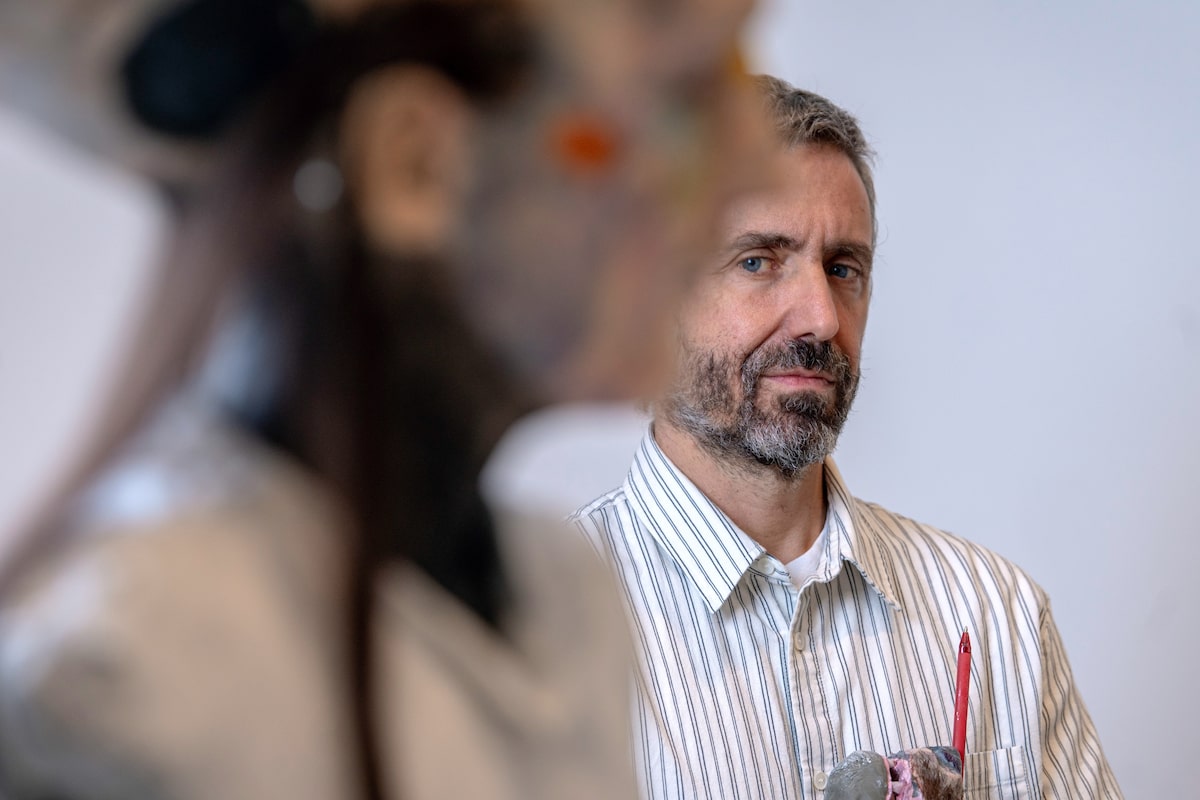
In a Montreal gallery, artist David Altmejd has left his mark: A plaster cast of a hand is clawing its way through the plinth displaying examples of his surreal sculptures, as though yet another were emerging. In a world gone digital and virtual, the Canadian artist is emphatically engaged with physical media, whether it’s plaster, clay, wood or resin. A list in the gallery includes more than 100 objects or materials he has used in his work.
“I do feel like there’s something that happens when my hands touch the material,” he said in an interview from his Los Angeles studio. “It’s almost as if it triggers a spirit that’s in the material and wakes it up. I realize as a sculptor that’s what I do.”
What is awakened is fantastical. Altmejd is known for highly detailed sculptures that use hybridization, replication and inversions of interior and exterior to evoke some crossover among human, natural and alien worlds. They are both dreamlike and nightmarish, including elements of science fiction, pop culture, classical myth and biology.
Altmejd’s sculpture process is partly planned – using many tools, materials, and techniques – but also guided by instinct.
His current show, at the Université du Québec à Montréal, the institution he attended in the 1990s when he abandoned a degree in biology for fine art, focuses on his busts while including subsequent pencil drawings on similar themes and those sculptural interventions into the plinths that display the work.
“His works reveal the artist’s vision of how beings are born, constructed, transformed, dislocated and regenerated,” wrote Louise Déry, the curator of the UQAM show, who also organized Altmejd’s show at the Canada Pavilion at the Venice Biennale in 2007, in an e-mail. “They plunge into the interior of the living being. They also reveal the breadth of a practice obsessed with the body and its flesh, the skull and its cavities, the eye and its connections, the hands and fingers that shape.”
Altmejd’s works reflect his vision of beings ‘born, constructed, transformed, dislocated and regenerated,’ writes curator Louise Déry.
The show she has curated is a gathering of highly unusual creatures: a man with a great domed head like a classic TV alien and long strings of hair; a rabbit with disconcertingly human eyes registering alarm; a head with the face replaced by a large hole from which crystals emerge. The exhibition includes many new works but also a werewolf’s head dating to Altmejd’s student days as he began to develop his monstrous iconography.
The appeal of the werewolf – part animal, part human, all transformation – is rather obvious. Altmejd’s other repeated character, the rabbit, is more obscure. As the artist explains it, the rabbit entered his iconography for a very practical reason: After he has finished a sculpture, he likes to draw on it, often in pencil, adding a final touch of the hand. There’s not much room on a human face, but the rabbit’s long ears offered a good drawing surface. Indeed, many of his rabbits have unnaturally long, upright ears.
Once he had begun creating rabbits, he started to realize they were guides to the unconscious, like the one in Alice’s Adventures in Wonderland, who leads Alice down the rabbit hole into a dreamworld. His identification with the rabbit as a guide or protector goes back to his childhood, he figures. Speaking in a soft Quebec accent, he explains he is the son of a Polish-Jewish immigrant father and Québécois mother who would call him “mon lapin” as an endearment, while the kids at school mocked his prominent teeth. The rabbit also represents mischief – think Bugs Bunny – and is a master of diversionary tactics.
Works that add human features to animals’ heads are a through-line in his practice.
“The rabbit acts as a sort of trickster figure that can go underground, who’s able to see in the dark and knows all the intricate channels of the underground by heart, can go in and out easily. I thought – I really love to delve deep into darkness – that’s a perfect spirit to accompany my creation.
“Also, to escape being caught by a predator, it can jump in unpredictable ways. And that’s what I do in my art. Every time something seems to be too controlled intellectually or too comfortable, there’s an aspect of my personality that makes me make a jump in a completely opposite direction.”
Altmejd’s process as he creates his sculptures can include such leaps; it is both preplanned, relying on his mastery of dozens of specialized tools, moulding materials and decorative effects, but also driven by instinct.
‘To escape being caught by a predator, it can jump in unpredictable ways. And that’s what I do in my art.’
“Definitely there has to be an aspect of the work that’s controlled, that’s very conscious, but that’s the practical aspect, the technical aspect, how to build something. It has to be based on a knowledge of how the materials hold together,” he said. “But there’s another aspect that’s very intuitive. I like the idea that I’m letting the work itself decide what shape it’s going to take. I try to listen to all the little voices – not literal voices.”
If a mistake keeps occurring, if he tries to stick an eye in one place but it keeps falling off, for example, he understands this is not what the sculpture wants.
The Comets is a sculpture that features three faces of a bearded man.
A video at the UQAM gallery follows him building The Comets, a sculpture that features three faces of a bearded man – like a prism’s fracturing of an image. His three sets of hands, with their fingers tented, are positioned in front of him, and a single third eye is mounted in his forehead. The video shows Altmejd making moulds of his own hands to produce the work and also building high cylindrical hats, like those of Orthodox priests, for the tripartite figure. Then, in a dramatic moment, he takes a hammer to the hats: The final piece is bareheaded.
“The piece itself said that we want to have these top hats. So I made the top hats. I made them beautiful. I made them sky-coloured,” he explained. “It’s as if the hats had created a new type of energy in the piece, in the object itself. When that energy came in the work, the hats were not necessary. I took them off. I mean, it wasn’t a waste of time to build the hats. It was necessary for the piece.”
Altmejd’s sideways jumps may yet take him back to Canada. He thinks of himself as rather rootless, having left Montreal for New York in 1999 to attend Columbia University and staying there, tasting success early and seeking to test his art in a larger arena. But he’s only lived in L.A. since 2019 and says he is considering a return home. Recently, he was in Finland working on a future show there, but he will return to Montreal in the spring for an exhibition in May at the Bradley Ertaskiran gallery.
“They have a specific space that they call the bunker. It’s an underground space and it’s going to be perfect for my next body of work.”
David Altmejd: Agora continues at the Galerie de l’UQAM to Jan. 24.
Andrej Ivanov/The Globe and Mail