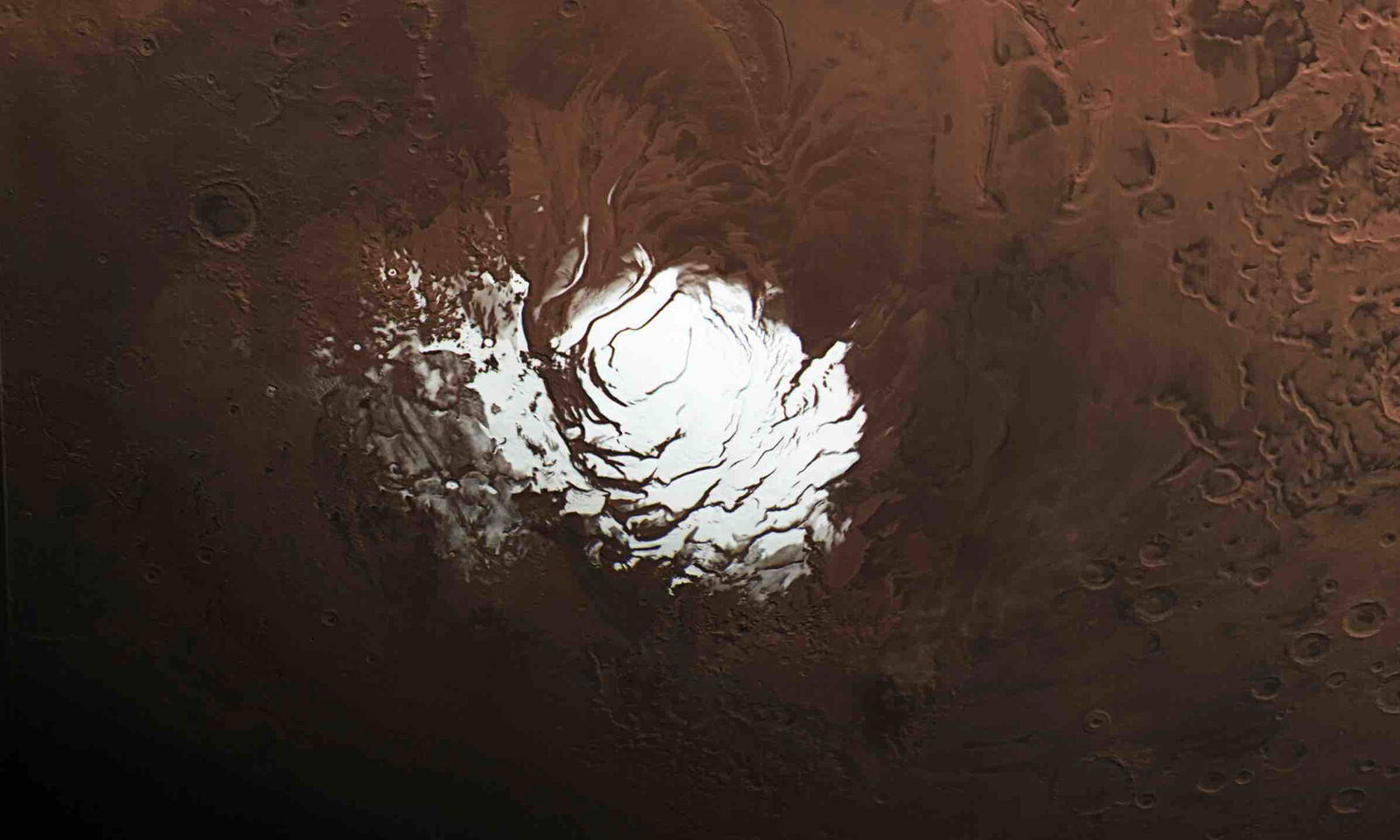
NASA scientists have made a discovery that is renewing the debate over an unusual feature hidden beneath thousands of feet of ice near the Martian south pole.
The new findings, made possible by the agency’s Mars Reconnaissance Orbiter (MRO), have led a team of NASA researchers to conclude that the mysterious region—long suspected of being an underground lake—may be something else entirely.
The team’s discovery was reported on November 17 in a new paper that appeared in Geophysical Research Letters.
A Discovery Below Martian Ice
In 2018, NASA first revealed the discovery of a mysterious feature beneath the Red Planet’s south pole, sparking a surge in interest over the possibility that a subsurface lake might exist there.
The discovery offered a tantalizing prospect, due primarily to the obvious associations between the presence of water and the increased potential for the existence of life.
However, new findings reported by a pair of MRO Shallow Radar (SHARAD) instrument scientists, Gareth Morgan and Than Putzig, throw cold water on the subsurface lake theory, pointing instead to the likelihood that this unusual feature hidden beneath the icy Martian south pole isn’t water at all, but instead a thick layer of rock and dust.
Based at the Planetary Science Institute in Tucson, Arizona, and in Lakewood, Colorado, Morgan and Putzig now say that their use of radar techniques made possible by SHARAD may be useful in future reconnaissance of the Red Planet, as scientists continue to search for subsurface resources like water that might not only be home to life, but which could be crucial for the survival of future crewed missions to Mars.
A Special Rolling Maneuver
To obtain the recent data, the MRO performed a unique maneuver that involves rolling 120 degrees, which allows the SHARAD radar’s signal to penetrate deeper underground, and thereby producing enhanced imagery of the Martian subsurface regions it penetrates.
Use of this specialized technique has already proven to be effective enough in the past that scientists are now eager to use it at other sites on the Red Planet, including those where past observations may not have revealed promising indications of buried subsurface ice.
Previously, the researchers and their colleagues with the SHARAD team had unsuccessfully tried to observe the Martian South Pole region where the suspected lake existed. To overcome this, the SHARAD team went to the MRO’s operations team at NASA’s Jet Propulsion Laboratory to work on finding a way of increasing the size of the spacecraft’s rolls.
With the MRO’s radar antenna located near the back of the spacecraft, its body shields its view, which weakens the sensitivity of the instrument. However, JPL engineers were able to find a workaround with a little help from engineers at Lockheed Martin Space who built the spacecraft: this resulted in a series of commands that enabled the spacecraft to complete a 120-degree roll, allowing the MRO to direct its radar’s signal more effectively at the Martian surface
Large Rolls Lead to Stronger Signals
The plan came to fruition earlier this year, when in late May SHARAD completed its initial very large roll, which successfully struck the target area. Penetrating nearly a mile of ice, the radar’s reflections revealed that the unusual subsurface feature that has intrigued scientists since its discovery in 2018 was likely not what they initially thought it might be.
“We’ve been observing this area with SHARAD for almost 20 years without seeing anything from those depths,” said Putzig in a statement. Now, with the data made possible by the MRO’s large roll, deeper radar penetration revealed a fainter signal than Putzig and Morgan expected, followed by no signal at all from an adjacent region they examined.

Their conclusion: something is causing the odd radar signal at the same location, revealed during past observations made using the Mars Advanced Radar for Subsurface and Ionospheric Sounding (MARSIS) instrument aboard the ESA (European Space Agency) Mars Express orbiter.
“While this new data won’t settle the debate, it makes it very hard to support the idea of a liquid water lake,” said Putzig in a statement, acknowledging the work that went into formulating the subsurface lake hypothesis.
Since the Martian south pole features a large cap of ice positioned above the planet’s very cratered terrain, the region beneath the icy exterior revealed with the SHARAD data appears very uneven. One possibility that could account for the 2018 observations made by MARSIS could be a large smooth feature, such as the remnants of an ancient flow of lava.
Going forward, additional observations using the MRO’s new very large roll capability could help to resolve the mystery once and for all, in addition to revealing clues to other longstanding mysteries associated with sites like Medusae Fossae along the Martian equator, which is also known to produce little in the way of radar returns.
Morgan, Putzig, and their colleagues’ paper, “High Frequency Radar Perspective of Putative Subglacial Liquid Water on Mars,” appeared in Geophysical Research Letters on November 17, 2025.
Micah Hanks is the Editor-in-Chief and Co-Founder of The Debrief. A longtime reporter on science, defense, and technology with a focus on space and astronomy, he can be reached at micah@thedebrief.org. Follow him on X @MicahHanks, and at micahhanks.com.