

Singer-songwriter EJAE / Captured from EJAE’s social media
JYP Entertainment spent 1.12 billion won ($765,000) last year on developing new talent. The figure appears in its annual business report filed this year. The company operates a dedicated rookie development division that selects trainees through auditions and provides training in vocals, dance and foreign languages. Officials from two major agencies say most companies maintain around 20 trainees. If JYP had approximately 30, this would mean the company spent roughly 3.12 million won per trainee each month on lessons and other costs — a significant investment.
From an agency’s perspective, trainees are the engine that drives future growth, making early investment essential. JYP’s spending on trainee development increased by about 30 percent from 850 million won in 2023.
Shrinking trainee numbers reveal growing class divide in K-pop
K-pop agencies have sharply increased their investment in trainees, yet the number of trainees in the industry is rapidly shrinking. This trend emerged during reporting for a recent story examining how K-pop’s once-prominent “rags-to-riches” narrative has faded amid a growing class divide in K-pop, as trainees are increasingly hailing from wealthy backgrounds and parents send their children to trainee preparation classes even before they join an agency. The story is part of the Hankook Ilbo’s “Reversal” series, which identifies moments of change in popular culture that reflect broader social and cultural shifts.
According to the Korea Creative Content Agency’s most recent survey on the pop culture and arts industry, the number of K-pop trainees at agencies fell to 1,170 in 2022, down 725 from 1,895 in 2020. That is a steep decrease of 38.3 percent in just two years. While “gold spoon” youths from wealthy families — as well as second-generation entertainers such as Riize’s Anton and STAYC’s Sieun — continue to debut in idol groups, the number of ordinary trainees is dropping quickly. This is happening even as the K-pop market enters an unprecedented boom, with huge global influence and soaring revenues, highlighted by the nominations of both “APT.” and “Golden” for Song of the Year at the Grammy Awards in February.
The report attributes the decline largely to the “growing burden of trainee development costs.”
Grueling training leads to health issues, psychological stress
One particularly troubling detail stood out. The share of trainees who voluntarily quit after joining an agency reached 34.4 percent, up 3.4 percentage points from 2020. Why are more teens giving up on their dreams? While major agencies have improved their training environments, many other companies still have poor working conditions.
According to a doctoral dissertation written by Kang Won-rae — a member of the dance duo Clon — titled “Problems and Improvements of K-Pop Idol Trainee System (2025),” seven to eight out of 10 female teenage trainees experience menstrual irregularities.
“Because they are young, they do not fully understand how serious it is when their period stops. Agencies do not really care about menstrual irregularities among female trainees. All that matters is having the right body shape,” one trainee said. Another trainee pointed out disorganized management: “We were told to ‘just practice on your own’ between 1 p.m. and 11 p.m. I thought there would be manuals or structured lessons with trainers, but that wasn’t the case.”
Many also complained of psychological stress. “We have to hold our breath while dancing, so most trainees experience hyperventilation. After repeating it so many times, I once thought, ‘I might actually die doing this.’”
Industry officials confirm that the preparation process is grueling. At one major agency, the system is known as “nine to ten.” Trainees clock in at 9 a.m., hand in their phones and spend the morning learning English and other foreign languages. After lunch, they receive vocal and dance lessons before continuing with individual practice. The day usually ends around 10 p.m. Even with such intense schedules, debuting is extremely rare. Korean American singer-songwriter EJAE, whose song “Golden” became a global sensation, trained for 12 years at SM Entertainment but never debuted.
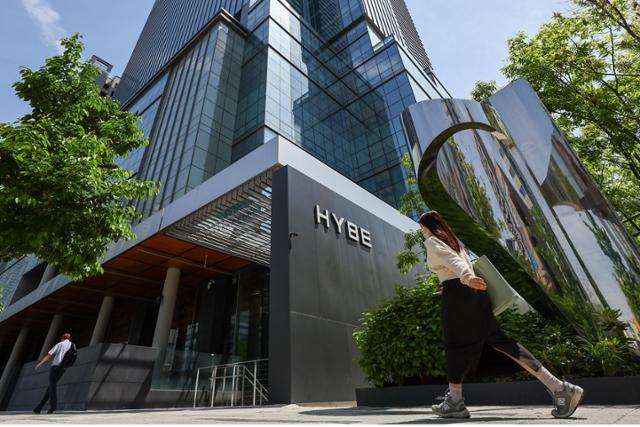
HYBE headquarters in Seoul / Yonhap
Intense pressure of an industry where youth is everything
Most trainees are in their teens. “Once they pass 20, many start feeling they are considered too old, and they quit,” one industry insider said. In an environment where youth is everything, teenage trainees without strong financial support from their families struggle to prepare alternative career paths. Compared with peers who receive a full regular education, these teens enter society earlier and face greater uncertainty about their futures.
Getting into medical school usually leads to becoming a doctor, but entering a K-pop agency does not guarantee an idol career. Far more trainees fail to debut than succeed.
As class polarization accelerates within the industry, trainees without safety nets are left vulnerable. Instead of focusing solely on concerns like the slump in the domestic TV and film market, the industry should consider how to support the social independence of these young people. Large agencies could start by piloting diverse vocational education programs.
“I hope there are alternative pathways, like job training, for those who fail to debut and leave the company. Most end up bouncing between part-time jobs,” said one trainee who contributed to Kang’s dissertation. A healthy K-pop ecosystem may only be possible when teenagers have a safe environment in which to pursue their dreams.
This article from the Hankook Ilbo, the sister publication of The Korea Times, is translated by a generative AI system and edited by The Korea Times.