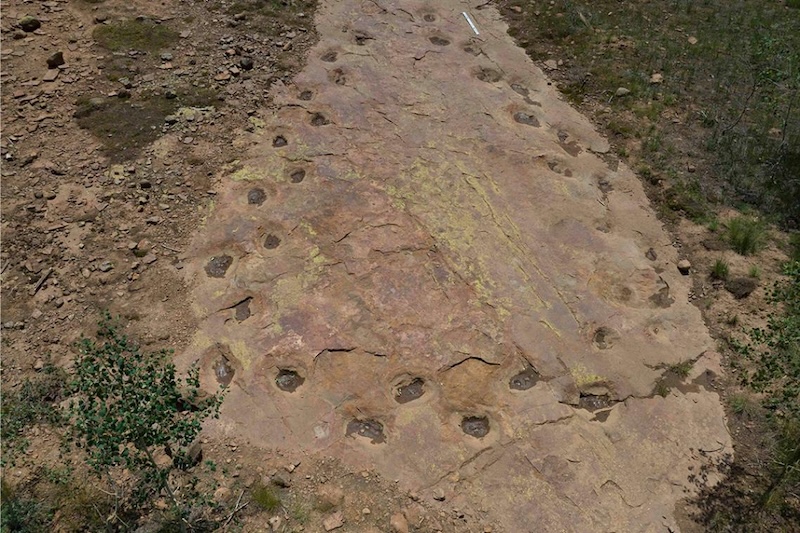
 Scientists have shared a new study into this looping section of the dinosaur’s tracks at West Gold Hill Dinosaur Tracksite in Colorado. One finding is that this dinosaur, alive 150 million years ago, might have had a limp. Image via Paul Murphey / The University of Queensland.
- Scientists have studied 150-million-year-old sauropod tracks in Colorado.
- Drone imaging and 3D modeling revealed the dinosaur made a full looping turn.
- Footprint patterns suggest the dinosaur might have been walking with a limp.
Scientists analyze unique looping dinosaur’s footprints
Some 150 million years ago, a sauropod – a type of long-necked herbivorous dinosaur – ambled along a stretch of moist sand flats in a floodplain. Then, it turned around in a tight loop, walking in the opposite direction.
Remarkably, the footprints it left behind remain preserved in sandstone, high in the Rocky Mountains of Colorado. And recently, scientists did a detailed study of these ancient looping tracks to better understand the sauropod’s movements. The team published a paper in late November 2025, with findings including the fact that this dinosaur might have been limping.
Anthony Romilio, at the University of Queensland’s Dinosaur Lab in Australia, was the study’s lead author. He talked about the tracks in a statement:
This was left in the Late Jurassic when long-necked dinosaurs such as diplodocus and camarasaurus roamed North America.
This trackway is unique because it is a complete loop.
While we may never know why this dinosaur curved back on itself, the trackway preserves an extremely rare chance to study how a giant sauropod handled a tight, looping turn before resuming its original direction of travel.
The scientists published their results in the peer-reviewed journal Geomatics on November 20, 2025.
Join EarthSky’s Kelly Kizer Whitt on a hike to the West Gold Hill Dinosaur Tracksite, where these looping footprints were found!
The sauropod tracks survived for over 150 million years
These unique tracks are at the West Gold Hill Dinosaur Tracksite, in the Uncompahgre National Forest near Ouray, Colorado.
In their study, the scientists analyzed 131 footprints. There were mostly hind leg imprints, stretching over a 313-foot-long (95 meters) track. The smaller forefeet imprints were likely overprinted by the hind legs.
The sauropod made these tracks 150 million years ago, before the Rocky Mountains had even formed (they only emerged 55 to 80 million years ago). Back then, in the late Jurassic, North America was located further south. As a result, the climate was warmer and more humid, with lush forests and shrublands. Somehow, these dinosaur tracks survived geological forces that heaved it up to an altitude of 9,301 feet (2,835 meters) in The Rockies.
Locals have known about the footprints since the 1950s. But researchers did not scientifically describe them until 2021. Later, in 2024, the U.S. Forest Service acquired the land and it eventually became part of the Uncompahgre National Forest. The tracks are accessible to hikers who want to see them for themselves.
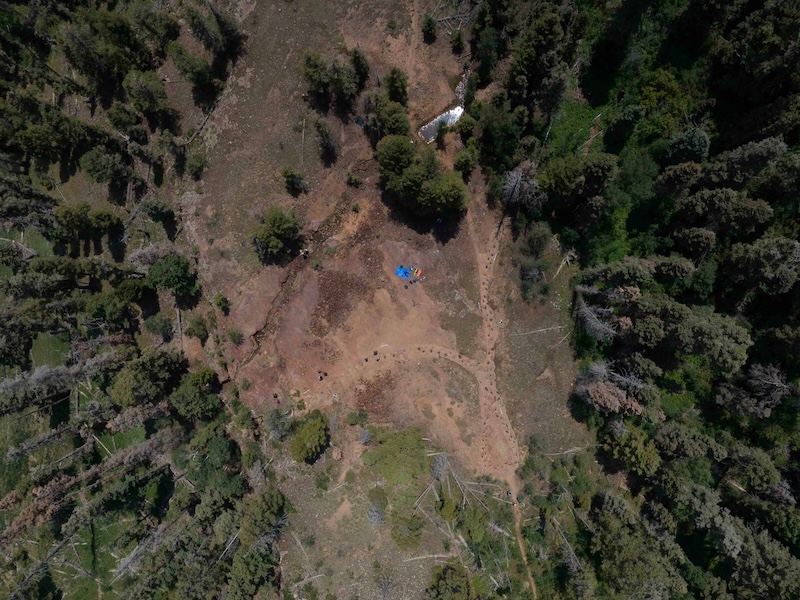 A wide aerial view of the sauropod track site. Image via Paul Murphey / The University of Queensland.
Studying over 300 feet of sauropod tracks
How does one analyze over 300 feet (91 meters) of dinosaur tracks? The scientists did it from above. They obtained detailed aerial images of the tracks using an unmanned aerial vehicle (UAV) or drone.
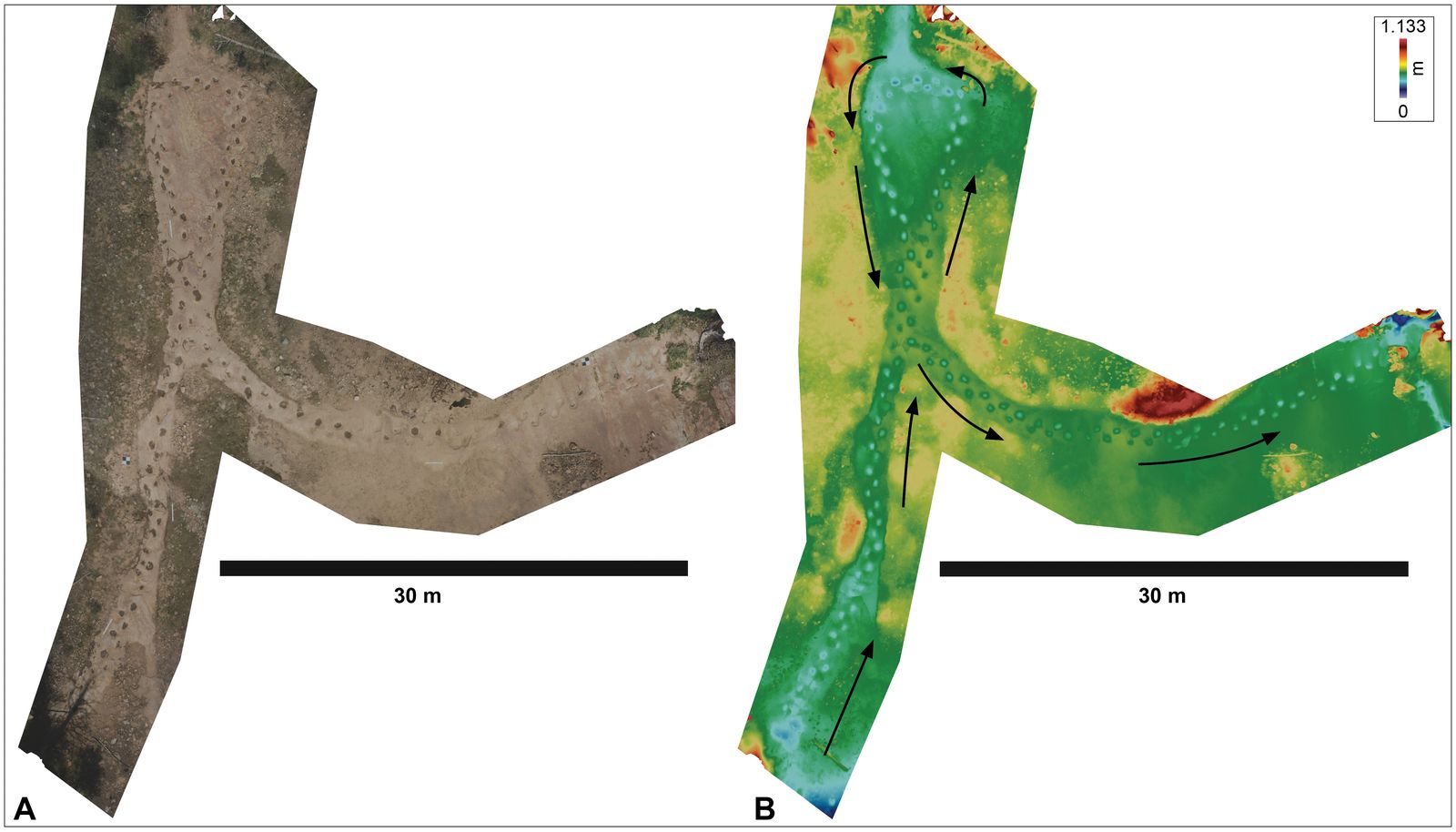 These 2 illustrations show the path taken by the sauropod. The left illustration shows the actual image from the drone. The right illustration shows the same data in false color, to accentuate landscape details showing the tracks. Image via Romilio, A. et al. / The University of Queensland.
Paper co-author Paul Murphey, of the San Diego Natural History Museum, said:
It has been challenging to document these footprints from the ground because of the size of the trackway.
We used drones to capture the entire trackway in high resolution.
With these images we generated a detailed 3D model, which could then be digitally analyzed in the lab at millimeter-scale accuracy.
Romilio added:
It was clear from the start that this animal began walking toward the northeast, completed a full loop, and then finished facing the same direction again.
The scientists reported that, based on the track measurements, the dinosaur was about 4.8 feet (1.5 meters) at its hips. It’s hard to know how tall the creature was in full because they don’t know which sauropod species made the tracks. But it appeared to be a small sauropod. Its stride length indicated it was walking leisurely at an average speed of 2 miles per hour (3 kph).
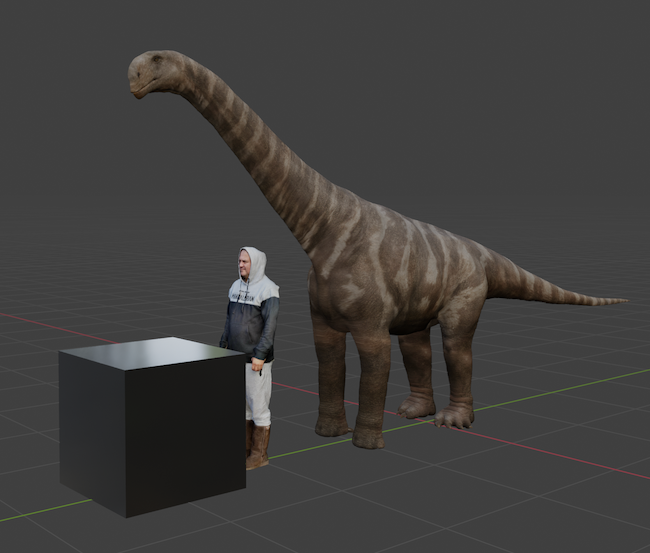 This image illustrates the size of the sauropod, based on track measurements, when compared to a man. Image via Anthony Romilio / The University of Queensland.
Did this dinosaur limp?
The tracks, particularly the section with the loop, revealed interesting information about how the dinosaur walked.
Romilio commented:
Within that loop we found subtle, yet consistent, clues to its behavior.
One of the clearest patterns was a variation in the width between left and right footprints, shifting from quite narrow to distinctly wide.
This shift from narrow to wide step placement shows that footprint width can change naturally as a dinosaur moves, meaning short trackway segments with seemingly consistent widths may give a misleading picture of its usual walking style.
We also detected a small but persistent difference in left and right step lengths, of about 10 centimeters or 4 inches.
Whether that reflects a limp or simply a preference for one side is hard to say.
He also remarked:
There are many long dinosaur trackways around the world where this method could be applied to extract behavioral information that was previously inaccessible.
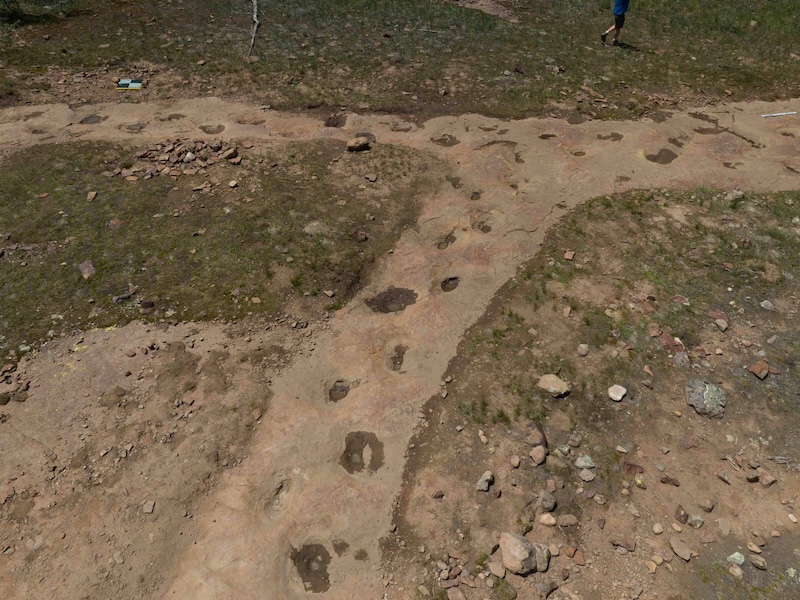 Here’s another view of the dinosaur’s tracks at the intersection where it goes from south to east. Image via Paul Murphey / The University of Queensland.
Bottom line: Scientists analyzed the 150-million-year-old footprints of a sauropod dinosaur and found it might have been limping.
Read more: Rare dinosaur tracks are longest continuous set of sauropod footprints
Read more: New dinosaur highway dig reveals record-breaking footprints
Shireen Gonzaga
View Articles
About the Author:
Shireen Gonzaga is a freelance writer who enjoys writing about natural history. She is also a technical editor at an astronomical observatory where she works on documentation for astronomers.