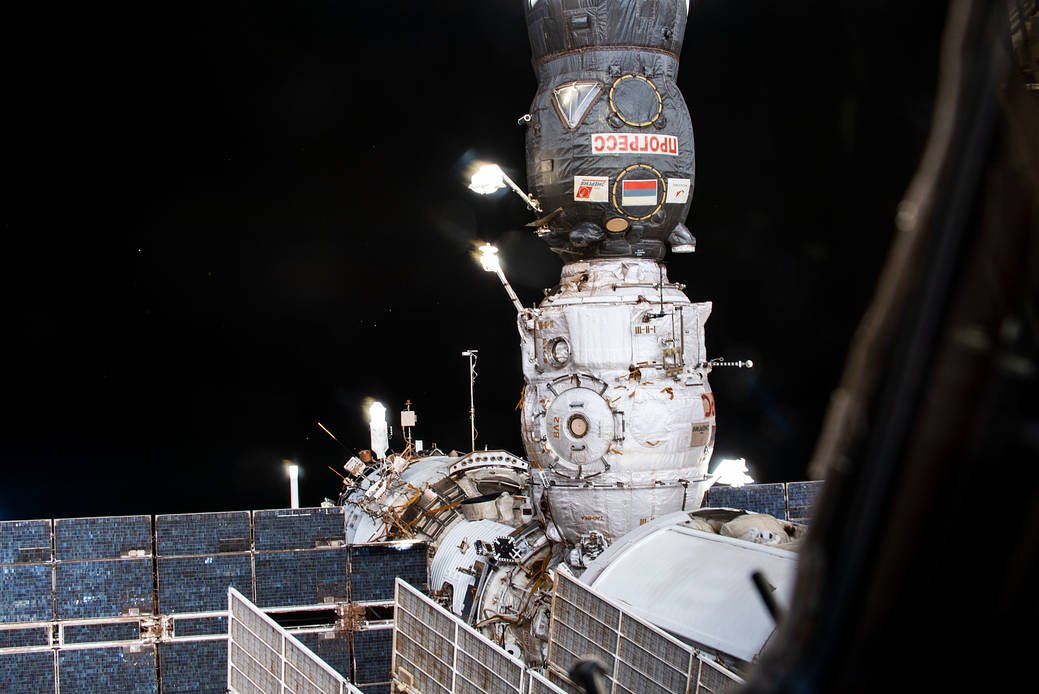
Russia’s ISS Progress 77 cargo spacecraft docks to the Pirs docking compartment on the International Space Station’s Russian segment in an undated photo. For the first time in its 25-year history, all docking ports on the space station are occupied, NASA officials said recently. Photo courtesy of NASA
For the first time in its 25-year history, all eight docking ports on the International Space Station are occupied, according to NASA.
The rare “orbital traffic jam” occurred after Northrop Grumman’s Cygnus XL cargo spacecraft was repositioned to the station’s Unity module, filling the final open port.
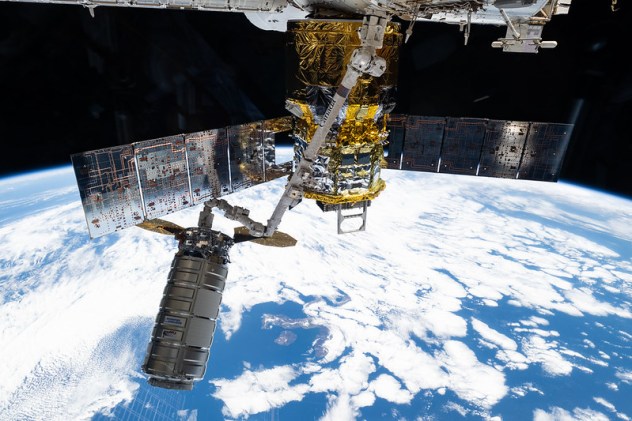
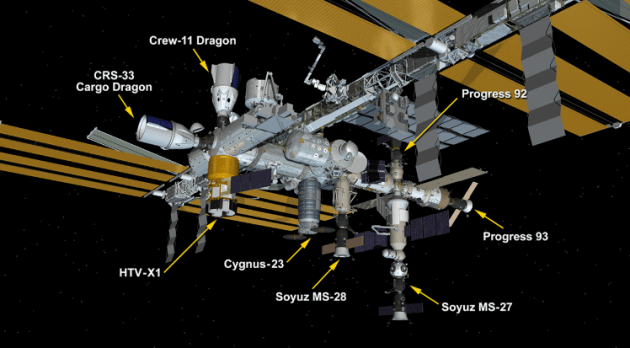
NASA said the eight visiting spacecraft currently at the ISS include vehicles from the United States, Russia and Japan. They consist of multiple SpaceX Dragon spacecraft, the Cygnus XL cargo craft, JAXA’s new HTV-X1 cargo vehicle, two Russian Soyuz crew spacecraft and two Progress cargo ships.
The map below shows the unusually busy ISS configuration with each port in use.
It has been an active week for supply deliveries and crew movements. On Thanksgiving, NASA astronaut Chris Williams and Roscosmos cosmonauts Sergey Kud-Sverchkov and Sergei Mikaev arrived aboard a Russian Soyuz spacecraft.
The Cygnus spacecraft was temporarily moved to make room for their docking.
On Monday morning, Cygnus was reattached to the ISS, and NASA astronauts Jonny Kim, Zena Cardman and Williams began unpacking science experiments and supplies that arrived on Sept. 18.
Next week, Kim will depart the station with Russian cosmonauts Sergey Ryzhikov and Alexey Zubritsky aboard the Soyuz MS-27 spacecraft to return to Earth.