Photo: Center for Whale Research

Nobody is safe from Orcas. The “wolves of the sea” have been spotted sucking the livers out of sharks, launching seals into orbit, and even sinking boats. The latest animals to feel the wrath of the ocean’s most persistent menace are seabirds in Washington.
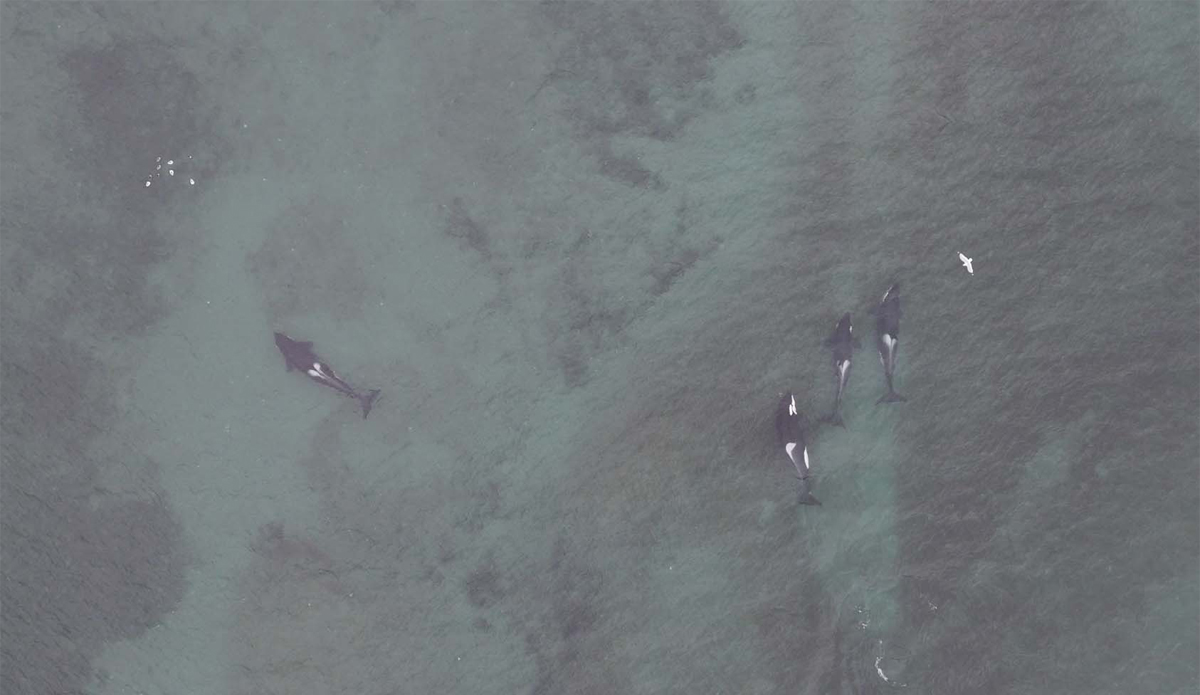
While they were doing fieldwork in November, researchers with the Orca Behavior Institute and the Center for Whale Research spotted Bigg’s orcas stalking seabirds in the Puget Sound, as they reported in an announcement. “Members of the T36s and T137s along with T99B were going after common loons and surf scoters in Murden Cove off Bainbridge Island,” they explained. “You can see in this still image from the drone footage how shallow the water was: the trio of whales on the right is kicking up mud with their flukes! On the left, one whale has broken away from the group to sneak up on an unsuspecting group of birds.”
However, the orcas were not trying to actually eat the birds. Researchers believe the behavior was a way to practice hunting skills, or a form of play. To the birds, though, it was no laughing matter. One rhinoceros auklet was the target of a pod that “chased, tail slapped, pounced on [the bird] for about a half-hour,” said one researcher to the Vancouver Sun. Another person observed the orcas attempting to “punt a bird while another member spy hops, seemingly to see where said bird is launched to” (spy hopping is a behavior where orcas will poke their heads out of the water in order to watch what’s happening above the surface).
This is far from the first time such behavior has been observed, as scientists John Ford and Graeme Ellis described in their 1999 book Transients. “This interaction may continue for several minutes before the bird is eaten, incapacitated, or left dead in the whale’s wake,” they wrote. “Seabirds seem to be more important as objects of play or harassment than as a dietary item. Juveniles playing with seabirds no doubt learn useful skills in prey capture and handling that may enhance their success in hunting harbor seals and other wily prey.”