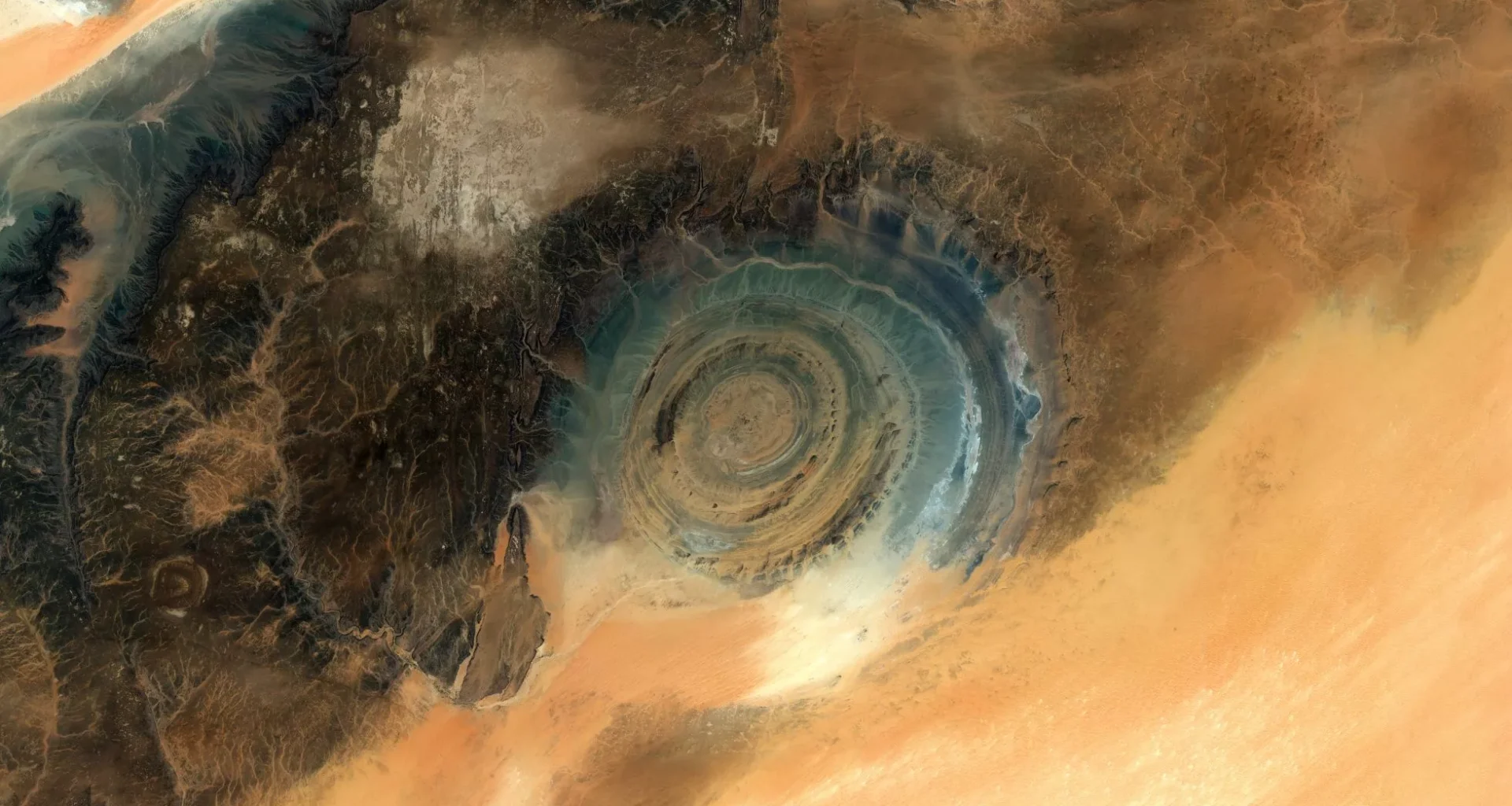
From the endless dunes of the Sahara, a colossal eye looks up at the sky. Known as the Richat Structure, this 50-kilometre-wide geological wonder has once again fascinated scientists and storytellers alike, thanks to new images from the Copernicus Sentinel-2 mission.
Carved into the golden sands of Mauritania’s Adrar plateau, the Richat Structure looks like a large target on Earth’s crust. Its circular rings are more visible from space than from the ground, which has puzzled geologists for a long time. Early explorers thought it was the result of a meteorite impact. Today, consensus points to a more terrestrial drama: the slow uplift of a molten dome, sculpted over millions of years by wind, water, and sand.
Geologists estimate the formation is at least 100 million years old, its rings preserving a layered history of Earth’s restless surface.
Sahara Desert changed from wet to dry every 20,000 years, study
In September 2025, Sentinel-2 captured two extraordinary views:
Natural-colour imagery reveals the Richat Structure as a dark bull’s-eye surrounded by the pale sands of the Erg Ouarane, a sea of dunes stretching hundreds of kilometres toward Mali.
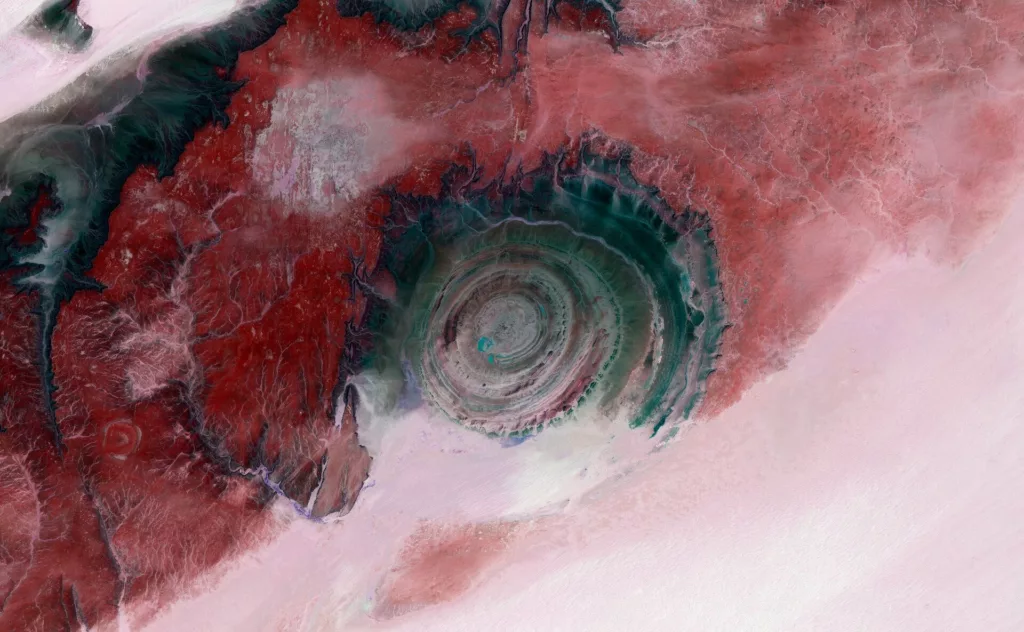 False color image. Credit: ESO
False-colour imagery highlights the geological contrasts. Quartzite sandstones, resistant to erosion, glow in shades of red and pink, forming ridges and outer rings. Valleys of softer rock appear darker, while tiny purple dots mark scattered trees and bushes tracing a dry riverbed across the southern flank.
The central rings rise about 80 metres, their rocks older than those on the outer rim, a paradoxical reversal of time exposed by erosion.
For decades, astronauts have looked down upon the Richat Structure, calling it the Eye of the Sahara or the Eye of Africa. Its symmetry and scale make it one of the most recognizable features on Earth from orbit, a natural compass in the desert’s vast monotony.
Even as the Sahara’s dunes creep into its southern edge, life persists. Sentinel-2’s false-colour view reveals vegetation clinging to ancient riverbeds, a reminder that even in one of the harshest landscapes on Earth, resilience endures.