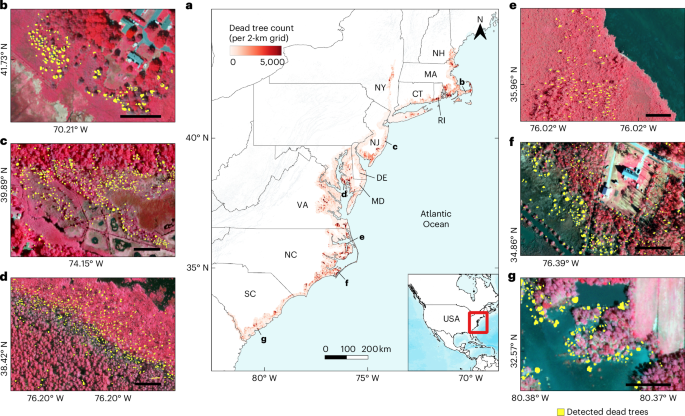
Adame, M. F. et al. All tidal wetlands are blue carbon ecosystems. BioScience 74, 253–268 (2024).
Donato, D. C. et al. Mangroves among the most carbon-rich forests in the tropics. Nat. Geosci. 4, 293–297 (2011).
Barbier, E. B. et al. The value of estuarine and coastal ecosystem services. Ecol. Monogr. 81, 169–193 (2011).
O’Donnell, K. L. et al. Saltwater intrusion and sea level rise threatens US rural coastal landscapes and communities. Anthropocene 45, 100427 (2024).
Choat, B. et al. Global convergence in the vulnerability of forests to drought. Nature 491, 752–755 (2012).
Chambers, J. Q. et al. Hurricane Katrina’s carbon footprint on US Gulf Coast forests. Science 318, 1107–1107 (2007).
Kirwan, M. L. & Gedan, K. B. Sea-level driven land conversion and the formation of ghost forests. Nat. Clim. Change 9, 450–457 (2019).
McDowell, N. et al. Processes and mechanisms of coastal woody-plant mortality. Glob. Change Biol. 28, 5881–5900 (2022).
Ury, E. A., Yang, X., Wright, J. P. & Bernhardt, E. S. Rapid deforestation of a coastal landscape driven by sea-level rise and extreme events. Ecol. Appl. 31, e02339 (2021).
White, E., Ury, E. A., Bernhardt, E. S. & Yang, X. Climate change driving widespread loss of coastal forested wetlands throughout the North American coastal plain. Ecosystems 25, 812–827 (2022).
Williams, K., MacDonald, M. & Sternberg, L. daS. L. Interactions of storm, drought, and sea-level rise on coastal forest: a case study. J. Coast. Res. 19, 1116–1121 (2003).
Conner, W. H. Ecology of Tidal Freshwater Forested Wetlands of the Southeastern United States (Springer, 2007).
Powell, E. et al. Spaceborne lidar observations reveal impacts of inundation on coastal forest structure across the US mid-Atlantic. Estuar. Coast. Shelf Sci. 323, 109372 (2025).
Smart, L. S. et al. Aboveground carbon loss associated with the spread of ghost forests as sea levels rise. Environ. Res. Lett. 15, 104028 (2020).
Smith, A. J. & Kirwan, M. L. Sea level-driven marsh migration results in rapid net loss of carbon. Geophys. Res. Lett. 48, e2021GL092420 (2021).
Carmichael, M. J., Helton, A. M., White, J. C. & Smith, W. K. Standing dead trees are a conduit for the atmospheric flux of CH4 and CO2 from wetlands. Wetlands 38, 133–143 (2018).
Martinez, M. & Ardón, M. Drivers of greenhouse gas emissions from standing dead trees in ghost forests. Biogeochemistry 154, 471–488 (2021).
Williams, K., Ewel, K. C., Stumpf, R. P., Putz, F. E. & Workman, T. W. Sea-level rise and coastal forest retreat on the west coast of Florida, USA. Ecology 80, 2045–2063 (1999).
Smith, I., Fiorino, G., Grabas, G. & Wilcox, D. A. Wetland vegetation response to record-high Lake Ontario water levels. J. Gt Lakes Res. 47, 160–167 (2021).
Tully, K. et al. The invisible flood: the chemistry, ecology, and social implications of coastal saltwater intrusion. BioScience 69, 368–378 (2019).
Bhattachan, A. et al. Evaluating the effects of land-use change and future climate change on vulnerability of coastal landscapes to saltwater intrusion. Elem. Sci. Anthr. 6, 62 (2018).
Sallenger, A. H., Doran, K. S. & Howd, P. A. Hotspot of accelerated sea-level rise on the Atlantic coast of North America. Nat. Clim. Change 2, 884–888 (2012).
Velasquez-Manoff, M. As sea levels rise, so do ghost forests. The New York Times (8 October 2019).
Zee, G., Griswold, L., Manzo, D. & Pereira, I. ‘Ghost forests’ threaten New Jersey’s water, ecosystem. ABC News (29 November 2023).
Cheng, Y. et al. Scattered tree death contributes to substantial forest loss in California. Nat. Commun. 15, 641 (2024).
Dixon, D. J., Zhu, Y., Brown, C. F. & Jin, Y. Satellite detection of canopy-scale tree mortality and survival from California wildfires with spatio-temporal deep learning. Remote Sens. Environ. 298, 113842 (2023).
Field, C. R., Gjerdrum, C. & Elphick, C. S. Forest resistance to sea-level rise prevents landward migration of tidal marsh. Biol. Conserv. 201, 363–369 (2016).
Pasquarella, V. J., Elkinton, J. S. & Bradley, B. A. Extensive gypsy moth defoliation in Southern New England characterized using Landsat satellite observations. Biol. Invasions 20, 3047–3053 (2018).
Bernhardt, E. Coastal freshwater wetlands squeezed between migrating salt marshes and working lands. Sci. Adv. 8, eadd1628 (2022).
Chen, Y. & Kirwan, M. L. Upland forest retreat lags behind sea-level rise in the mid-Atlantic coast. Glob. Change Biol. 30, e17081 (2024).
Tully, K. L., Weissman, D., Wyner, W. J., Miller, J. & Jordan, T. Soils in transition: saltwater intrusion alters soil chemistry in agricultural fields. Biogeochemistry 142, 339–356 (2019).
Ury, E. A., Wright, J. P., Ardón, M. & Bernhardt, E. S. Saltwater intrusion in context: soil factors regulate impacts of salinity on soil carbon cycling. Biogeochemistry 157, 215–226 (2022).
Ardón, M., Morse, J. L., Colman, B. P. & Bernhardt, E. S. Drought-induced saltwater incursion leads to increased wetland nitrogen export. Glob. Change Biol. 19, 2976–2985 (2013).
Kirwan, M. L. et al. Feedbacks regulating the salinization of coastal landscapes. Annu. Rev. Mar. Sci. 17, 461–484 (2025).
Helton, A. M. et al. Over, under, and through: hydrologic connectivity and the future of coastal landscape salinization. Water Resour. Res. 61, e2024WR038720 (2025).
Ohenhen, L. O., Shirzaei, M., Ojha, C., Sherpa, S. F. & Nicholls, R. J. Disappearing cities on US coasts. Nature 627, 108–115 (2024).
Osland, M. J. et al. Migration and transformation of coastal wetlands in response to rising seas. Sci. Adv. 8, eabo5174 (2022).
Maxwell, T. L. et al. Soil carbon in the world’s tidal marshes. Nat. Commun. 15, 10265 (2024).
Aakala, T., Kuuluvainen, T., Gauthier, S. & De Grandpré, L. Standing dead trees and their decay-class dynamics in the northeastern boreal old-growth forests of Quebec. Ecol. Manag. 255, 410–420 (2008).
Kearney, W. S., Fernandes, A. & Fagherazzi, S. Sea-level rise and storm surges structure coastal forests into persistence and regeneration niches. PLoS ONE 14, e0215977 (2019).
McDowell, N. et al. Pervasive shifts in forest dynamics in a changing world. Science 368, eaaz9463 (2020).
Lagomasino, D. et al. Storm surge and ponding explain mangrove dieback in southwest Florida following Hurricane Irma. Nat. Commun. 12, 4003 (2021).
White, E. & Kaplan, D. Restore or retreat? Saltwater intrusion and water management in coastal wetlands. Ecosyst. Health Sustain. 3, e01258 (2017).
Fagherazzi, S. et al. The ecohydrology of coastal ghost forests. Ecohydrology 18, e70020 (2025).
Kirwan, M. L. & Megonigal, J. P. Tidal wetland stability in the face of human impacts and sea-level rise. Nature 504, 53–60 (2013).
Neville, J. A., Emanuel, R. E., Ardón, M. & Pavelsky, T. Location and design of flow control structures differentially influence salinity patterns in small artificial drainage systems. J. Water Resour. Plan. Manag. 149, 05023002 (2023).
van Zelst, V. T. M. et al. Cutting the costs of coastal protection by integrating vegetation in flood defences. Nat. Commun. 12, 6533 (2021).
Fagherazzi, S. et al. Sea level rise and the dynamics of the marsh-upland boundary. Front. Environ. Sci. 7, 25 (2019).
Du, L. et al. Drainage ditch network extraction from lidar data using deep convolutional neural networks in a low relief landscape. J. Hydrol. 628, 130591 (2024).
Storm surge overview. NOAA https://www.weather.gov/phi/stormsurge (2025).
National Agriculture Imagery Program (NAIP). USDA Farm Production and Conservation Business Center https://naip-usdaonline.hub.arcgis.com/ (2024).
Brandt, M. et al. An unexpectedly large count of trees in the West African Sahara and Sahel. Nature 587, 78–82 (2020).
Gu, J. et al. Recent advances in convolutional neural networks. Pattern Recognit. 77, 354–377 (2018).
Kattenborn, T., Leitloff, J., Schiefer, F. & Hinz, S. Review on convolutional neural networks (CNN) in vegetation remote sensing. ISPRS J. Photogramm. Remote Sens. 173, 24–49 (2021).
Ouali, Y., Hudelot, C. & Tami, M. An overview of deep semi-supervised learning. Preprint at https://arxiv.org/abs/2006.05278 (2020).
Ronneberger, O., Fischer, P. & Brox, T. U-Net: convolutional networks for biomedical image segmentation. In International Conference on Medical Image Computing and Computer-Assisted Intervention (eds Navab, N. et al.) 234–241 (Springer, 2015).
Tan, M. & Le, Q. V. EfficientNet: rethinking model scaling for convolutional neural networks. In International Conference on Machine Learning 6105–6114 (ICML, 2019).
Deng, J. et al. ImageNet: a large-scale hierarchical image database. In 2009 IEEE Conference on Computer Vision and Pattern Recognition 248–255 (IEEE, 2009).
Abraham, N. & Khan, N. M. A novel focal tversky loss function with improved attention U-Net for lesion segmentation. In 2019 IEEE 16th International Symposium on Biomedical Imaging 683–687 (IEEE, 2019).
Detection surveys. US Forest Service https://www.fs.usda.gov/science-technology/data-tools-products/fhp-mapping-reporting/detection-surveys (2021).
3D Elevation Program. US Geological Survey https://www.usgs.gov/3d-elevation-program (2024).
NOAA Shoreline. NOAA https://shoreline.noaa.gov/med-res.html (2024).
Hansen, M. C. et al. High-resolution global maps of 21st-century forest cover change. Science 342, 850–853 (2013).
Coastal Change Analysis Program (C-CAP) regional land cover. NOAA Office for Coastal Management https://coast.noaa.gov/digitalcoast/data/ccapregional.html (2024).
Protected Areas Database of the United States (PAD-US). USGS https://doi.org/10.5066/P96WBCHS (2024).
Ord, J. K. & Getis, A. Local spatial autocorrelation statistics: distributional issues and an application. Geogr. Anal. 27, 286–306 (1995).
Caldas de Castro, M. & Singer, B. H. Controlling the false discovery rate: a new application to account for multiple and dependent tests in local statistics of spatial association. Geogr. Anal. 38, 180–208 (2006).
Breiman, L. Random forest. Mach. Learn. 45, 5–32 (2001).
Hoeppner, S. S., Shaffer, G. P. & Perkins, T. E. Through droughts and hurricanes: tree mortality, forest structure, and biomass production in a coastal swamp targeted for restoration in the Mississippi River Deltaic Plain. For. Ecol. Manag. 256, 937–948 (2008).
Dormann, C. F. et al. Collinearity: a review of methods to deal with it and a simulation study evaluating their performance. Ecography 36, 27–46 (2013).
Zhu, M. et al. Class weights random forest algorithm for processing class imbalanced medical data. IEEE Access 6, 4641–4652 (2018).
Nembrini, S., König, I. R. & Wright, M. N. The revival of the Gini importance?. Bioinformatics 34, 3711–3718 (2018).
Greenwell, B. M. pdp: an R package for constructing partial dependence plots. R. J. 9, 421 (2017).
National hydrography dataset. US Geological Survey https://www.usgs.gov/national-hydrography/national-hydrography-dataset (2024).
TIGER/Line Shapefiles. US Census Bureau https://www.census.gov/geographies/mapping-files/time-series/geo/tiger-line-file.html (2024).
National levee database. US Army Corps of Engineers https://levees.sec.usace.army.mil/ (2024).
Ho, D. E., Imai, K., King, G. & Stuart, E. A. MatchIt: nonparametric preprocessing for parametric causal inference. J. Stat. Softw. 42, 1–28 (2011).
Yeung, H. C. H. et al. Overlooked and extensive ghost forest formation across the US Atlantic coast–data. Zenodo https://doi.org/10.5281/zenodo.16380867 (2025).
Individual tree species parameter maps. US Forest Service https://www.fs.usda.gov/science-technology/data-tools-products/fhp-mapping-reporting/individual-tree-species-parameter-maps (2022).