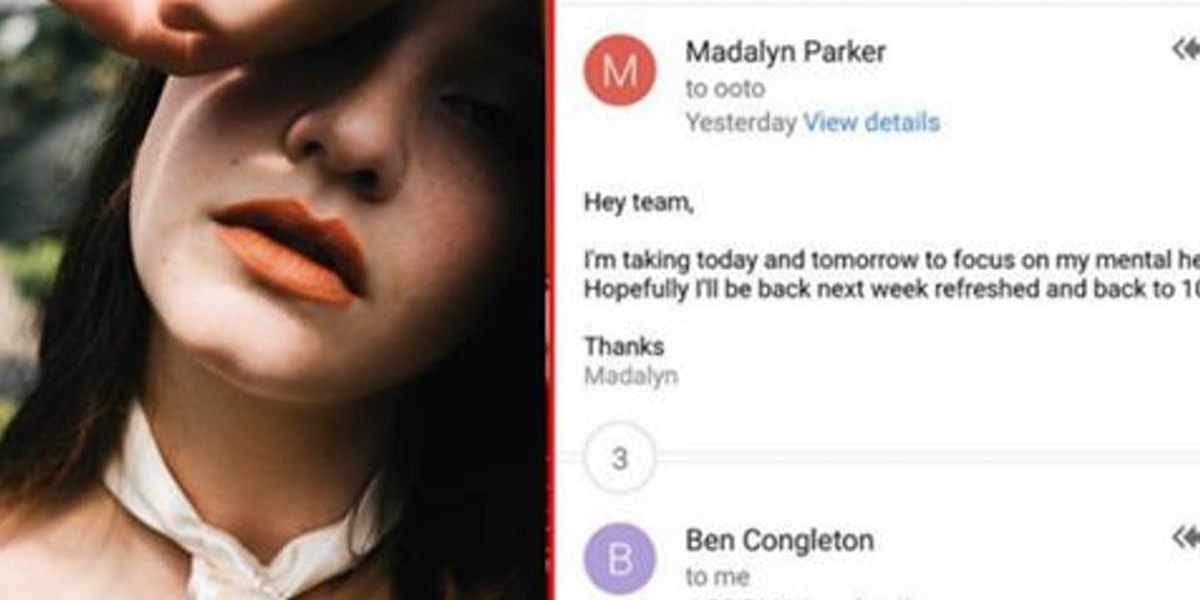
Madalyn Parker, an accessibility engineer from Michigan, wanted to take a couple days off work. There was just one problem. She didn’t have the flu, nor did she have plans to be on a beach somewhere, sipping mojitos under a palm tree. Parker simply wanted a few days away from work to focus on her mental health.
Parker lives with depression. And, she says, staying on top of her mental health is absolutely crucial. “The bottom line is that mental health is health,” she told Upworthy over email. “My depression stops me from being productive at my job the same way a broken hand would slow me down since I wouldn’t be able to type very well.”
 Parker, on the edge of burnout, knew she needed to step away. Photo by Resume Genius on Unsplash
When she informed the team of her time off, she made the bold choice to be completely honest and transparent about why she needed to step away. She was also firm and non-apologetic.
“I am taking today and tomorrow to focus on my mental health. Hopefully,” she wrote to them, “I’ll be back next week refreshed and back to 100%.”
Soon after the message was sent, the CEO of Parker’s company wrote back. What could easily have been a stomach-dropping moment quickly turned into a heartwarming one instead, as Parker’s boss completely had her back. And then some.
“Hey Madalyn,
I just wanted to personally thank you for sending emails like this. Every time you do, I use it as a reminder of the importance of using sick days for mental health — I can’t believe this is not standard practice at all organizations. You are an example to us all, and help cut through the stigma so we can all bring our whole selves to work.”
Moved by her CEO’s response, Parker posted the email exchange to Twitter.
The tweet, published on June 30, 2017, amassed over 45,000 likes and 16,000 retweets — though Parker has since moved her account to Private.
“It’s nice to see some warm, fuzzy feelings pass around the internet for once,” Parker says of the response to her tweet. “I’ve been absolutely blown away by the magnitude though. I didn’t expect so much attention!”
Even more impressive than the tweet’s reach, however, were the heartfelt responses it got.
“Thanks for giving me hope that I can find a job as I am,” wrote one person, who opened up about living with panic attacks. “That is bloody incredible,” chimed in another. “What a fantastic CEO you have.”
 The office is not always the best environment for mental health. Photo by Israel Andrade on Unsplash
Parker, as an accessibility expert who struggles with mental health, continues to educate people about the importance of proper self-care and self-awareness. In a blog post on her website, she warns of the dangers of “brownout,” the phase of exhaustion at work that comes right before burnout and utter collapse:
Parker writes the signs of brownout are:
- You do a lot, but have little interest in what you’re doing
- Your to-do list is never-ending
- You are constantly connected to work via your smartphone, from when you wake up to when you go to bed. This includes evenings, weekends, and even vacation.
- Your body is starting to show signs of wear. You don’t eat well, you don’t exercise, and you don’t get enough sleep.
There are a lot of ways to address this hyper-connection and exhaustion, from altering your work environment, to exercising, to eating more of the right foods. Taking time away without being physically sick is another good way to hit the reset button, just as she modeled in her original email to her team.
Many users were astounded that a CEO would be that understanding of an employee’s mental health needs.
They were even more surprised that the CEO thanked her for sharing her personal experience with caring for her mental health.
After all, there’s still a great amount of stigma associated with mental illness in the workplace, which keeps many of us from speaking up to our colleagues when we need help or need a break to focus on ourselves. We fear being seen as “weak” or less committed to our work. We might even fear losing our job.
– YouTube www.youtube.com
Ben Congleton, the CEO of Parker’s company at the time, Olark, even joined the conversation himself.
In a blog post on Medium, Congleton wrote about the need for more business leaders to prioritize paid sick leave, fight to curb the stigma surrounding mental illness in the workplace, and see their employees as people first.
“It’s 2017. We are in a knowledge economy. Our jobs require us to execute at peak mental performance,” Congleton wrote. “When an athlete is injured, they sit on the bench and recover. Let’s get rid of the idea that somehow the brain is different.”
Parker’s story first went viral in 2017. Since then, mental health days still have a stigma in some places but the understanding and acceptance of them has grown quite a bit. There’s now a Mental Health Awareness Day every year on October 8 and in places like California, mental health days are covered with the same worker protections as sick days. The Mayo Clinic recommends individuals take mental health days as “an intentional act to alleviate distress and poor mood and motivation, while improving attitude, morale, functioning, efficiency and overall well-being.”
As they accurately report, mental health days are not just for people are feeling overwhelmed, they can be part of a deliberate strategy to maintain productivity and strong morale amongst individuals and teammates at work.
Kudos to Parker for not only taking care of herself, but publicly modeling how its done for the rest of us.
This article originally appeared eight years ago. It has been updated.