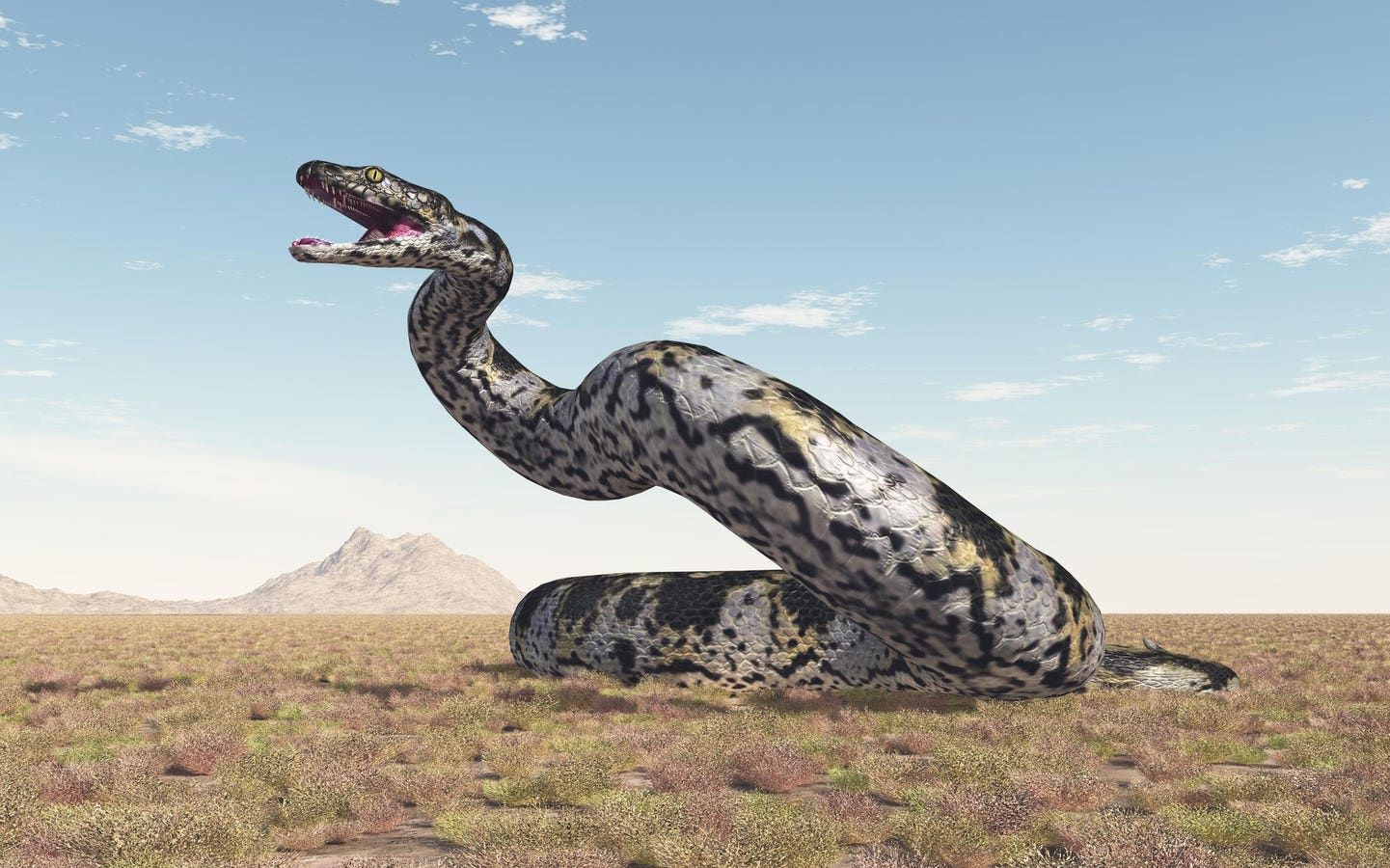
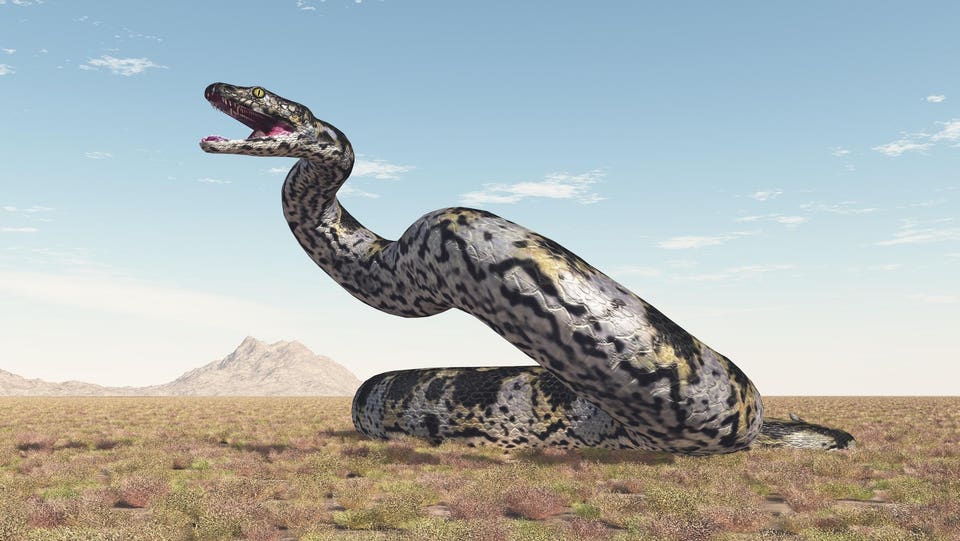
About 60 million years ago, long before humans and just after the dinosaurs vanished, a giant snake rose to the top of Earth’s food chain.
getty
In the humid swamps of what is now Colombia, there was once a snake longer than a city bus and heavier than a small car that dominated the landscape. Its name is Titanoboa cerrejonensis, and the “titan” part captures only a fraction of its true scale. It measured in at an estimated 42 feet (13 meters) long, and it weighed more than 2,500 pounds (1,133 kilograms). Titanoboa, to date, is the largest snake paleontologists have ever discovered.
But beyond its immense size alone, Titanoboa also teaches us how the Earth’s climate shaped evolution, during a time when it was recovering from the greatest mass extinction since the dinosaurs disappeared.
A Giant Snake Discovered Beneath A Coal Mine
Titanoboa was first discovered in 2009, when scientists excavating the Cerrejón coal mine in La Guajira, Colombia, uncovered a gigantic vertebrae. At first, it was so massive that they assumed it must have belonged to a crocodile. However, the structure of the bone itself suggested otherwise. These were very clearly snake vertebrae, yet they were still far too large for any known species.
As described in their 2009 study published in Nature, the researchers were eventually able to identify 28 individual Titanoboa fossils. This was enough to reconstruct its full size, and with remarkable accuracy, at that. Its vertebrae were nearly twice the diameter of those of a modern anaconda.
Given the unbelievable size discrepancy between Titanoboa and even the largest snakes we know of today, this begs the question: What compelled evolution to produce such an enormous reptile? The answer to this question lies in the fact that, unlike mammals, snakes aren’t able to regulate their own temperature.
Specifically, a snake’s metabolic rate — and, by extension, their maximum body size — is constrained by ambient temperature. This means that bigger snakes need much warmer climates in order to move, hunt and digest their food efficiently. By analyzing Titanoboa’s size, scientists reverse-engineered the climate it must have lived in.
As the researchers noted, ancient Colombia had an average daily temperature of around 30–34°C (86–93°F), which is significantly warmer than today’s tropics. As a result, Titanoboa became something of a living thermometer for the Paleocene world.
An Apex Snake In A Reptile-Dominated World
Ecologically, Titanoboa sat comfortably at the top of the food chain. After the dinosaurs disappeared, mammals were still small: most of them were rodent-like creatures, and they typically all weighed well under 10 pounds. This means that Titanoboa’s real competitors — and prey — were other reptiles.
The Cerrejón Formation contained fossils that revealed the Paleocene as an ecosystem filled with giants. For instance, a 2012 study from the Journal of Systematic Palaeontology notes the discovery of turtles with shells over five feet (1.5 meters) wide (Carbonemys cofrinii). Similarly, a 2011 study from Paleontology described crocodile-like reptiles that reached 20 feet (6 meters) long (Acherontisuchus guajiraensis).
A replica of the prehistoric Titanoboa, the largest snake to ever live, on display at Grand Central in New York City, 2012. (Photo by Michael Loccisano/Getty Images)
Getty Images
Titanoboa most likely had to hunt creatures like these in the water, relying on both stealth and tremendous constriction force. Yet unlike modern pythons and boas, rapid strikes would have been unlikely for Titanoboa; its enormous size would have made sudden lunges difficult.
Instead, scientists believe Titanoboa behaved like a supersized anaconda: lying in wait in rivers, ambushing prey and applying crushing pressure. With its size, Titanoboa could exert forces exceeding 400 pounds per square inch, which would be more than enough to collapse the ribcage of even a large reptile.
What This Snake Teaches Us About Snake Evolution
Before Titanoboa’s discovery, paleontologists believed that snakes only evolved to have extreme body sizes much later. However, this fossil forced a major reevaluation, as its anatomy suggested:
- A lineage of booid snakes related to modern boas and anacondas
- Aquatic adaptations similar to modern semiaquatic constrictors
Titanoboa also answered a lingering question: Why are there no giant snakes today? Once again, the answer lies in climate. Modern tropics simply aren’t warm enough to support the metabolic needs of such a large ectotherm. Titanoboa required a consistently hot environment with minimal seasonal variation; these conditions are no longer possible on Earth today.
This also means that it wouldn’t be possible for giant snakes like Titanoboa to exist in any of our current ecosystems. Even the warmest of them fall far short of the Paleocene’s heat levels. We also know this due to the fact that, given how much global temperatures cooled over millions of years, we’ve seen giant ectotherms decline across the board: giant crocodilians, turtles and snakes have all become much smaller.
Still, Titanoboa carries an important warning. If global temperatures are to continue rising — or to start rising more dramatically than they already are — the ecological rules that once produced such megafauna could come into play once again. While we wouldn’t see Titanoboa return, larger ectotherms and ecosystem shifts could re-emerge.
Do you have an eye for nature photography? Join my Nature Photography Club and take your photos to the next level.
Are you an animal lover who owns a pet, perhaps even a pet snake? Take the science-backed Pet Personality Test to know how well you know your little friend.