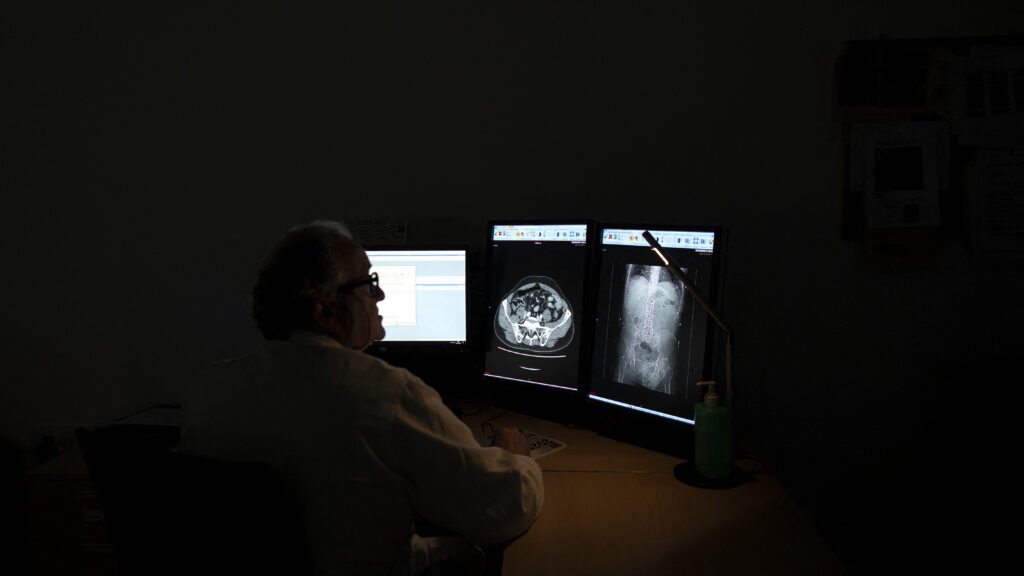
In the massive demonstration arena of Chicago’s McCormick Place conference complex this week, hundreds of computer monitors lit up with every body part and radiological image: fractures in X-rays, breast cancer in mammograms, brain atrophy in MRIs, and heart blockages in CT angiograms. With nearly every black-and-white image came a promised boost from artificial intelligence.
In radiology today, and at its largest annual conference held by the Radiological Society of North America, artificial intelligence is inescapable. This year, more than 100 companies filled the floor of the conference’s AI showcase, larger than two football fields — some booths modest, some decked out in multi-story, neon-lit structures, tempting wanderers with on-demand cappuccinos and smoothies. Attendees stopped for selfies with a 3D heart model larger than their heads as it pulsed with light, demonstrating a company’s coronary artery AI.
AI snuck into pitches well beyond the boundaries of its dedicated grotto. The biggest hardware manufacturers in radiology — GPS, people say, for GE, Philips, and Siemens — have also leaned in. Patients-for-hire in boxers stared dutifully into the middle distance as their bodies were gelled-up and prodded to demonstrate AI-assisted ultrasound, and visitors snacked on Chicago-made gourmet popcorn as they walked through a Disney-esque “patient experience” guided by AI.
STAT+ Exclusive Story
Already have an account? Log in

This article is exclusive to STAT+ subscribers
Unlock this article — and get additional analysis of the technologies disrupting health care — by subscribing to STAT+.
Already have an account? Log in
Individual plans
Group plans
To read the rest of this story subscribe to STAT+.