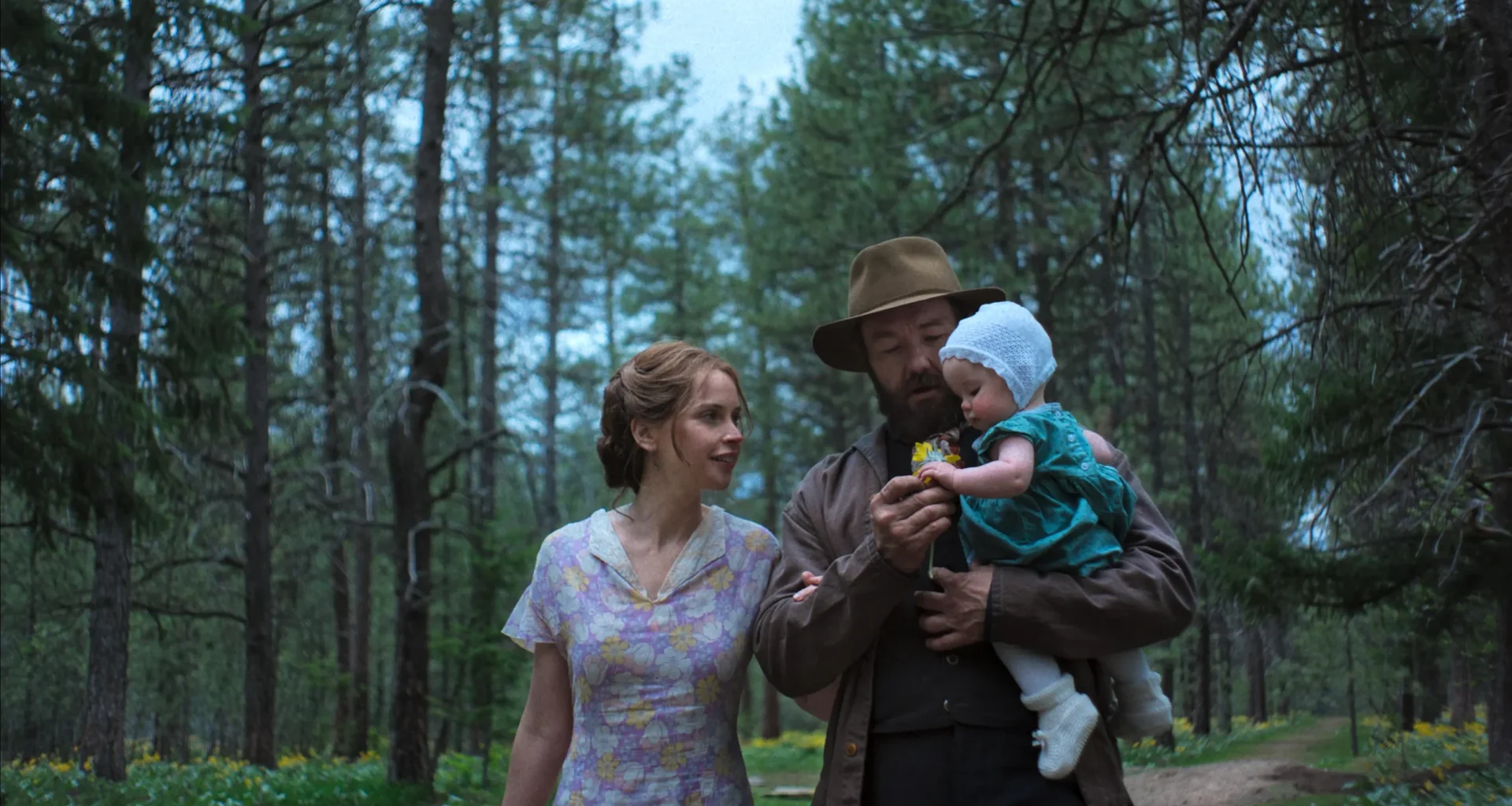
The story begins with a young, orphaned Robert Grainier (Joel Edgerton) arriving alone by train in Washington State in the late 1800s, just as the Great Northern Railway lines are being laid and the nation is engaged in expansionism. His life is aimless, punctuated only by physically demanding jobs as part of a gruff and sometimes violent construction crew. That is, until he meets Gladys Olding (Felicity Jones). The two fall in love, build a log cabin along the Moyie River, have a daughter they name Kate, and settle into a perfect, if rugged, life. Grainier continues to take logging and construction jobs around the country, often gone for months at a time. When a wildfire sweeps through his home and burns everything to cinders, he assumes Gladys and Kate were consumed by the flames. But with no physical remains, he holds on to the hope that they escaped and that he will see them again.
The rest of Grainier’s life is spent in the quiet confines of his rebuilt cabin, in a permanent state of grief and heartbreak, convinced he can hear Gladys and Kate’s voices in the trees that surround him. The decades pass. The nation changes around him, as does the world. Technological revolutions arrive; planes, trains, and automobiles; global wars are fought and resolved; the stirring of capitalism and global trade reshape the landscape. Yet Grainier remains outside these moments, seemingly untouched and unaware. Only the rail bridges he builds with his crew of other lonesome men, and the trees he cuts down, indicate a world progressing elsewhere – one in need of fresh lumber and budding opportunities. Grainier dies alone at the age of 80 in his remote cabin. Though barely aware of it, his life has both traversed and contributed to the modern age.
Much has been made of director Terrence Malick’s influence on Bentley’s own direction, and indeed Train Dreams moves in a similarly leisurely fashion to Malick’s Days of Heaven (1978). The same grassy, windswept vistas fill the frame in gorgeous depth. A narrator – here Will Patton – relates the circumstances of Grainier’s life in poetic, folksy prose. It’s an easy connection to make. Yet the film feels closer in tone and circumstance to Frank Darabont’s eponymous adaptation of Stephen King’s novella The Shawshank Redemption (1994). Both films occupy a similar timeframe, though The Shawshank Redemption begins later, in 1947. However, the character of Brooks Hatlen (James Whitmore), the old-timer incarcerated for fifty years, bridges the timeframe of Train Dreams and shares several traits with Grainier.
When Brooks is released from Shawshank in 1954 – having entered prison in 1904 – he enters a world that bears little resemblance to the one he remembers. He notes the rise of automobiles and the hurried pace of modern life. He is a man out of time. A similar moment occurs in Train Dreams when the elderly Grainier travels by train to Spokane in 1962. Standing outside an appliance store, he watches a grainy image of astronaut John Glenn orbiting Earth on a television in the window. It becomes clear he has never seen a television before, never spoken on a telephone, and knows nothing of the world – not even that the technology exists to put men in space. He catches his reflection in a mirror for the first time in a decade and is shocked by his aged appearance. All the progress of the century has passed him by. Connecting back to The Shawshank Redemption, its inmates are kept ignorant by a physical wall separating them from the world; Grainier, meanwhile, has built an internal wall that accomplishes the same thing. He has willingly exiled himself from humanity, its achievements, and its catastrophes.
In our age of constant connectivity, over-reliance on technology, and overwhelming amounts of information available at the touch of a screen, one cannot help but envy Grainier’s position in his world. He is out of place, of a different time, yet oddly connected to the future. One also has to admire a film that harkens back to a simpler mode of filmmaking, one in which narrative, performance, and gentleness are the primary focus. Train Dreams also feels out of place, of another time, and yet somehow of the future. It is rare these days to encounter a film that is this slow, delicate, and quiet. That rarity is perhaps what makes Train Dreams so astounding – and so impactful.
Train Dreams is out on Netflix on December 1st. The film arrived quietly on the platform after a limited theatrical run and is adapted from American writer Denis Johnson’s novella of the same name. While access in any form is welcome, the film’s true home should have been the cinema. Its immersive beauty and quiet contemplation deserve to be seen and felt on the big screen.