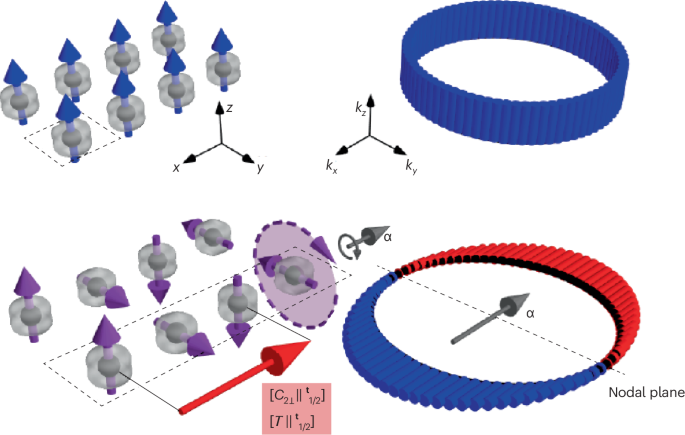
Different magnetic orders in real space give rise to different spin-dependent electronic structures in momentum space, as shown in the figure. The isotropic Fermi surface shown in the top panel corresponds to ferromagnetic order that is known as an s wave, in the language of spherical harmonics. By contrast, the commensurate spin helix shown in the bottom panel gives rise to p-wave spin splitting in momentum space. The work of Hirschberger pursues the route shown in the bottom panel, where an antiferromagnetic background of localized moments obeying certain symmetries couples to delocalized itinerant electrons in a metallic material, and results in p-wave magnetism.
The authors first identified Gd3Ru4Al12 as a material that hosts an incommensurate magnetic helix. Substituting a small amount of Rh for Ru allowed the authors to tune the period of the helix towards a commensurate spin helix that satisfies the symmetry requirements. They confirm this using resonant elastic X-ray scattering at the Photon Factory in Japan to show that the magnetic ordering vector kmag = (1/6, 1/6, 0) is commensurate with the underlying crystal lattice and coplanar.