The film and television world’s appetite for stories based on real events has revealed a familiar paradox in recent decades: creators who cling too closely to what actually happened, replicating every detail in an effort to reproduce real-life drama, often end up with a dry, sanitized and lifeless version of the original story. By contrast, works that leave room for interpretation or imagination allow their creators to take bold leaps, giving the final product new and intriguing meaning.
Hamnet, Maggie O’Farrell’s novel, is a prime example. O’Farrell built a human, emotionally rich drama out of one sparsely documented historical fact: the death of Hamnet Shakespeare, an 11-year-old boy in the 16th century. The only contemporary record is a single line that does not even mention a cause of death.
6 View gallery
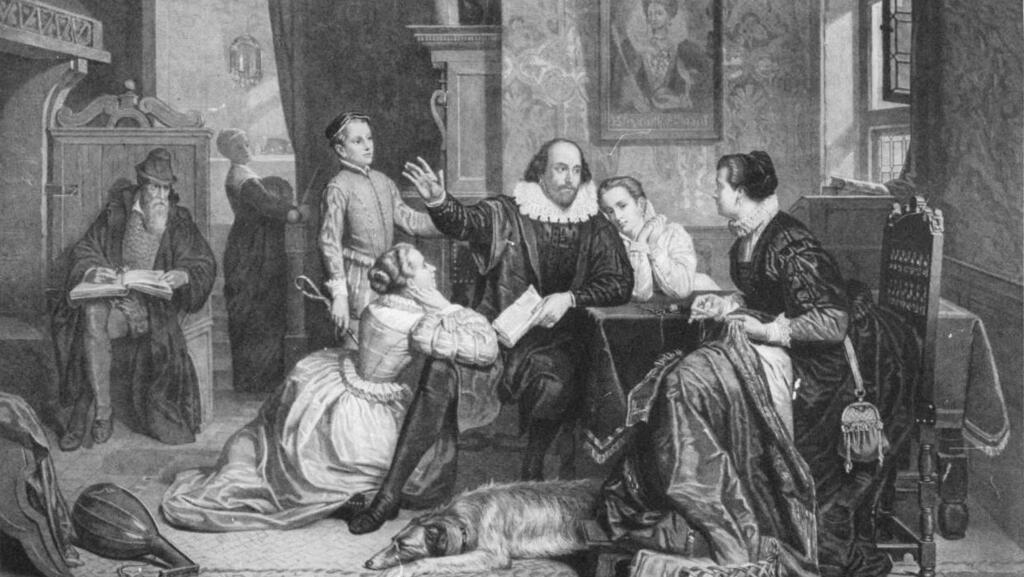
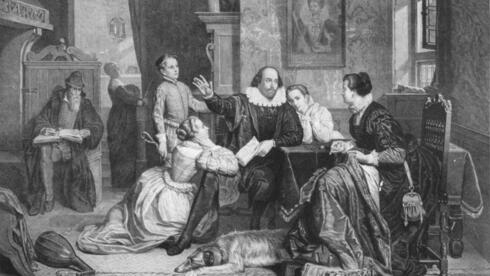
A 19th-century German engraving showing Shakespeare as a family man, surrounded by his wife Anne and children listening to his stories
(Photo: By Perine, George Edward, 1837-1885, printmaker. – engraved for the Eclectic by Perine & Giles., Public Domain)
Most likely, William Shakespeare, the famed English playwright, was not present at his son’s funeral in the summer of 1596. Records from the time indicate he was touring in Kent. His mother, Shakespeare’s wife Anne (Agnes) Hathaway — who happens to share a name with the modern actress — his twin sister Judith, his older sister Susanna and a few close relatives were presumably there. Shakespeare’s family remained in their hometown of Stratford-upon-Avon while he lived in London or traveled on tour with his acting company.
Hamnet was not the couple’s first child. Shakespeare was 18 and Hathaway 26 when they married, with her already three months pregnant. The rushed ceremony, held away from town and under a special license, has led many scholars to believe the marriage arose from necessity rather than romance. Their first child, Susanna, was followed by the twins. When Hamnet was born, Shakespeare still lived in Stratford, but by the time his son was a young boy, he had begun building his theatrical career in London. Scholars estimate that by the time Hamnet turned four, his father was away from home for long stretches — a common situation in Elizabethan England — leaving his mother and grandparents as the central figures in the boy’s life.
Researchers believe Hamnet died of the plague, the same disease that wiped out a fifth of Stratford’s population the year Shakespeare was born, or of another infectious illness. The town was a breeding ground for disease in that era, and epidemics swept through regularly throughout the 16th century. Hamnet was buried at Holy Trinity Church, which still attracts tourists today because Shakespeare himself was baptized there.
His death was not unusual for the period — nearly a third of children died before age 15 — but such frequency did not lessen the depth of parental grief. Shakespeare returned to London, while Agnes stayed in Stratford with their daughters. With some imagination, one can trace the emotional impact of Hamnet’s death in the plays Shakespeare later produced.
The playwright never confirmed that Hamlet was directly shaped by his son’s death. Up to that year, he had focused mainly on comedies, and he continued writing them afterward, producing works like The Merry Wives of Windsor, As You Like It and Much Ado About Nothing. The exception was King John, a tragedy many scholars date to the year Hamnet died, which includes a shattering monologue by Constance, a grieving mother mourning her son Arthur: “Grief fills the room up of my absent child… puts on his pretty looks… stuffs out his vacant garments with his form; then, have I reason to be fond of grief?”.
6 View gallery
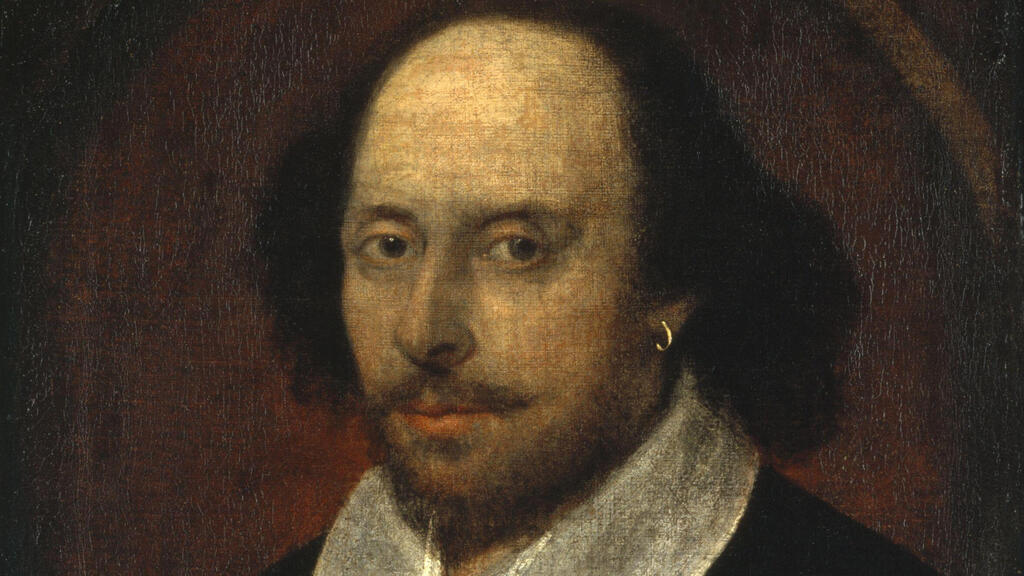
William Shakespeare, 1610
(Illustration: John Taylor)
Later came King Lear — with its devastated father mourning his beloved daughter — as well as Macbeth, Romeo and Juliet, Othello and other tragedies. But scholars have invested most energy in exploring the link between Shakespeare’s grief and Hamlet, for obvious reasons: the near-identical names (in that era, “Hamlet” and “Hamnet” were considered variants of the same name) and the themes woven through the play. The plot, in case you avoided the high-school summary, follows Prince Hamlet of Denmark, who is commanded by the ghost of his murdered father to avenge his death after Hamlet’s uncle Claudius kills the king and marries his mother, Gertrude. The prince’s tortured hesitation drives the play toward its tragic end.
Although Shakespeare’s own circumstances were inverted — a father grieving for a son rather than a son mourning a father — Hamlet stages an encounter between a father’s spirit and his son. This gives Shakespeare a way to process his own grief by reversing roles, placing himself emotionally in the position of the bereaved son. Through this device, he explores unresolved mourning, guilt, helplessness — feelings that may have haunted him because he was absent when his son died — as well as the fraught bond between father and child. And he leaves behind the haunting plea at the heart of the play: “Remember me.”
Irish author Maggie O’Farrell fell in love with Hamlet as a teenager, a fascination that eventually grew into a desire to write a historical novel about the man who created it. While reviewing Shakespeare biographies, some of them hefty volumes, she was stunned to discover that across hundreds of pages, Shakespeare’s son Hamnet appeared only twice at best: at his birth and at his death. She noticed the timing of Hamlet’s release, about four or five years after the family tragedy, and became drawn to the question that would become her main creative engine: how did Shakespeare’s wife feel knowing her husband wrote a play and named it after her dead son?
6 View gallery

Writer Maggie O’Farrell
(Photo: AP Photo/Alastair Grant, File)
O’Farrell had a complicated relationship with that question. More than once during her research, she decided to abandon it and move on to other projects. Having experienced several life-threatening medical crises herself (including an infectious inflammation of the brain tissue), she could understand the emotions that must have overwhelmed Mrs. Shakespeare, but she also knew that to write the book, she would have to “place herself in the mind of a woman forced to sit beside her child’s bed and watch him die.” O’Farrell raised a son and two daughters, just like Shakespeare’s family, and knew she would inevitably think of her own son while shaping Hamnet’s character. She decided not to begin the novel until he passed the age of 11. It took three more books before she returned to Agnes Shakespeare and her profound grief.
To keep the focus from drifting to William Shakespeare — the celebrity in the story — she avoided using his name, calling him “the husband,” “the father,” or “John and Mary’s son.” For Anne Hathaway, she restored her original name, Agnes, as recorded in her father Richard’s will.
But she was not starting from scratch. History had already formed a certain view of Agnes, and O’Farrell had to dismantle it before rebuilding her according to her own vision. The hasty marriage, the fact that Shakespeare spent most of his life away from his wife and the complete absence of written documentation — no letters, diaries or even hints in his plays — about their emotional relationship pushed scholars to assume that even if the marriage was stable, it lacked passion or affection. Some even claimed Anne trapped Shakespeare in a marriage he did not want, or as O’Farrell put it, “they tried to give Shakespeare a retroactive divorce.”
The frustration and anger these claims stirred in O’Farrell were enough to convince her to restore Agnes’s dignity on the page. She knew there was no evidence that Shakespeare despised his wife, and that after retiring from theater in 1613, even though he had amassed enough wealth to live anywhere he wished, he chose to return to his home in Stratford. She also relied on Shakespeare’s will, in which he left Anne “the second-best bed,” meaning their shared marital bed (the best bed in the house was reserved for guests).
6 View gallery
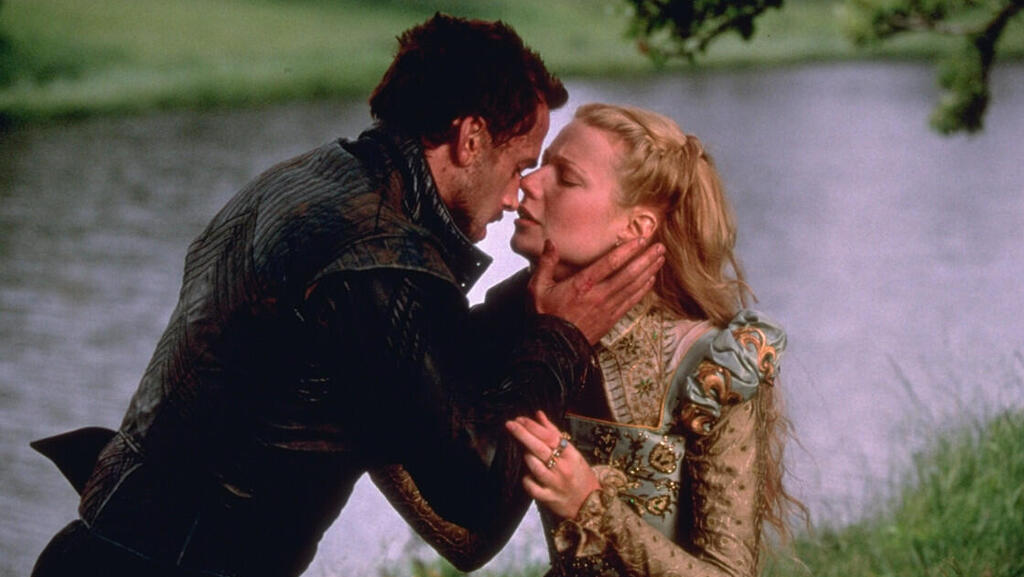
From ‘Shakespeare in Love’
(Photo: Courtesy of yes)
O’Farrell set out to strip from readers everything they thought they knew about the woman left behind and give her literary justice. In her view, Agnes’s motives — marrying a very young, impoverished teacher — were nothing less than noble: she saw the spark of Shakespeare’s talent and predicted his success. The novel grants Agnes unusual abilities as an herbal healer and seer, as well as an act of profound generosity: O’Farrell’s Agnes initiates the painful separation between father and family, allowing him to pursue his creative potential as an actor, playwright and director.
Beyond the unimaginable loss of a child, Hamnet’s death likely produced enormous guilt for his mother, a woman believed to have healing powers who could not save him. She does everything she can — including using herbs and extreme folk remedies, such as tying a toad to his stomach — but nothing works. Agnes has no one with whom to share her grief. Shakespeare is portrayed as a restless soul driven by a need to escape the shadow of his abusive father, John Shakespeare. His absence intensifies the emotional and practical burden on Agnes, who remains in Stratford to shoulder the mourning alone.
The novel’s dramatic climax, published in 2020, comes when Agnes travels to London and watches her husband play the ghost of Hamlet’s father. At first, she is horrified by his choice of name, but as she watches, she realizes Shakespeare channeled his grief and guilt into the play, transforming it into an act of atonement and remembrance. He takes on the role of the dead and gives life to his son. The absent father in life becomes the present father in death, onstage.
6 View gallery
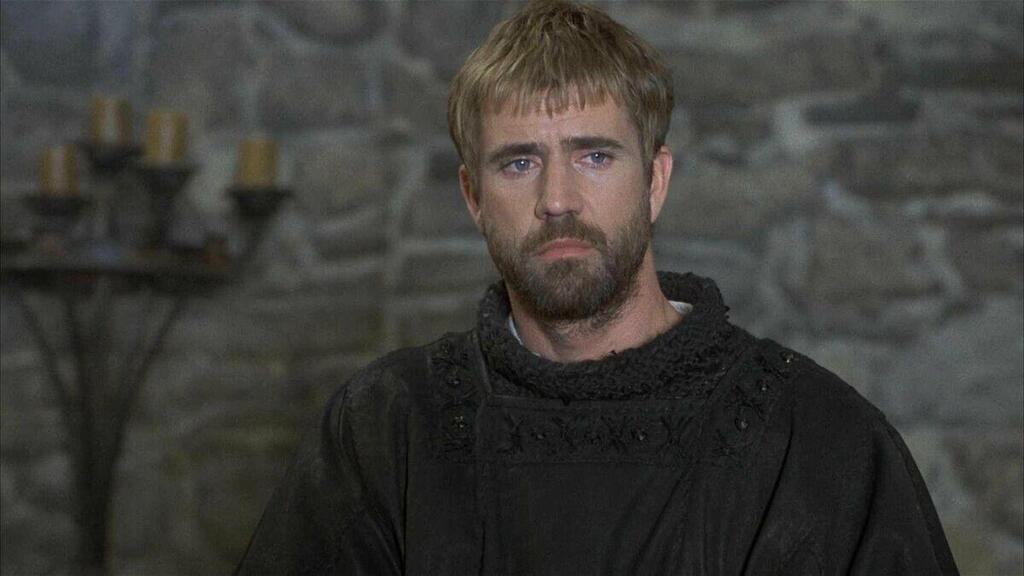
From ‘Hamlet’
(Photo: PR)
Hamnet moves between two timelines: the courtship of William and Agnes and their family life in Stratford; and the summer of 1596, when Judith, the twin sister, falls ill with the plague and Hamnet tries to save her, leading to his death and the family’s collapse. Unlike traditional period dramas, O’Farrell does not focus on political history. There is no queen, no court, no banquets — only home, fields, labor and illness, or as one wise man put it, “people, work, poop and pee.” Agnes’s world and her deep connection to nature and healing offer a feminine counterpoint to her husband’s art. Hamnet is ultimately about what the death of a child does to parents, to a marriage and to the experience of time itself, and whether any glimmer of hope can help them grow from shared trauma — to be or not to be.
Hamnet quickly became a commercial and critical success, winning awards and solidifying its appeal as a candidate for adaptation. The adaptation soon followed, with O’Farrell co-writing the screenplay and Steven Spielberg among the producers. In the film, Jessie Buckley plays Agnes, and Paul Mescal (Normal People, another bestselling adaptation) portrays William Shakespeare. Hamnet is played by Jacobi Jupe (Peter Pan & Wendy). The film is directed and edited by Oscar-winning Chloé Zhao (Nomadland). For the Hamlet performance scenes, a scaled-down replica of the Globe Theatre was built, complete with hundreds of extras as the audience. The timeline jumps of the novel were streamlined into a more linear structure, thankfully, allowing viewers to immerse themselves in the relationships and the grief.
6 View gallery

Chloé Zhao and Steven Spielberg
(Photo: Chris Pizzello/Invision/AP)
From a historical footnote to a bestselling novel (and a stage adaptation) and now a Hollywood film, Hamnet is part of a broader trend that seeks narratives that humanize historical icons, focusing on the human cost of artistic genius and the relationships that shaped their work. These stories aim to illuminate the nature of humanity rather than celebrate professional achievement in isolation. They also spotlight overlooked figures whose influence on history’s central characters was anything but marginal. “I’ve always thought that the biggest tragedy, the biggest drama of his life — of Shakespeare’s life — happened off stage in Stratford, at home,” O’Farrell said in an interview with the Shakespeare Unlimited podcast. “That was with the death of his son.”