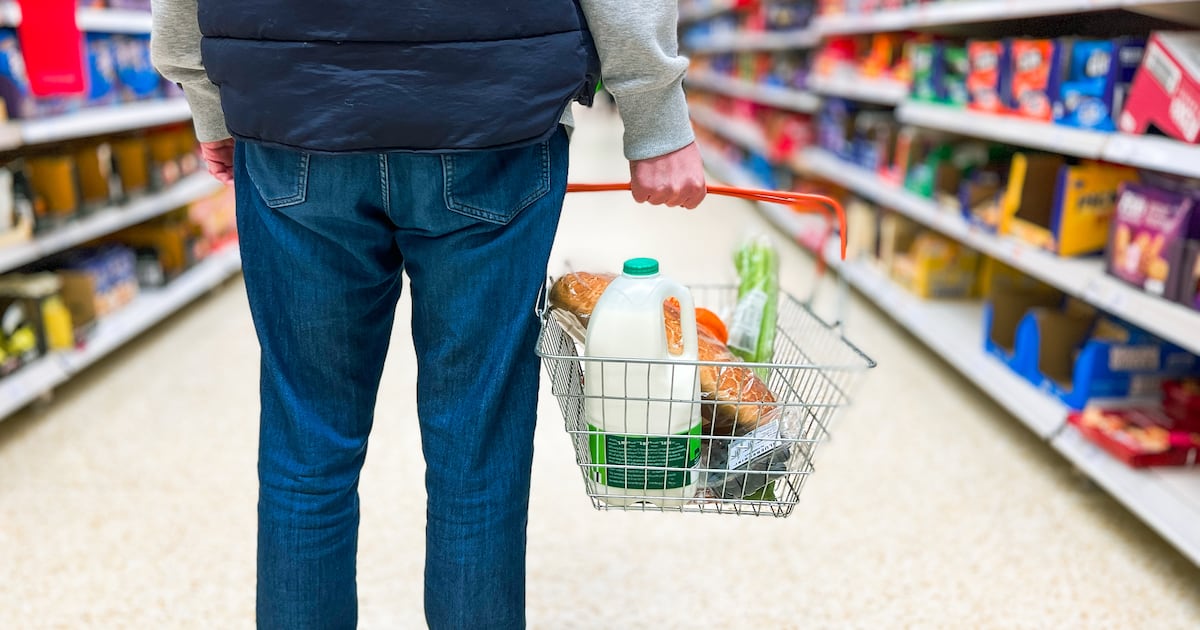
Even the woman manning the till in Tesco cannot hide her surprise at how little €100 buys these days and marvels at how many people spend that and still take their shopping away in a single plastic bag.
She leans over to a colleague and whispers: “Imagine being able to carry €100 worth of shopping in one hand – isn’t that just mad?”
It is indeed mad but this exchange, witnessed by The Irish Times in recent weeks, is hardly surprising any more.
Since early 2022 prices up and down supermarket aisles have been climbing. More than three years of price hikes have left many Irish families worse off by at least €3,500 annually.
While prices are not increasing as much as they were at the height of the cost-of-living crisis in mid-2023, they are still climbing and sometimes climbing fast.
News stories about supermarket prices are hardly new and have been running for as long as there have been supermarkets.
They have rarely made for happy reading.
In 2013 this newspaper noted that the price of a typical basket of groceries, including bread, milk, sugar and tea, had increased by more than 12 per cent in two years, with some products going up by almost 40 per cent.
The report that year, from the Consumers’ Association of Ireland (CAI), highlighted how a 1kg bag of sugar had gone from €1.05 to €1.45, while a packet of well-known sausages climbed to €1.85 from €1.55 and a box of branded tea that cost €3.24 in 2011 cost €3.78 two years later.
We didn’t know it then but those were the good old days.
Fast forward to today and the sugar costs €2.35, the sausages €3.89 and the tea €7. Those three items that cost €13.24 this week cost less than half that price – just €5.84 – 15 years ago.
Figures published last month by retail analysts Worldpanel by Numerator suggest that grocery prices are just over 6 per cent higher than this time last year. While that is lower than the runaway inflation of 17 per cent recorded in the summer of 2023, the 6 per cent is on top all the other hikes of recent years.
Worldpanel’s figures are just one metric to measure grocery inflation. Others are scarcely more cheering. The most recent flash estimates from the Central Statistics Office (CSO) suggests food prices are up by 4.2 per cent since this time last year.
And then there are first-hand accounts. Earlier this week we asked users of social media network X about their experiences at the supermarket tills.
“It seems everything is more expensive, but particularly meat (beef), coffee, dairy,” said one respondent, James Ryan.
“What I find most infuriating with grocery shopping now is the variance in price from week to week of staples. It is quite the job to keep track of price increases.”
“Beef and chicken are through the roof, soft drinks outside of ‘deals’ are also up. And it’s every week. What was €6.99 last week becomes €7.99 this week,” noted another, Sean Daly.
For her part, Judy Brady highlighted “the usual culprits: meat, butter, red sauce, brown sauce, sugar, tea, washing-up liquid, shampoo, I could go on and on.”
TU Dublin academic and retail analyst Damian O’Reilly forecasts supermarket inflation will probably peak at about 3.5 per cent for the year, though he warns some staples are climbing much faster.
He does not anticipate any significant changes in 2026 and suggests prices will climb by a similar margin at the very least next year.
Higher energy costs, wages, climate change and geopolitical uncertainty along with the continuing war in Ukraine are all going to keep pushing prices higher.
[ Irish inflation climbs over 3% again on higher energy and food pricesOpens in new window ]
O’Reilly singles out red meat, butter, milk, chocolate and coffee as being key drivers of grocery inflation. He suggests that if those products were stripped out of a typical basket of goods, grocery inflation in Ireland over the past 12 months would be considerably lower.
CSO data certainly bears that out. The price of beef has climbed by almost 27 per cent and chocolate is up by around 23 per cent, while butter costs at least 18 per cent more now than it did last year.
But it is not just food.
The cost of health and motor insurance has climbed in recent months, adding hundreds of euro on to household bills, while petrol and diesel have also been edging up.
And then there are energy bills which have also been going in the wrong direction for quite some time.
This week it emerged that the Government cancelled the energy credits that softened the blow of spiralling gas and electricity prices in the wake of Russia’s invasion of Ukraine in February 2022, even though civil servants suggested there was still a case to be made for them.
In the budgets leading up to the November 2024 general election, the Government included one-off energy credits totalling €1,100 over three years but in its first post-election budget it decided that the supports were unsustainable.
Documents released to Sinn Féin MEP Lynn Boylan under the Freedom of Information Act suggested the Government did so despite advice from officials.
“The cost-of-living crisis has not gone away and people are actually struggling more now than they were even a year ago,” Ms Boylan said this week.
“According to the department’s own analysis, when you take away the energy credits and the vast reduction, the difference was €321 extra that households would be expected to pay this year. Energy bills now are more expensive than they were at the height of that crisis in 2022 after the illegal invasion of Ukraine.”
In response, the Minister for Finance Simon Harris said it was a “misrepresentation” to suggest one-off energy credit payments were scrapped against the advice of civil servants. He claimed the Government wanted to take a “more targeted approach”.
Daragh Cassidy of price comparison website Bonkers.ie says people getting their gas and electricity bills in the days ahead will really see the impact of sustained high prices.
“Gas prices are around double where they were three or four years ago before the war in Ukraine and electricity prices are around 70 to 80 per cent higher than they were so they are still very high,” he says.
He points out that wholesale prices are a key factor in keeping bills elevated.
“When we hear in the CSO figures that the wholesale prices have fallen, we need to remember that that was from an insanely high level and not all of the original increase was passed on to consumers,” he says.
“Before the crisis the average price of electricity was around €40 to €50 per megawatt hour and it went up to around €400 per megawatt hour and for the last six months it has been trending at between €100 and €110 so – compared to more normal times – prices are still high.”
It is not all down to war in eastern Europe.
The cost of generating the electricity is about 40 to 50 per cent of a consumer’s bill, Cassidy says; the remainder is made up of taxes, grid fees, maintenance costs and other charges.
“Wind is not free and is not particularly cheap,” he says.
”We are investing a huge amount in the [national electricity] grid and will need to invest billions more. Grid fees went up by €130 over the last two years and next year it will be another €16 to €18,” he says.
“Then there are capacity market payments: money for plants to be on standby in case the wind doesn’t blow. Those fees are higher in Ireland because we have such variable wind.”
He questions the narrative that Irish consumers are being ripped off.
“We could say we were being ripped off if businesses were making huge profits but there are not supernormal profits being made. There are inefficiencies in the market that are leading to higher prices,” he says.
He warns that things are unlikely to change in the short or even medium term.
“Wind at €100 per megawatt hour is not cheap,” he says, referring to the standard at which energy is priced on world markets.
“And you need to invest in battery storage, you need to invest in an interconnector, you need to invest in the grid. There might be small reversal of the hikes but anyone expecting cheap energy prices in the next year or so or for prices to return to normal is going to be disappointed,” he says.
Cassidy suggests the situation here is “not necessarily as bad as people think if that makes it any easier to take.
“Britain, Germany, Denmark, Belgium have prices that are actually similar to ours so other countries are still feeling the shock too,” he says.
While that might well be true, it is unlikely to make many people feel much better.