When young film-makers ask Marshall Curry what makes a documentary idea, he tells them: “There are some stories that make great New Yorker articles, but they’re not movies.” It was only a matter of time before the director found himself testing his own wisdom with The New Yorker at 100, a new Netflix film about the magazine. “Somebody said to me that trying to make a 90-minute movie about the New Yorker was like trying to make a 90-minute movie about America. Ken Burns does that with one war.”
The film pulls back the curtain on the mystical media shop. Curry and his crew spent a year rummaging through the archives, listening in on production meetings, shadowing famous bylines – none more venerated in the industry than editor David Remnick, the magazine’s abiding leader. Curry had hoped to make a meal out of staffers pushing to meet the February 2025 publishing date, the magazine’s centennial anniversary issue, but the scenes he found didn’t quite approximate anything from the boiler room-centered dramas of film fiction or even The September Issue doc on Anna Wintour’s clannish Vogue operation. “I wanted to see people running around each other and saying, ‘We’ve got to get this thing done before the deadline!’” Curry says. “But they don’t do that.”
Supreme self-assuredness is how the New Yorker has managed to remain an essential subscription in a contracting media landscape where paper journalism has been reduced to a niche product. While rivals chased trends in hopes that eyeballs would follow, and faded into irrelevance, the New Yorker doubled down on curiosity and honed its refined palate, collaging wry cartoons, original art and cultural observations around authoritative profiles and investigations. And readers show their loyalty every time they lose themselves in an issue on the subway, troop around town in New Yorker-branded totes or point with some embarrassment to the stack of issues they haven’t gotten all the way through yet.
“My mini stack is around here somewhere,” says Curry, who grew up in New Jersey reading his parents’ magazine subscription. “I started looking at the cartoons because I was a little intimidated by all those words. Then I started reading the shorter stuff, then the longer stuff – then I got my own subscription and have had one nonstop since.”
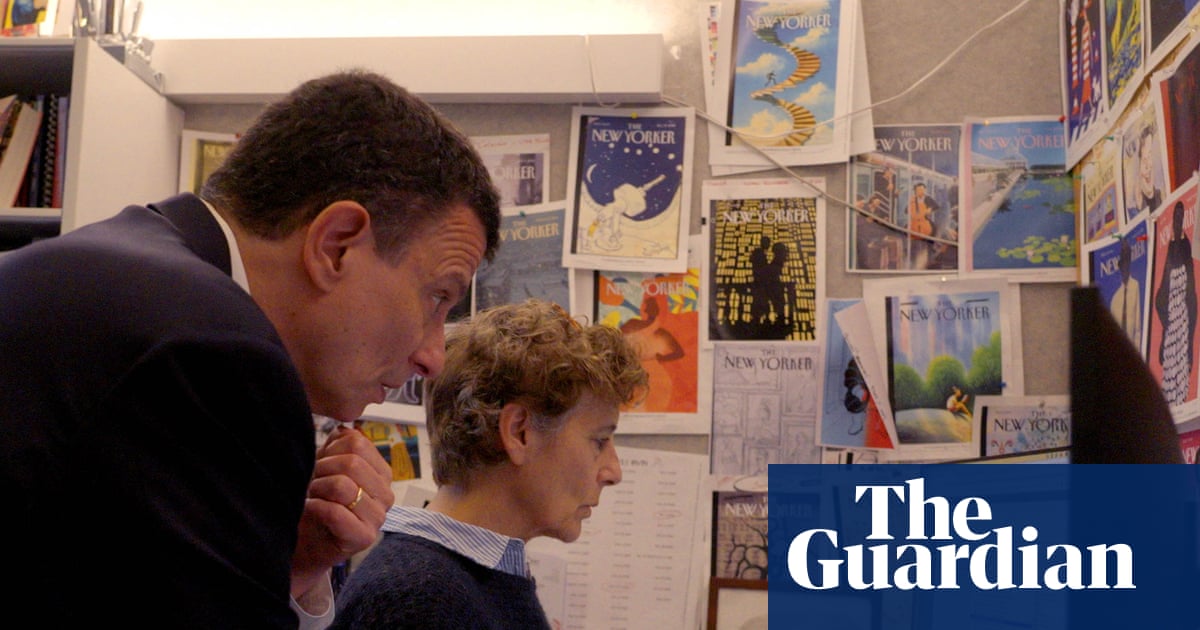
Curry’s film is as much of a tasting menu as the magazine itself – one that has Academy Award-winner Julianne Moore playing narrator. Jesse Eisenberg and Chimamanda Ngozi Adichie enthuse over their rarefied status as New Yorker contributors. Sarah Jessica Parker and Molly Ringwald nerd out about Roz Chast as the celebrated cartoonist makes parakeet fodder out of her old New Yorker issues. It follows Françoise Mouly, art editor, as she wrestles with what to do for the centennial issue cover in between reporting adventures with New Yorker staffers – in a Syrian prison with Jon Lee Anderson, war correspondent, alongside Rachel Syme, profile writer, for her interview with Carol Burnett, at home with Ronan Farrow, investigative reporter, as he reels in a big scoop on Trump administration surveillance tactics.
The big challenge for Curry was turning the tables on these expert reporters and interviewers. “There’s this trick that documentary film-makers learn quickly where you ask a question, the person finishes it but you don’t jump in with your next question because the person will try to fill the awkward silence that frequently follows – and they’ll add some additional piece of color that’s even better than the thing they said in their original answer,” he says. “Well, I asked David a question. He answers it. I sit quietly. He looks at me. I look at him. Finally, he says: ‘Marshall, I know this trick, too.’”
Where the film really shines is in retracing an institutional history that dates back to the New Yorker’s rowdy early days as a Mad magazine-style funny paper hatched by a high school dropout from Colorado. But where Mad committed to the comedy bits, the New Yorker seized on the world shaking events it observed through the years and took them as opportunities for its journalism to grow up. John Hershey’s seminal piece on Hiroshima, his 30,000-word response to the US government banning photographs of the civilian impacts of their nuclear bombing of Japan, made war coverage a priority for the magazine. James Baldwin’s 1962 essay A Letter from the Region of My Mind, which arrived in the throes of the civil rights movement, opened the magazine to non-white perspectives at a time when the mainstream media wasn’t platforming Black voices – much less Baldwin, just an aspiring novelist at the time.
“It’s interesting that you use the phrase ‘grow up,’” Curry says. “That’s kind of what we get to watch the magazine do, start out as this silly 10-year-old with its silly cartoons, and the one day an atom bomb gets dropped. When the film premiered at Telluride film festival, a woman stopped me on the street and said ‘I feel like I was watching the biography of an old friend.’”
David Remnick and Nicholas Blechman Photograph: Courtesy of Netflix
Truman Capote’s In Cold Blood, which effectively launched true crime as a genre, became a reason to build the industry’s most rigorous fact-checking department after Capote was found to have taken fictional liberties with the piece. Curry’s film makes sure to fulfill the required fan service and tarry over the New Yorker’s world-class pedantry: the quirky typographical style, its habit of accenting élite, coöperate and other common words – the gleeful reader letters that stream in when the magazine’s vaunted fact-checking department gets caught out. (Readers love smacking fact-checkers around with that word, apparently.)
And yet: for as much as the New Yorker has grown up through the years, to the point of distinguishing itself as a dynamic multimedia brand now, concerns about its future remain ever-present. Remnick, who turned 67 in October, has defined the magazine’s direction for the past two decades; readers and insiders worry the magazine could become a museum piece after he steps down. Curry’s film only nods at the magazine union’s protracted collective bargaining fight with Condé Nast; last month, the magazine conglomerate fired four New Yorker employees who were also prominent union members after announcing the near shuttering of Teen Vogue. Before that, a veteran New Yorker fact-checker walked off his job amid tensions over the magazine’s coverage of the Israel-Gaza conflict.
Curry says he didn’t see any signs of strife while embedded with the magazine. “My sense was there was a lot of diversity of thought, and people disagreed,” he says. “I heard writers arguing about whether Trump was in fact a racist and open debates about a lot of other things. I was kind of surprised, honestly.”
In the days leading up to the film’s debut this week, the New Yorker posted a link to a story on photographer Ann Hermes and her work documenting the decline of local newspapers across the US. It’s the sort of post that might scan as self-promotion and self-awareness to a discerning New Yorker reader. Can the magazine endure for another 100 years? Can it even survive this economy? “They still have 1.25 million subscribers and I’m sure they’d like that number to go up,” Curry says. “But they’re not trying to be McDonald’s and sell billions and billions of hamburgers to everybody in the world,” Curry says. “They’re making handmade, exquisitely crafted sushi for two seatings a night at their small restaurant for people who love and care about perfectly made sushi.”