Topline
Northern U.S. states may glimpse Northern Lights overnight on Sunday, Dec. 7 through Monday, Dec. 8, according to a forecast by space weather experts at NOAA. In the wake of a coronal mass ejection on the sun last week, a G1-rated geomagnetic storm make sightings possible low on the northern horizon — just as a 2025’s strongest meteor shower gets underway.
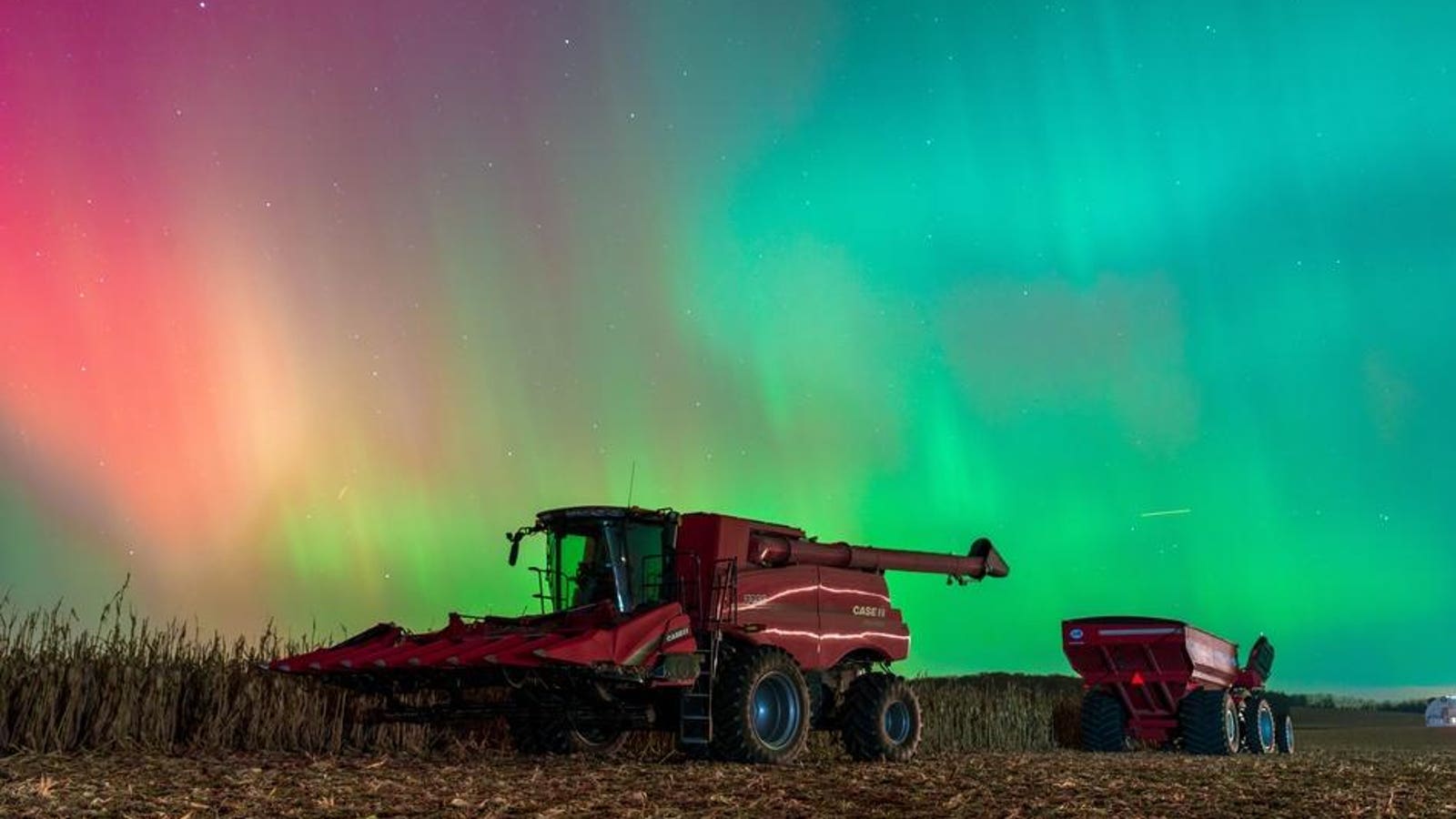
The Aurora Borealis lights up the night sky over Monroe, Wisconsin, on November 11, 2025, during one of the strongest solar storms in decades. The geomagnetic event pushes the northern lights deep into the continental United States, with vibrant pink, red, and green hues illuminating rural farmsteads and open fields across the Midwest. (Photo by Ross Harried/NurPhoto via Getty Images)
NurPhoto via Getty ImagesKey Facts
NOAA’s forecast includes a G1-rated geomagnetic storm that could see visibility stretch as far south as 12 U.S. states.
A coronal mass ejection left the sun on Dec. 4 after an M6-rated solar flare. A CME is a cloud of charged particles that travels across the solar system and interacts with Earth’s magnetic field.
According to Spaceweather.com, a huge sunspot is now facing Earth and is expected to produce major solar flares. That could mean more, and more intense, aurora next week.
The presence of a waning gibbous moon — which rose as a full supermoon on Dec. 4 — may make faint aurora harder to see.
The Geminid meteor shower began from Thursday, Dec. 4 and continue through Wednesday, Dec. 17, 2025, with its peak overnight on Saturday, Dec. 13 and Sunday, Dec. 14, according to the American Meteor Society.
Where The Northern Lights May Be Visible
U.S. states in with a chance of seeing faint aurora on the northern horizon include Alaska and (northerly parts of) Washington, Idaho, Montana, Wyoming, North Dakota, South Dakota, Minnesota, Wisconsin, Michigan, New York and Maine.
For the best views, locate a dark place using the Dark Sky Place Finder and a light pollution map. The darker the northern sky, the more vibrant the display — even during moderate geomagnetic storms — though some displays are only visible to cameras.
Read More