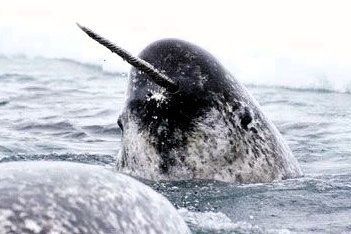
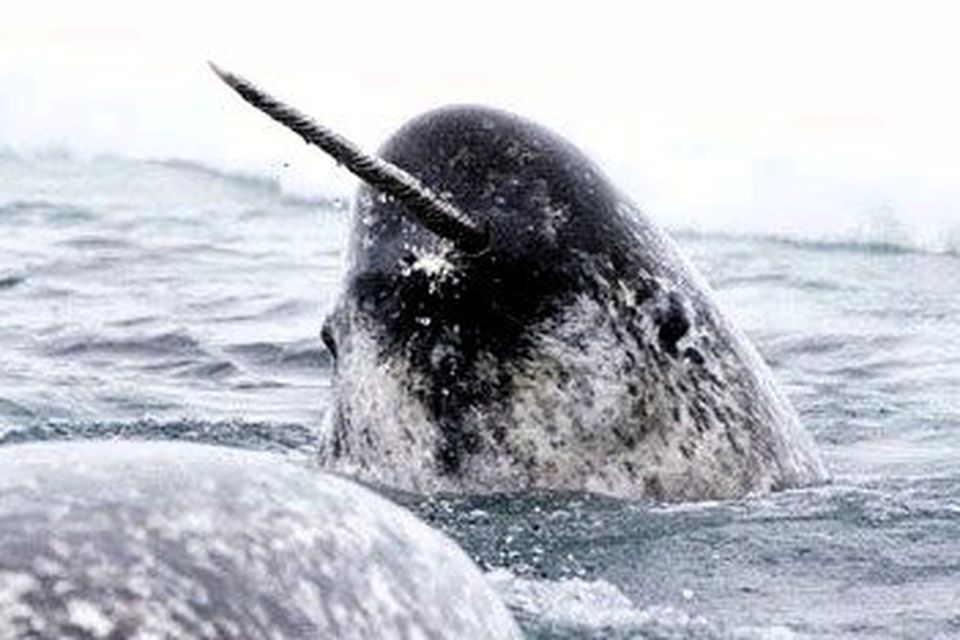
A Narwhal surfacing amid Arctic ice flows showing its remarkable tusk.
A family walking along Sweet Nellies Beach on the Inishowen Peninsula in Co Donegal came upon the stranded remains of a blubbery thing 2-3m long. They assumed it was a small whale or a large dolphin. They followed the correct procedure, went online, and reported their discovery to the Irish Whale and Dolphin Group (https://iwdg.ie/).
The IWDG has a nation-wide corps of volunteers who respond quickly to reports of strandings and sightings of marine mammals. Members of the corps arrived at the scene to recover the carcass, identify the species, take measurements and photos, and collect skin samples.
Collaborating with regional staff of the National Parks and Wildlife Service (NPWS) the IWDG decided to transport the carcass to the Regional Laboratory in Cork for post mortem examination and tests. These tests confirmed that the remains were those of a female Narwhal, a species of whale that had never before been recorded in Ireland.
The Narwhal, a word with its origin in Old Norse, is found exclusively in the Arctic waters of the north Atlantic, north of the 60° parallel. We are used to reports of southern species arriving in Ireland due to global warming, but it was strange, though not unheard of, for an Arctic species to be found so far south. NPWS records show that the recent Donegal stranding was the tenth record of Narwhal in western Europe, the fourth female, and a first for Ireland.
Narwhals are famous for their long tusks. Males and about 15% of females have tusks; the Donegal individual, a female, did not have the remarkable appendage. In animals that have them, the long, slim tusks point forward from their heads like the handle of a sweeping brush.
Each tusk grows from a single canine tooth, spirals counter-clockwise and can grow up to three metres long laying down annual layers like tree rings. The exceptional tooth protrudes from the animal’s upper lip. The purpose of the tusk is unknown. Suggested possible functions include social status signalling, mate selection, sensory perception, fighting, and a tool for foraging, particularly for stunning or manipulating prey.
References to the mythical unicorn, the legendary horse-like creature with a single large, pointed, spiralling horn projecting from its forehead have been traced back to ancient times but it is not known if unicorns legends are in any way linked to Narwhal sightings in Arctic waters.