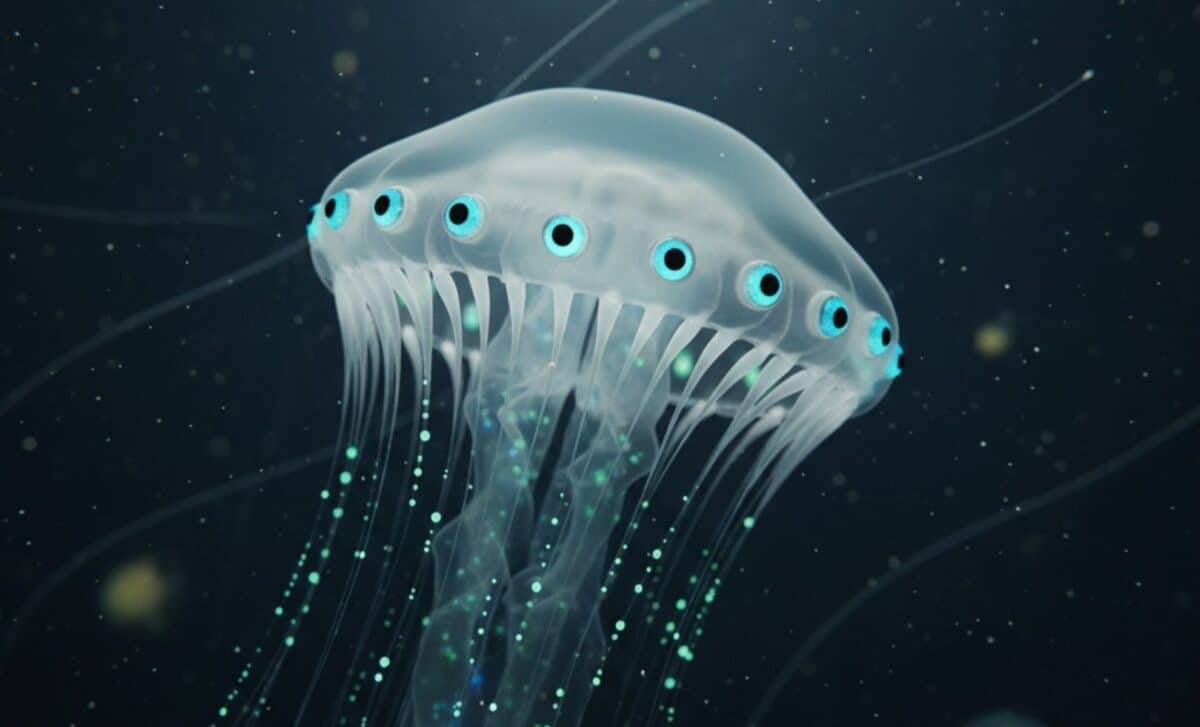
Scientists have uncovered a new species with a surprising feature: 24 eyes. Found in a shrimp pond at the Mai Po Nature Reserve, the jellyfish, named Tripedalia maipoensis, was discovered by a research team led by Professor Qiu Jianwen from Hong Kong Baptist University (HKBU). This tiny creature, measuring only about half an inch long, belongs to a small group of box jellyfish species, known for their distinct cube-shaped bodies and complex behaviors. The study detailing this discovery was published in Zoological Studies.
The Mystery of the 24 Eyes
Tripedalia maipoensis shares many features with its Caribbean cousin, Tripedalia cystophora, but stands out due to its unique physical traits. The jellyfish’s bell, which is nearly transparent and only about six-tenths of an inch in diameter, takes on a nearly cubic shape. Each corner of its bell features three flattened structures called pedalia, which help propel the jellyfish through the water. These pedalia are attached to long tentacles that can reach up to four inches.
What sets Tripedalia maipoensis apart, however, is its impressive array of eyes. Like other members of the Tripedaliidae family, this creature boasts 24 eyes, grouped into four clusters called rhopalia. As shown by the study, two of these eyes in each cluster are larger and image-forming, while the others are simpler, tracking light and dark. Researchers suspect that these eyes play a role in navigation and hunting.
“This box jellyfish connects the base of its tentacles and its bell with a flat base that looks like a boat paddle, making it distinct from other common jellyfish,” explained Qiu Jianwen, , a professor in the Department of Biology at Hong Kong Baptist University and lead researcher, in a video. “Another feature of the box jellyfish is that it has six eyes located on each side of its body.”
Jellyfish Behavior: More Complex Than We Thought
Despite having no brain, Tripedalia jellyfish exhibit behaviors that suggest a surprising level of cognitive ability. For instance, studies on Tripedalia cystophora have shown that the jellyfish can alter its swimming patterns after encountering obstacles, a form of associative learning.
This type of learning allows the jellyfish to link previous experiences to future behavior. Though Tripedalia maipoensis has not yet been tested for similar behaviors, its close relationship with Tripedalia cystophora leads scientists to believe that it might share these learning capabilities.
Interestingly, this ability to learn despite lacking a central brain is not unique to the creature. Other simple organisms, like certain species of octopus, have been found to exhibit similar forms of learning.
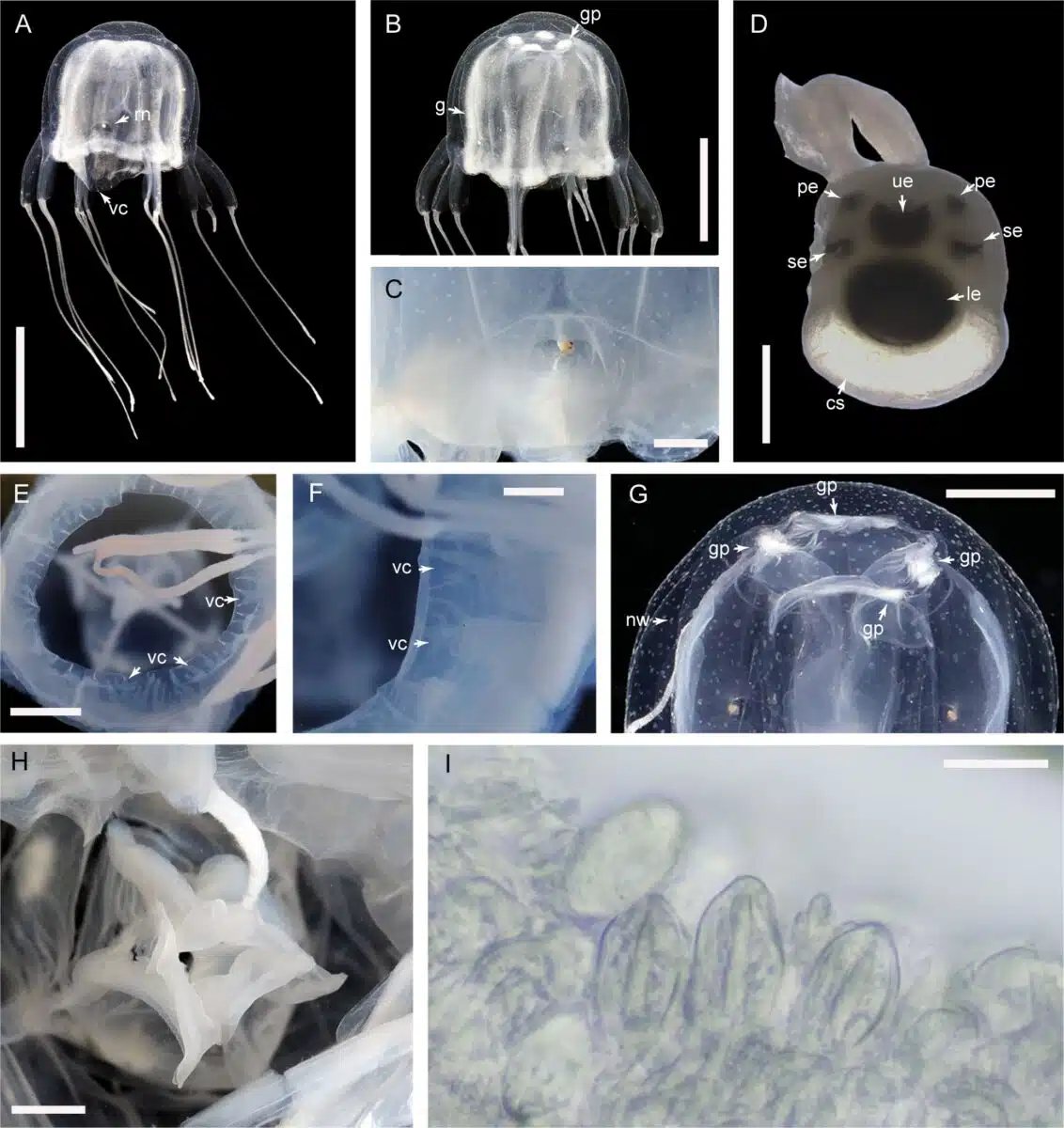 Morphological features and evolutionary placement of Tripedalia maipoensis. Credit: Zoological Studies
Secret Creature in the Heart of the City
The discovery of Tripedalia maipoensis in the Mai Po Nature Reserve brings attention to an often-overlooked aspect of marine biodiversity: the possibility that new creatures may be hidden in familiar environments. Despite being a well-studied area located near a bustling urban landscape, reveals that even human-modified habitats can still harbor undiscovered species.
“We are thrilled with this discovery. Finding a new species in Mai Po, where extensive research has been conducted, highlights the potential for more marine life discovery in the Hong Kong and even the Chinese coastal waters,” Professor Qiu said.
The research team suggest that the presence of Tripedalia maipoensis in a shrimp pond, an ecosystem shaped by both natural and human factors, indicates that quieter, less disturbed wetlands could be home to even more undiscovered species.
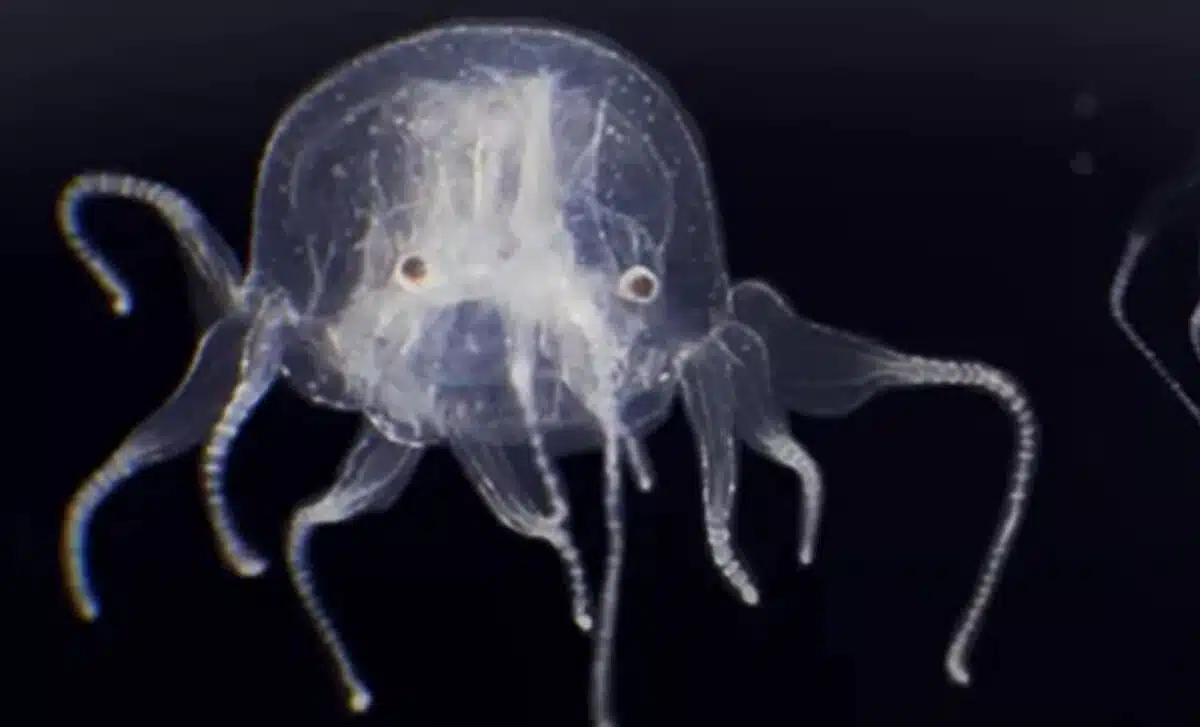 Similar to other box jellyfish, the newly discovered species has 24 eyes, grouped in clusters of six around its cube-shaped body. Credit: Hongkongbaptistu via Youtube