
NASA’s Scientific Balloon Program is back in Antarctica, launching two exciting balloon missions that aim to uncover some of the universe’s biggest mysteries. The missions kicked off in early December from the icy landscape near McMurdo Station, marking the start of a long-duration scientific campaign. The balloons will help scientists learn more about dark matter and high-energy particles from deep space.
These missions, called PUEO and GAPS, will gather critical data that could transform our understanding of the universe. PUEO will focus on detecting tiny, high-energy particles called neutrinos, while GAPS will hunt for particles related to dark matter. Both missions are part of NASA’s ongoing efforts to explore the far reaches of space, using new technologies to answer big questions about our world.
PUEO Mission: Hunting for High-Energy Neutrinos
The PUEO mission is a big deal for NASA, as it’s the first mission to launch under their Astrophysics Pioneers program. This initiative is all about doing important science in a cost-effective way. PUEO’s goal is to detect neutrinos, tiny particles that travel across the universe, undisturbed by the environment. These particles carry crucial information about powerful cosmic events like black holes and neutron star mergers.
To catch these elusive particles, NASA plans to use the Antarctic ice sheet as a giant detector. According to NASA, PUEO will look for radio signals generated when these high-energy neutrinos interact with the ice.
“I’m excited to see our first Astrophysics Pioneer mission on the launch pad, with more to come very soon,” said Shawn Domagal-Goldman, NASA’s acting director of Astrophysics. “The PUEO mission is essentially like using the Antarctic ice as one big telescope.”
This mission promises to be the most sensitive survey of cosmic neutrinos ever conducted.
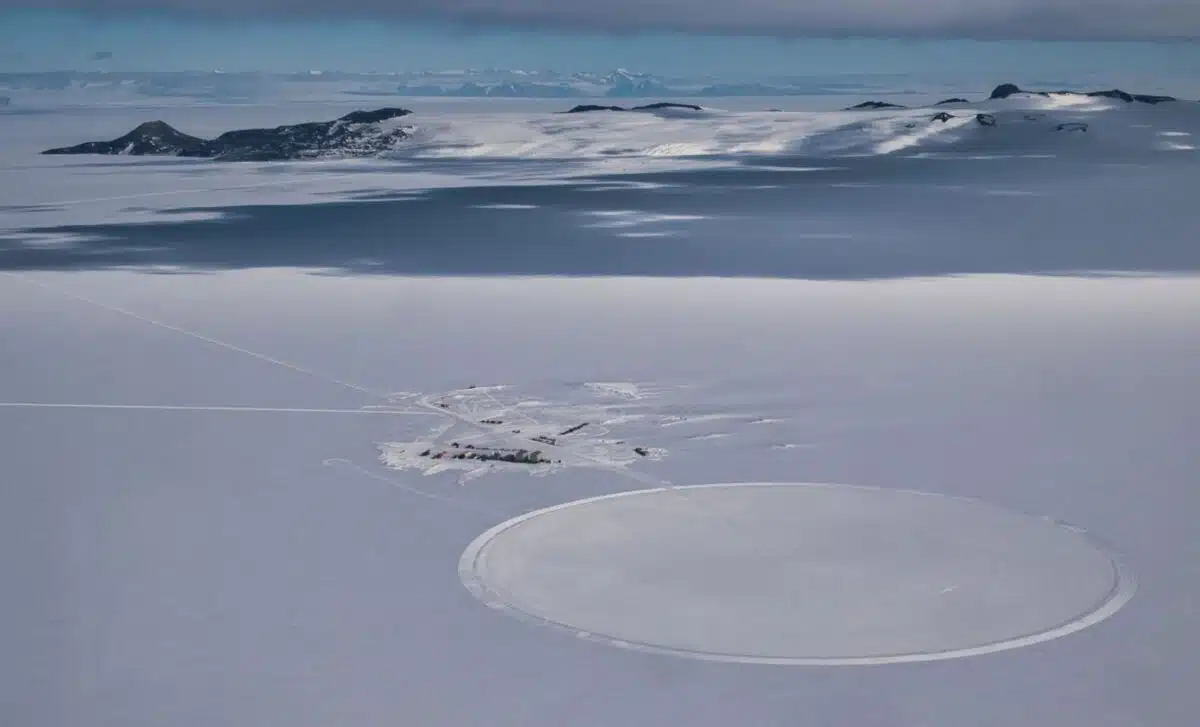 Situated about eight miles from McMurdo Station, NASA’s Long Duration Balloon camp lies on Antarctica’s Ross Ice Shelf. Credit: NASA/Scott Battaion
GAPS Mission: Chasing the Secret of Dark Matter
The GAPS mission is another key part of this scientific campaign, focusing on the mysterious dark matter that makes up most of the universe. Dark matter is invisible and hasn’t been fully understood, even though scientists know it exists because of its gravitational effects. GAPS hopes to find anti-matter particles that are believed to be produced when dark matter decays.
A single detection of one of these particles could change everything we know about the universe. If GAPS succeeds, it could open up a new chapter in our understanding of dark matter and its role in the cosmos.
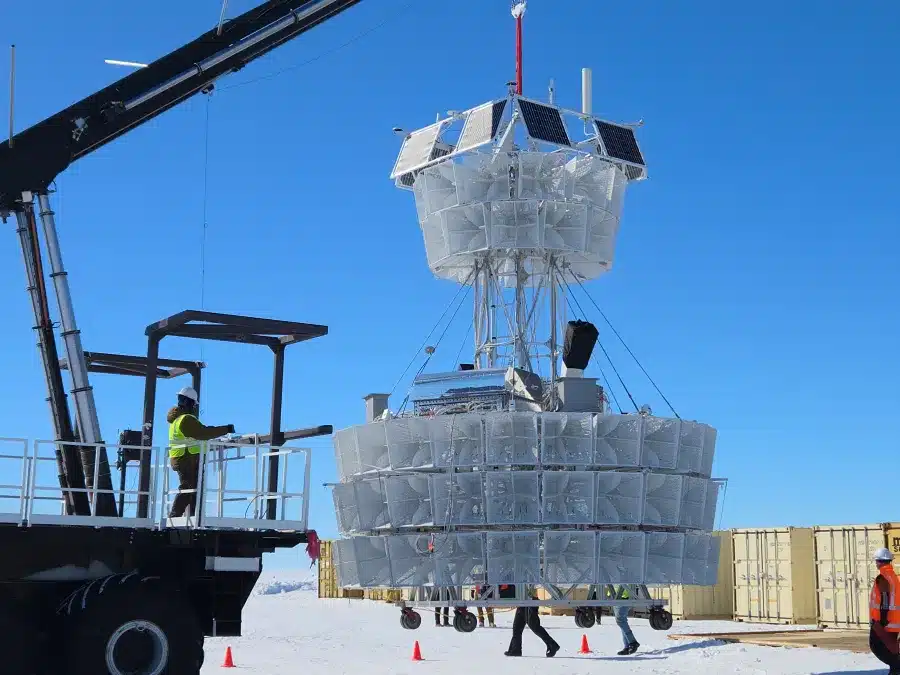 The scientific instrument for the Payload for Ultrahigh Energy Observations (PUEO) is meticulously set up during integration procedures in Antarctica. Credit: NASA/ Andrew Hamilton
Balloon Technology: Why NASA Uses Them for Long-Term Space Exploration
The balloons NASA is using for these missions are pretty special. They’re designed to stay in balance with the surrounding atmosphere, which is key for long, uninterrupted flights over Antarctica. The zero-pressure balloons maintain an equilibrium with their surroundings, making them perfect for the harsh conditions of the polar region.
NASA’s Wallops Flight Facility oversees the balloon program, with Peraton handling mission planning and engineering. The balloons themselves are built by Aerostar. Thanks to this technology and teamwork, NASA can conduct these long-duration missions in a way that would be impossible with traditional spacecraft. These balloons provide a unique opportunity to collect data in ways that would otherwise be challenging.