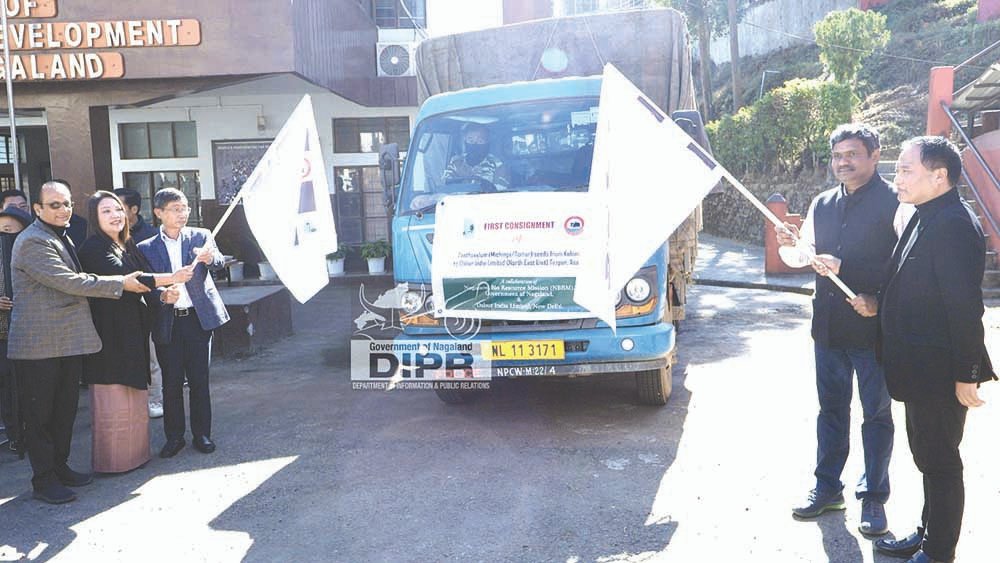
Nagaland on Saturday dispatched its first consignment of Zanthoxylum (Michinga/Tomar) seeds to Dabur India Ltd., North East Unit, Tezpur, marking a significant step in the State’s efforts to commercialise its bio-resources. The consignment was flagged off by chief secretary Sentiyanger Imchen at SIRD office complex, Kohima.
The seeds will be transported from Kohima to Tezpur as part of a buy-back arrangement under the Nagaland Bio-Resource Mission.
Imchen described the initiative as “a programme of substance,” where outcomes were visible and measurable. He said Nagaland possessed immense potential in medicinal and aromatic plants, and that the mission had spent the past decade cataloguing these resources to facilitate commercial use.
He noted that Zanthoxylum was widely grown and consumed across the State, and therefore held strong prospects for organised trade. However, he pointed out that despite Dabur’s request for 10 tonnes, Nagaland was able to supply only 1.5 tonnes in the first batch.
Calling this a reminder of the need to scale up, he said the State must produce in larger quantities to attract buyers. “Nagaland grows many crops, but we are not able to produce sufficient quantities for people from outside to come and buy from us,” he stated.
The chief secretary urged progressive farmers and entrepreneurs to adopt scientific cultivation practices, maintain quality and ensure consistent volume. He expressed appreciation to Dabur India for partnering with the mission and hoped the collaboration would pave the way for commercialisation of more medicinal plants and herbs from the State.
In a message, head of Central Procurement and Planning Division (CPPD), Dabur India Ltd., New Delhi, Narayanan Renganathan, said Dabur—established in 1884—continued to depend heavily on medicinal herbs. He acknowledged that herb cultivation in India had long remained unorganised, but appreciated recent efforts by state governments to streamline the sector. He said Dabur was providing planting materials, training and agricultural support to farmers in various States, including Arunachal Pradesh, which currently supplies 10 metric tonnes.
Expressing optimism that Nagaland could expand its production, he said, “Today we are flagging off with one truck. Soon, I wish to see one truck leaving every month, followed by one truck every week.” He added that Dabur was open to collaborating beyond medicinal herbs, pointing to opportunities in spices and pineapple processing, provided local supply chains and processing units were strengthened.
Team Leader, Nagaland Bio-Resource Mission, Dr. Kruolalie Tsúrho, highlighted the mission’s journey in identifying and promoting indigenous bio-resources for commercial use.
Following the flag-off, a stakeholder conclave was held at the SIRD Conference Hall, where Dabur officials interacted with government departments, farmer groups and mission partners. Discussions centred on quality parameters, supply-chain requirements, pricing and long-term procurement plans for Zanthoxylum and other medicinal plants.
The initiative is expected to enhance farmers’ income and promote commercial cultivation of bio-resources across rural Nagaland. With the first consignment dispatched, the mission aims to develop a sustainable value chain for indigenous species and open new livelihood avenues.
Earlier, the chief secretary flagged off the consignment in the presence of senior officials from Dabur India Ltd., representatives of the State government, entrepreneurs and farmers.