Home » Middle East » AlUla and Saudi Arabia Lead the Way in Astrotourism: Unveiling the Magic of Stargazing and Ancient Astronomy
Published on
December 7, 2025

Astronomy is experiencing a remarkable renaissance in Saudi Arabia’s vast deserts, where history intersects with the stars. Knowledge of the night sky was once essential for navigating the Arabian Peninsula, and it is now becoming a focal point of cultural tourism. Saudi Arabia’s rich history in astronomy dates back to the Golden Age of Islam and is being revived in the modern era, attracting global attention through new stargazing experiences and astrotourism initiatives.
A New Age for Astronomy in Saudi Arabia
During the Islamic Golden Age, from the 9th to the 13th centuries, Arab scientists advanced astronomy to unprecedented levels. Arabic names for stars, such as Altair and Aldebaran, still echo across the night sky today. Tools like the astrolabe, essential for navigation, were perfected by Arab scientists, making astronomy one of the key achievements of the era. The period also saw the establishment of the House of Wisdom in Baghdad, where astronomers and scientists from across the Islamic world worked together to refine celestial observations.
In recent years, Saudi Arabia has embraced its astronomical heritage, aligning it with modern tourism efforts. This newfound focus is not just a celebration of the Kingdom’s past but a way to position it as a top destination for stargazing and space-related tourism.
AlUla: A Hub for Astrotourism
At the heart of Saudi Arabia’s ambitions in astrotourism lies AlUla, a breathtaking desert landscape rich in history, culture, and now, astronomy. Located in northwestern Saudi Arabia near the ancient Nabataean city of Hegra, AlUla is being developed into a world-class destination for both cultural exploration and astronomical observation.
AlUla Manara, an exciting new visitor centre dedicated to the cosmos, is under construction and promises to be a state-of-the-art facility for astronomy lovers. It will house interactive exhibits, high-tech telescopes, and immersive workshops that bridge the gap between ancient celestial wisdom and modern scientific exploration. With plans to become a hub for astrotourism, AlUla aims to draw stargazers from around the world.
Dark Sky Certification: A Milestone for AlUla
In a remarkable achievement, AlUla Manara and the nearby Gharameel Nature Reserve were designated as an International Dark Sky Park in 2024. This certification, awarded by DarkSky International, is the first of its kind in the Gulf region. The reserve spans over 2,300 square kilometres and is renowned for its clear, pollution-free skies. Here, visitors can experience the night sky as ancient travelers once did, unmarred by artificial light.
To achieve this prestigious status, AlUla had to meet strict criteria, including environmental and lighting controls, a long-term conservation strategy, and a commitment to education and public outreach. As a result, AlUla now joins a select group of locations worldwide recognized for their dark skies, including places like the Grand Canyon and the Scottish Highlands.
AlUla: Where the Desert Meets the Cosmos
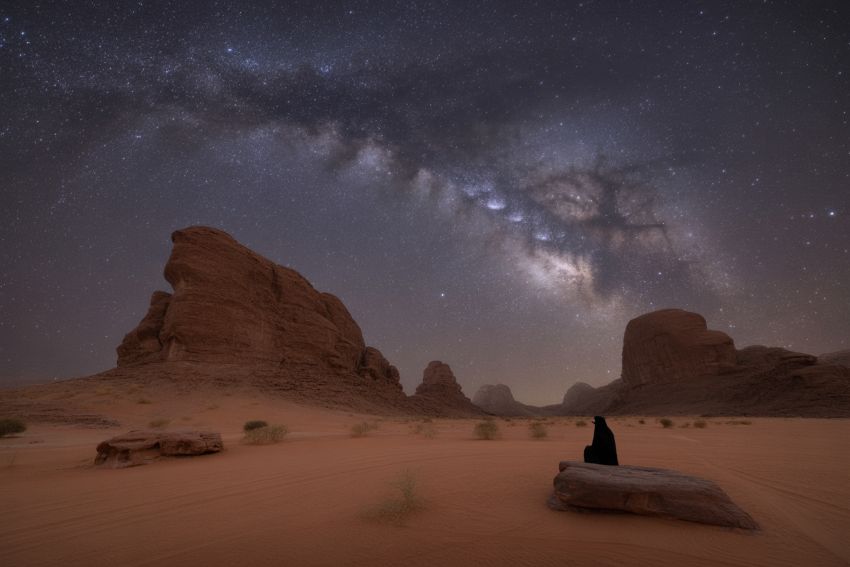
Beyond the high-tech innovations, AlUla offers something truly unique for stargazers: the chance to observe the universe in its purest form. The vast, unspoiled desert landscapes provide an exceptional backdrop for the night sky. The absence of light pollution, combined with the region’s ideal atmospheric conditions, makes AlUla one of the best places on Earth for stargazing.
As night falls, visitors to AlUla are greeted with a spectacle of thousands of stars and the mesmerizing arch of the Milky Way. The ancient rock formations and desert vistas provide a surreal setting, amplifying the celestial experience. These breathtaking views are just as captivating by day, with the rich history of the Nabataean ruins and the natural beauty of the surrounding landscape offering an all-encompassing desert adventure.
Bridging Ancient Wisdom with Modern Science
AlUla’s commitment to stargazing is not limited to breathtaking views; it is also about fostering a deeper understanding of the cosmos. With interactive programmes, workshops, and events, AlUla Manara will play a crucial role in educating visitors about the scientific and cultural significance of the stars. These experiences will allow visitors to connect with the universe in new ways, learning about both the ancient navigational systems used by desert travelers and the latest discoveries in modern astronomy.
The ongoing development of AlUla Manara will also serve as a global hub for research and education in astronomy and space science, furthering Saudi Arabia’s position as a leader in the field of space exploration and tourism.
Stargazing: A Tradition Revived
The traditions of stargazing in Saudi Arabia are centuries old. In fact, the Kingdom is home to some of the clearest skies on the planet, making it an ideal location for observing the stars. As Nawal Al-Anazi, a prominent astronomer from Saudi Arabia, points out, the desert conditions of the country offer perfect conditions for stargazing, particularly during the cooler months of October to March.
In these months, the skies are clearer, and visitors can easily spot constellations such as Orion, Ursa Minor, and Polaris. Many desert excursions are already being organized, offering tourists the chance to camp under the stars, combining the charm of Bedouin storytelling with the wonders of modern astronomy.
The Role of Local Astronomical Societies
In addition to AlUla’s growing role as a stargazing destination, Saudi Arabia boasts several other initiatives to promote astronomy and space science. Local organizations such as Falak for Space Science and Research in Riyadh and Noor Astronomy in Al-Qassim are leading the way in educating the next generation of stargazers. These clubs and societies aim to ignite a passion for astronomy among young Saudis and encourage the growth of a domestic space science community.
In addition to their educational efforts, these groups contribute to the global conversation on space science and its impact on daily life. By linking astronomy with tourism, Saudi Arabia is creating a thriving ecosystem that fosters both scientific discovery and cultural appreciation.
A Future in the Stars
As AlUla grows as a top astrotourism destination, its role as a hub of space science and discovery will only grow. The completion of AlUla Manara will serve as a focal point for tourists, scientists, and stargazing enthusiasts from all over the world, providing a one-of-a-kind opportunity to explore the universe from one of the most pristine locations on Earth.
Saudi Arabia’s astrotourism initiative is a promising step towards combining the country’s rich cultural heritage with cutting-edge scientific advances. AlUla is on track to become one of the world’s top astronomy and stargazing destinations by preserving its dark skies and fostering a deeper connection between humanity and the cosmos.
