
“One thing that stands out in the new National Military Strategy is that it is 10X more critical of Europe than Russia” – Representative Don Bacon (Republican, Nebraska).
Landing Friday with the subtlety of a scud missile, the new National Security Strategy of the United States of America has quite a lot to say about Europe and us Europeans. And it ain’t pretty.
Not since Vladimir Putin’s July 2021 essay on the history of Ukraine as part of greater Russia has a major power published a more bracing analysis of Europe’s strategic position in the twenty first century.
OK – the chapter on our continent is entitled ‘Promoting European Greatness’.
But it diagnoses Europe’s chief problem not as the usual American talking points on economic decline or military weakness. It’s far more profound than that.
According to US President Trump’s National Security Strategy, the main problem to be addressed by the US in Europe is “civilisational erasure”.
The keywords in this strategy document are not bomb, fleet, missile, factory or resource – they are culture, civilisation, religion, family, history and character.
And the quiet part – not uttered aloud, but strongly implied – is about race.
Indeed the first priority of the entire document states “the era of mass migration is over”.
“We want Europe to remain European, to regain its civilisational self-confidence, and to abandon its failed focus on regulatory suffocation,” the strategy says.
And that aligns the US with the kind of internal European analysis of Victor Orban, Marine LePen, Jason Bardella, the Polish Justice and Law party and Germany’s Alternativ fur Deutschland, to name but a few.
Some on the right-hand side of the political aisle in Ireland will also see reflections of their own political thought in these pages.
Maybe some on the left-hand side too (it declares US policy to be “pro-worker”).
And it sees the EU as a malign actor, along with other unspecified “transnational bodies” presumably including the International Criminal Court, the G20, the WTO etc.
It’s not quite at the same level as Russia declaring the EU one of its three “strategic enemies” (the USA and NATO are the other two): but it’s certainly not a warm embrace either.
It codifies many of the views first expressed by US vice president JD Vance at the Munich security conference into an official policy document.
EU governments can’t say they weren’t warned.
“The larger issues facing Europe include activities of the European Union and other transnational bodies that undermine political liberty and sovereignty, migration policies that are transforming the continent and creating strife, censorship of free speech and suppression of political opposition, cratering birthrates, and loss of national identities and self-confidence,” it states.
Strategy suggests Europe should ‘reverse migration’
The US Strategy suggests that Europe should follow the US lead on closing its borders and instituting “reverse migration”.
Without using the word “white”, the document says current European immigration and social policy will make the continent less white.
It states that “America’s goal should be to help Europe correct its current trajectory”.
And it justifies this on national security grounds.
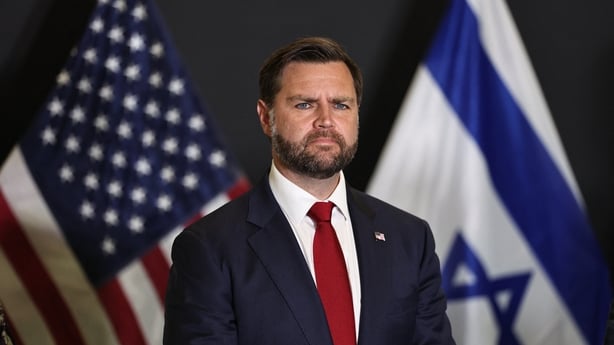
It codifies many of the views first expressed by US vice president JD Vance
“Should present trends continue, the continent will be unrecognisable in 20 years or less.
“As such, it is far from obvious whether certain European countries will have economies and militaries strong enough to remain reliable allies. Many of these nations are currently doubling down on their present path.”
This, it believes, will have significant implications for European security, as expressed through NATO, because it will change the racial and cultural character of European countries, and with it the political interests of those countries that do not “course correct”.
“Over the long term, it is more than plausible that within a few decades at the latest, certain NATO members will become majority non-European.
“As such, it is an open question whether they will view their place in the world, or their alliance with the United States, in the same way as those who signed the NATO charter.”
Yet, it states: “Europe remains strategically and culturally vital to the United States.
“Transatlantic trade remains one of the pillars of the global economy and of American prosperity.
“European sectors from manufacturing to technology to energy remain among the world’s most robust.
“Europe is home to cutting-edge scientific research and world-leading cultural institutions.
“Not only can we not afford to write Europe off – doing so would be self-defeating for what this strategy aims to achieve.”
Top-level policy for how US should deal with Europe
It then sets out the top-level policy for how the US government should deal with Europe.
“American diplomacy should continue to stand up for genuine democracy, freedom of expression, and unapologetic celebrations of European nations’ individual character and history,” it said.
“America encourages its political allies in Europe to promote this revival of spirit, and the growing influence of patriotic European parties indeed gives cause for great optimism.
“Our goal should be to help Europe correct its current trajectory.”
The question of why this course correcting action is important to US national security is answered thus: “We will need a strong Europe to help us successfully compete, and to work in concert with us to prevent any adversary from dominating Europe.”
The document said: ‘Our goal should be to help Europe correct its current trajectory’
And it seems there is some room for sentiment in foreign relations.
The policy states: “America is, understandably, sentimentally attached to the European continent – and, of course, to Britain and Ireland.”
But Paddy’s Day and the like will only get you so far – there is plenty to be done on the other 364 days, if you want to stay the course with the Americans.
And the policy boils that down to a single word: Character.
“The character of these countries is also strategically important because we count upon creative, capable, confident, democratic allies to establish conditions of stability and security.
“We want to work with aligned countries that want to restore their former greatness.”
Make Ireland Great Again?
A recurrent theme is lack of self-confidence among the Europeans.
It diagnoses this a key issue in the resolution of the Ukraine war and in the management of Europe’s long-term relationship with Russia.
It says the US will have to get stuck into all three issues – Europe, Ukraine and Russia – with the aim of “re-establishing conditions of strategic stability across the Eurasian landmass, and to mitigate the risk of conflict between Russia and European States”.
Note the emphasis on European States, not the EU or NATO.
It says it will have to commit significant diplomatic resources to this task.
For the stated aim of rebuilding European self-confidence, that implies a much more activist US diplomatic engagement in Europe, of a type we have not seen much of certainly since the end of the Cold War.

It diagnoses self-confidence among Europeans as a key issue in the resolution of the Ukraine war
“This lack of self-confidence is most evident in Europe’s relationship with Russia”, the document states.
“European allies enjoy a significant hard power advantage over Russia by almost every measure, save nuclear weapons.
“As a result of Russia’s war in Ukraine, European relations with Russia are now deeply attenuated, and many Europeans regard Russia as an existential threat.
“It is a core interest of the United States to negotiate an expeditious cessation of hostilities in Ukraine, in order to stabilise European economies, prevent unintended escalation or expansion of the war, and reestablish strategic stability with Russia, as well as to enable the post-hostilities reconstruction of Ukraine to enable its survival as a viable state.”
Trump Administration at odds with European officials
The National Security Strategy starkly describes the current tensions between the EU and US over how the Ukraine war should be addressed.
“The Trump Administration finds itself at odds with European officials who hold unrealistic expectations for the war perched in unstable minority governments, many of which trample on basic principles of democracy to suppress opposition.
“A large European majority wants peace, yet that desire is not translated into policy, in large measure because of those governments’ subversion of democratic processes.
“This is strategically important to the United States precisely because European states cannot reform themselves if they are trapped in political crisis.”
This is the political and strategic background against which disputes with EU states – especially Ireland – surrounding the regulation of online media platforms are playing out.
This document links US national security concerns with the commercial interests of online companies like X, Meta, Alphabet and every AI developer out there.
Comisiún na Meán needs to read this, not just the Department of Foreign Affairs and Trade or the Department of Defence and the Military.
Industry and Commerce, Environment, Education – really any senior civil servant, company director or policy worker ought to at least scan this one to get a feel for the policy engine that is now humming away in the bowels of the White House.
Business as usual it most assuredly is not.
Here’s the bullet point version:
“Our broad policy for Europe should prioritise:
- Reestablishing conditions of stability within Europe and strategic stability with Russia
- Enabling Europe to stand on its own feet and operate as a group of aligned sovereign nations, including by taking primary responsibility for its own defense, without being dominated by any adversarial power
- Cultivating resistance to Europe’s current trajectory within European nations
- Opening European markets to US goods and services and ensuring fair treatment of US workers and businesses
- Building up the healthy nations of Central, Eastern, and Southern Europe through commercial ties, weapons sales, political collaboration, and cultural and educational exchanges
- Ending the perception, and preventing the reality, of NATO as a perpetually expanding alliance
- Encouraging Europe to take action to combat mercantilist overcapacity, technological theft, cyber espionage, and other hostile economic practices.”
Yes there is a world beyond Europe, and the Americans know about it too.
But this document sets limits on US ambition.
International relations viewed through an ‘America first’ prism
Out is lengthy name-checking of countries involved in conflict or catastrophe, in comes a more focused, high-level approach that views all international relations through an “America first” prism.
Matching resources to aims – ends to means – is now the order of the day: clear definition of what America wants, not vague platitudes or desired end states.
It rejects endless intervention abroad and favours a short list of objectives aimed at securing and enhancing American economic, military, political and cultural power into the future.
It jettisons much post-war American foreign policy in the post war period, in favour of a sharper focus on a few core objectives: a “focused definition of the national interest”, peace through strength, a “predisposition to non-interventionism”, flexible realism, and the primacy of nations.
“Our elites badly miscalculated America’s willingness to shoulder forever global burdens to which the American people saw no connection to the national interest,” it said.
“They overestimated America’s ability to fund, simultaneously, a massive welfare-regulatory-administrative state alongside a massive military, diplomatic, intelligence, and foreign aid complex.
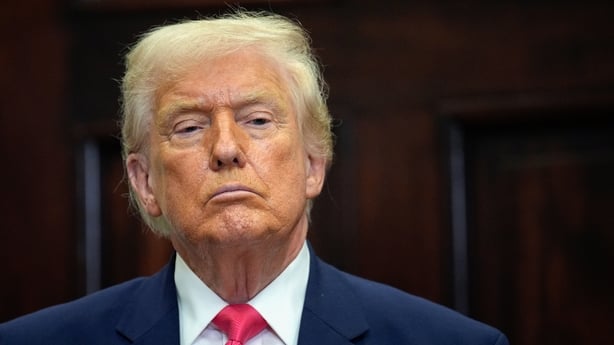
US President Trump’s National Security Strategy gives a clear definition of what America wants
“They placed hugely misguided and destructive bets on globalism and so-called ‘free trade’ that hollowed out the very middle class and industrial base on which American economic and military preeminence depend.
“They allowed allies and partners to offload the cost of their defense onto the American people, and sometimes to suck us into conflicts and two controversies central to their interests but peripheral or irrelevant to our own.
“And they lashed American policy to a network of international institutions, some of which are driven by outright anti-Americanism and many by a transnationalism that explicitly seeks to dissolve individual state sovereignty.
“In sum, not only did our elites pursue a fundamentally undesirable and impossible goal, in doing so they undermined the very means necessary to achieve that goal: the character of our nation upon which its power, wealth, and decency were built.”
Three pages of document focus on Europe
Europe is one of five regions that get varying amounts of attention in the document.
In terms of number of pages, Asia gets six, Latin America gets four, Europe three, the Middle East two and Africa just over half a page.
The overarching aim is to keep foreign competitors – mostly China – at bay in these regions, and use US economic, technical military, political, financial and cultural strengths to tip advantage in the regions in Americas favour.
In the Western Hemisphere – i.e. the Americas – it states: “After years of neglect, the United States will reassert and enforce the Monroe Doctrine to restore American preeminence in the Western Hemisphere, and to protect our homeland and our access to key geographies throughout the region.”
The Munroe Doctrine was originally conceived by US President Munroe in 1823 as a way of keeping European colonial powers out of the Americas by asserting US primacy over the continent.
It was later used to justify US intervention – military and covert – in the affairs of Latin American countries.
Today it seems to be manifesting in Venezuela, and perhaps in heading off the EU-Mercosur trade agreement (a significant lump of the political opposition in the European Parliament to the Mercosur deal also lines up with much of the Trump European policy ideas).
China and lesser power players targeted
But China and lesser power players are also targeted by what the White House is calling the “Trump Corollary” to the Munroe Doctrine – keeping hostile forces out of the US Sphere of influence.
“We will deny non-Hemispheric competitors the ability to position forces or other threatening capabilities, or to own or control strategically vital assets, in our Hemisphere,” it said.
This ‘Trump Corollary’ to the Monroe Doctrine is a “common-sense and potent restoration of American power and priorities, consistent with American security interests”, the policy document states.
In Asia, the military containment of China and the management of economic competition with it are the key priorities.
It says increased military deterrence will work hand in hand with a “rebalancing” of the economic relationship with China to try and avoid war and achieve balanced economic growth for the Indo Pacific region as a whole (home to one third of nominal GDP and about half of GDP measured by purchasing power parity, numbers that are only going to rise this century).
It also critiques past US policy on China: “President Trump single-handedly reversed more than three decades of mistaken American assumptions about China: namely, that by opening our markets to China, encouraging American business to invest in China, and outsourcing our manufacturing to China, we would facilitate China’s entry into the so-called rules based international order.”
“This did not happen. China got rich and powerful, and used its wealth and power to its considerable advantage.

It critiques past US policy on China (stock image)
“American elites – over four successive administrations of both political parties – were either willing enablers of China’s strategy or in denial.”
In the Middle East the US strategic aim is to greatly reduce its involvement in the affairs of the region, and hand it over to the countries of the region to manage themselves.
The reason is the declining influence of oil in US politics, and the shift to other economic drivers in the region – aided by US diplomatic efforts to normalise relations between Israel and other states in the region.
“As this administration rescinds or eases restrictive energy policies and American energy production ramps up, America’s historic reason for focusing on the Middle East will recede.
“Instead, the region will increasingly become a source and destination of international investment, and in industries well beyond oil and gas – including nuclear energy, AI, and defence technologies.
“We can also work with Middle East partners to advance other economic interests, from securing supply chains to bolstering opportunities to develop friendly and open markets in other parts of the world such as Africa.”
On Africa itself, the strategy document says: “For far too long, American policy in Africa has focused on providing, and later on spreading, liberal ideology.
“The United States should instead look to partner with select countries to ameliorate conflict, foster mutually beneficial trade relationships, and transition from a foreign aid paradigm to an investment and growth paradigm capable of harnessing Africa’s abundant natural resources and latent economic potential.”
While there is plenty of “hard power” targets set by this strategy – the world most robust industrial base, energy base, scientific base, military and financial power etc – what marks this one out is its insistence – for the US and for Europe – on key internal soft power aims.
And for America it says: “We want the restoration and reinvigoration of American spiritual and cultural health, without which long term security is impossible.
“This cannot be accomplished without growing numbers of strong, traditional families that raise healthy children.”
You have probably noticed an upswing in many of these themes in your social media feeds over the past 18 months.
Expect a lot more in the years ahead, as MAGA goes international.