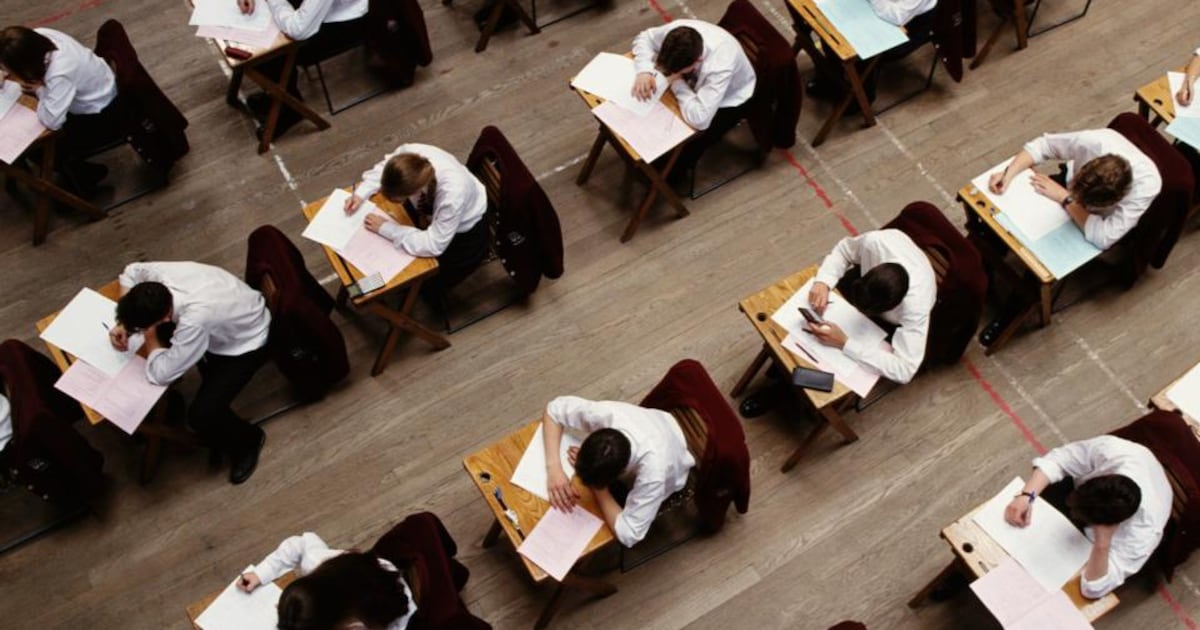
Leaving Cert reform began in classrooms last August. Originally, the plan was to have some schools pilot the new subjects and learn from that experience before the subjects were introduced for everyone.
After a unilateral announcement by then education minister Norma Foley on Morning Ireland two years ago, that schedule was scrapped. Instead, current fifth-year students are guinea pigs in vital subjects such as biology, physics, chemistry and business.
As the end of the first term approaches, teachers are probably best described as wearily getting on with it. Although the TUI accepted a package of supports and the ASTI rejected it, neither union could be described as being thrilled with the way teachers’ concerns were largely ignored.
There are some positive aspects. Sample exam papers were issued before term started.
Additional funding was provided, with the grant per student for science subjects rising from €13 to €25. All non-fee-paying schools will receive a minimum payment of €13,000 up to a maximum of €22,000, depending on the number taking science. Deis schools will receive an additional 10 per cent. In total, almost €20 million will be invested.
While this funding is welcome, veteran science teachers remember a 2002 task force report on the physical sciences, because a decline in students studying science was seen as a critical threat to our economic growth.
The task force recommended that €142.8 million should be spent to bring post-primary labs and equipment up to international standards. Lab technicians should also be State-funded in every school.
No such investment happened. Today, more than 20 years later, a fraction of that figure is being invested. Most schools still do not have lab technicians.
Incidentally, 16.4 per cent of Leaving Cert students sat physics in 2001, and 12 per cent sat chemistry. In 2025, 12.7 per cent sat physics and 13.8 per cent sat chemistry. Only biology has seen a significant increase, from 43.7 per cent in 2001 to 59 per cent in 2025.
Science teachers have fears about safety, particularly in chemistry, given that health and safety guidelines were last updated in 2001. Those guidelines were never designed for every student carrying out an individual experiment.
Teachers are supposed to have no input into the design of these experiments. Many schools will still have overcrowded, inadequate facilities despite funding increases. Teachers are terrified of the obvious dangers.
The allocation of 40 per cent of the final marks to coursework is also causing profound unease in every subject.
In the sample coursework brief for business, for example, students must write 1,500 words exploring how ethical considerations impact marketing for a business operating in the service sector in Ireland. Not the slightest effort has been made to proof this title against cheating by using GenAI.
On April 1st 2024, Foley promised “comprehensive guidance” for teachers on AI in schools, including assessment. The coursework guidelines were eventually issued in mid-November, more than 19 months later. They are brief and naive.
AI cannot be used to generate coursework, and paraphrased AI-generated content is still plagiarism. If properly referenced, AI can be used to generate background information, structure coursework plans and clarify resource material. Credit can only be awarded for the effective use of AI-generated material in the support or development of the candidate’s own work.
[ Can the Leaving Cert be AI-proofed?Opens in new window ]
Perhaps a saint would stick to these guidelines. Those less advanced on the road to sanctity might decide to use humanising AI, which conceals giveaway characteristics of AI-generated material – or those with rich parents might access top-tier subscription plans that will protest a little before they do the work for you. Even if coursework is conducted in class, there is nothing to prevent students from bringing in notes generated by AI. Some GenAIs can imitate an individual’s handwriting.
Teachers are responsible for ensuring students do not succumb to these temptations. They are to accomplish what plagiarism-detection software has failed to do – accurately identify AI-generated material.
At a recent Oireachtas Committee on Education meeting, Arlene Forster, chief executive of the National Council for Curriculum and Assessment, dismissed concerns about AI and coursework. She characterised AI as a “new piece of technology, but it is not new in terms of how it could be used inappropriately”. She compared it to concerns about Google and Wikipedia, which is a bit like comparing a bicycle to a self-driving car.
Meanwhile, in November, an independent review of the curriculum, assessment and qualifications system in England said exactly the opposite. It states that “externally set and marked exams remain the fairest and most reliable method of assessment, particularly in safeguarding disadvantaged students from systemic biases that can arise in coursework-based evaluation.” It also mentions that students like written exams when they are fair.
[ Teachers are being bullied into accepting reforms that will damage educationOpens in new window ]
In the short term, post-primary teachers will make this reform work – like they made online teaching work during Covid-19. However, within a decade, schools with the means to fundraise with ease for advanced facilities and premium GenAI tools may have pulled even farther ahead of the schools where socio-economic disadvantage is already entrenched.
It risks making a mockery of the slogan of Leaving Cert reform, equity and excellence for all.