Back to Article List
Planet Mercury is now a bright light in the predawn sky, reaching its greatest western elongation from the Sun on this date.
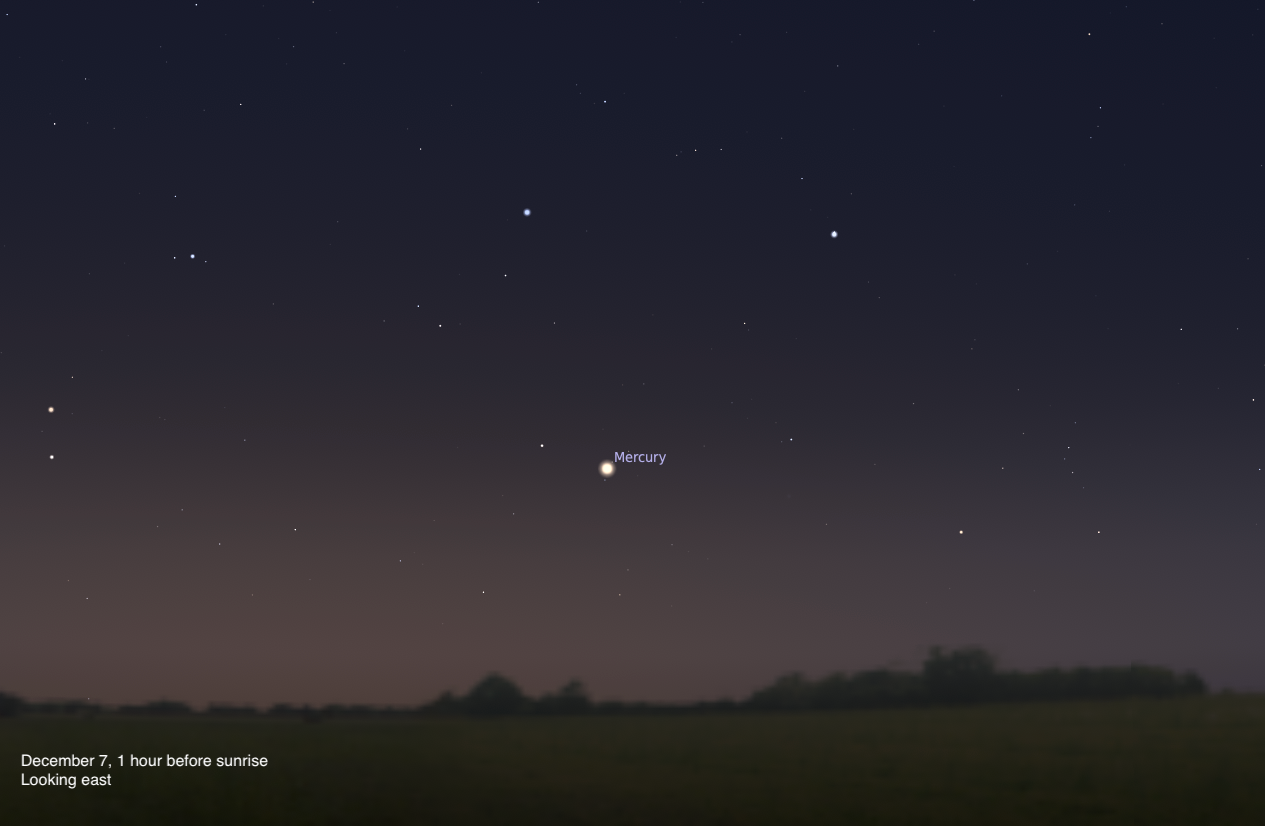
Mercury reaches its greatest elongation west of the Sun today, when it is 21° from our star. It stands some 8° high in the east in the starry sky an hour before sunrise, near Libra’s two brightest stars. Credit: Stellarium
- A notable celestial event on December 6 involves Europa and its shadow transiting across the Jovian disk.
- Early-morning observations of Mercury are detailed, occurring just prior to its greatest western elongation, positioning the planet 21° west of the Sun.
- Specific observational parameters for Mercury include its visibility at 6 A.M. local time (6° elevation in the eastern sky amidst Libra, magnitude –0.4), and its telescopic appearance as a 7″ wide, 61 percent illuminated disk.
- The article provides essential ephemeris data for the observation period, including local times for sunrise, sunset, moonrise, moonset, and the Moon’s waning gibbous phase (86% illumination).
Looking for a sky event this week? Check out our full Sky This Week column.
December 6: Europa and its shadow cross Jupiter
Early-morning observers can catch Mercury just hours before it reaches greatest western elongation from the Sun at 4 P.M. EST. The solar system’s smallest planet now stands 21° west of our star, rising nearly two hours before the Sun.
By 6 A.M. local time, Mercury is about 6° high in the east, amid the stars of Libra. Shining at magnitude –0.4, it should be easy to spot in the still-dark sky, close to the fainter, 4th-magnitude star Gamma (γ) Librae. Through a telescope, Mercury shows off a disk that is 7” wide and 61 percent lit. Pay particular attention to the orientation of the lighting — Mercury appears illuminated from below as it rises, indicating the direction of the Sun as it follows Mercury into the sky.
As always, make sure to put away any optics at least several minutes before sunrise from your location. That time may differ from the one given below.
Sunrise: 7:09 A.M.
Sunset: 4:34 P.M.
Moonrise: 7:35 P.M.
Moonset: 10:10 A.M.
Moon Phase: Waning gibbous (86%)
*Times for sunrise, sunset, moonrise, and moonset are given in local time from 40° N 90° W. The Moon’s illumination is given at 10 P.M. local time from the same location.