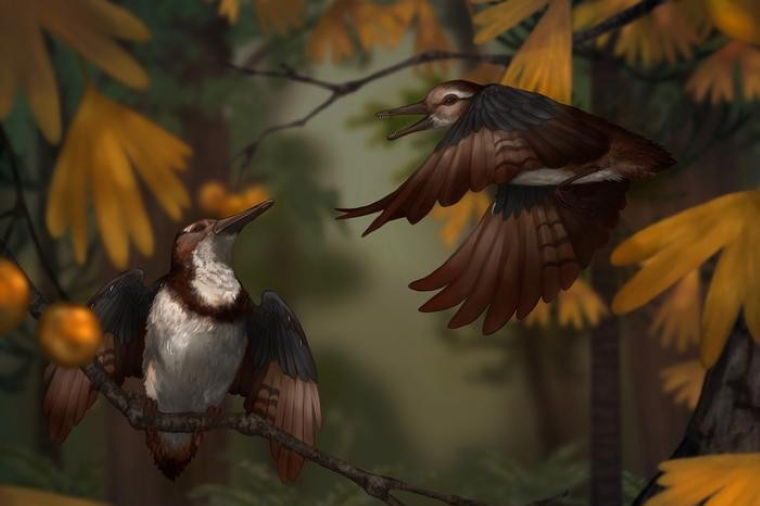
Researchers from the Chicago Field Museum have discovered a new species of bird-like dinosaur that thrived during the Cretaceous and became extinct 66 million years ago. An examination of the fossilized remains also revealed that the ancient bird likely choked to death on hundreds of tiny stones.
Although the team has a health-related theory to explain the stones’ presence in the animal’s throat, they acknowledge that the precise reason may never be known.
According to Jingmai O’Connor, the associate curator of fossil reptiles at Chicago’s Field Museum and the project’s leader, as soon as she laid eyes on the approximately 120-million-year-old specimen, she knew she was likely looking at a previously undocumented species of winged dinosaur.
“There are thousands of bird fossils at the Shandong Tianyu Museum, but on my last trip to visit their collections, this one really jumped out at me,” O’Connor said. “I immediately knew it was a new species.”
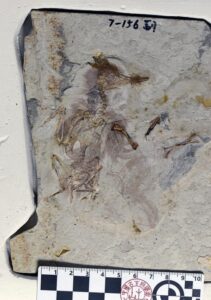 The unlucky fossil bird, preserved with over 800 tiny rocks in its throat (visible as the gray mass next to the left of its neck bones). Image Credit: Photo courtesy of Jingmai O’Connor.
When the researcher examined the specimen more closely, she found it shared several traits with a large fossil bird called Longipteryx. However, this species appeared to be much smaller, with the research team comparing it to the size of a modern sparrow.
“It had really big teeth at the end of its beak, just like Longipteryx, but it’s a tiny little guy,” O’Connor explained. “So based on that, I knew it was something new.”
Because O’Connor is a fan of the bad Chromeo, she named her discovery Chromeornis. Still, while the researcher was excited to have found a new species of extinct dinosaur, close-up examination of the specimen also presented the researchers with a mystery. Lodged in the creature’s throat were what appeared to be hundreds of tiny stones.
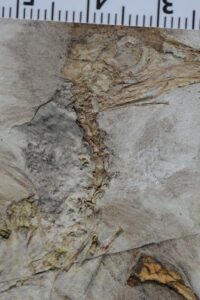 Close-up of the mass of rocks in the throat of Chromeornis (the rocks are the gray mass just to the left of the neck bones). Image Credit: Courtesy of Jingmai O’Connor.
“I noticed that it had this really weird mass of stones in its esophagus, right up against the neck bones,” O’Connor explained. “This is really weird, because in all of the fossils that I know of, no one has ever found a mass of stones inside the throat of an animal.”
Due to their location and overall chemical composition, the researcher soon realized that the newly discovered dinosaur must have swallowed the stones while still alive, rather than the rocks simply washing up near its body. Because some birds are known to swallow tiny rocks and store them in a muscular stomach called a gizzard to aid digestion, the team decided to test whether these were gizzard stones. This included comparing the size, composition, and location of ancient dinosaur-bird fossils containing gizzard stones to those in the newly identified fossil’s throat.
“We had quantified the average volume of the stones, the number of stones that these other fossil birds had in their gizzards, the size of the gizzard stone mass compared to the total size of the bird,” says O’Connor. “We CT-scanned this new fossil so we could compare it to these other birds with gizzards.”
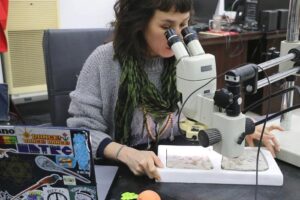 Paleontologist Jingmai O’Connor examines Chromeornis under a microscope. Image Credit: Courtesy of Jingmai O’Connor.
According to the team’s statement, those tests revealed over 800 stones in the deceased animal’s throat. O’Connor said that it is “more than we would have expected” in birds known to have gizzard stones. The density of the stones also seemed inconsistent with gizzard stones, with O’Connor noting that some of the tiny stones weren’t actually stones, but instead “seemed to be more like tiny clay balls.”
After considering all the evidence as a whole, the researcher said her team could “very clearly say that these stones weren’t swallowed to help the bird crush its food.” Although the team cannot immediately conclude why the ancient, winged creature swallowed so many stones, O’Connor suggested that the extinct animal may have been ill.
“When birds are sick, they start doing weird things,” she explained. “So, we put forth a tentative hypothesis that this was a sick bird that was eating stones because it was sick.”
If correct, O’Connor suggests that the sick animal swallowed too many stones. When it tried to regurgitate them “as one big mass,” they became stuck in the esophagus, and the unfortunate creature suffocated. Whatever the reason they were swallowed in the first place, the researchers believe that the attempt to regurgitate the stones was likely what caused the dinosaur’s death.

“It’s pretty rare to be able to know what caused the death of a specific individual in the fossil record,” says O’Connor. “But even though we don’t know why this bird ate all those stones, I’m fairly certain that regurgitation of that mass caused it to choke, and that’s what killed that little bird.”
Along with identifying a new species and solving a mysterious, 120-million-year-old death, O’Connor said her team’s findings can have implications for conservation efforts to protect at-risk species still alive today especially when one considers that these birds were the most successful of their time yet failed to survive the mass extinction event that killed off all the dinosaurs except those that survived and became modern birds.
“During that environmental disaster, the enantiornithines went from being the most successful group of birds to being wiped out,” O’Connor explained. “Understanding why they were successful but also why they were vulnerable can help us predict the course of the mass extinction we’re in now.”
“Learning about Chromeornis and other birds that went extinct could ultimately help guide conservation efforts today,” she added.
The study “A new small-bodied longipterygid (Aves: Enantiornithes) from the Aptian Jiufotang Formation preserving unusual gastroliths” was published in Palaeontologica Electronica.
Christopher Plain is a Science Fiction and Fantasy novelist and Head Science Writer at The Debrief. Follow and connect with him on X, learn about his books at plainfiction.com, or email him directly at christopher@thedebrief.org.