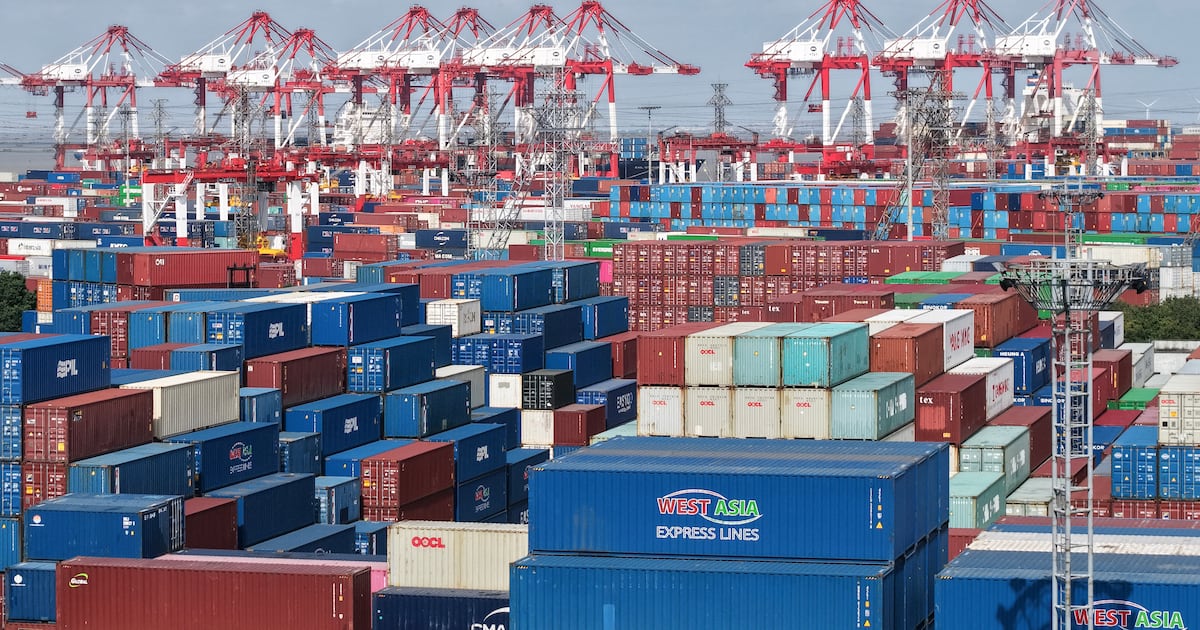
China’s trade surplus has topped €1 trillion (€860 billion) for the first time, as a sharp drop in exports to the United States was more than made up for by increased sales to the European Union (EU) and other parts of the world.
Exports in November rose by 5.9 per cent compared to a year earlier, while imports increased by just 1.9 per cent, although exports to the US fell by a large 29 per cent.
The figures will increase pressure on the European Commission to take action to protect the EU’s industrial base from Chinese imported goods, which rose by almost 15 per cent in November compared to a year earlier.
French president Emmanuel Macron said on Sunday that he warned Chinese president Xi Jinping during a visit to China last week that Europe would have to take urgent action if what he described as the “unbearable” trade imbalance was not addressed.
“I told them that if they didn’t react, we Europeans would be forced, in the very near future, to take strong measures and withdraw from co-operation, like the United States, such as imposing tariffs on Chinese products,” Macron told the French business daily Les Echos.
“China is hitting the heart of the European industrial and innovation model.”
The commission sets trade policy for the EU member-states and officials in Brussels are considering setting “made in Europe” targets of up to 70 per cent of the value of some goods.
[ Fresh push for US tariff exemptions on whiskey and medtechOpens in new window ]
The EU has already launched investigations into Chinese electric vehicles on the basis that companies gained an unfair advantage because of China’s industrial policy.
The Chinese yuan has fallen by about 10 per cent against the euro so far this year, making imports from China to the EU even more competitive on price. China now accounts for about 15 per cent of global goods exports.
The politburo, which is the top leadership body of the Chinese Communist Party, promised on Monday to “keep domestic demand as the main driver” of the economy.
But the country’s unexpectedly strong export performance means that it should reach its economic growth target of around 5 per cent this year without introducing major new stimulus measures.
Beijing’s stimulus measures have so far been more modest than many western economists and analysts believe are needed to rebalance the economy towards domestic demand. But as exports to the EU, Africa, South-East Asia and Latin America have surged in recent months, China faces the threat of protectionist measures in a number of markets.
The average US tariff on Chinese goods is 47.5 per cent, even after US President Donald Trump agreed to reduce it following a meeting with Xi in South Korea last month. Beijing and Washington are negotiating a broad-based agreement covering export controls on rare earth minerals and semiconductors as well as tariff rates.