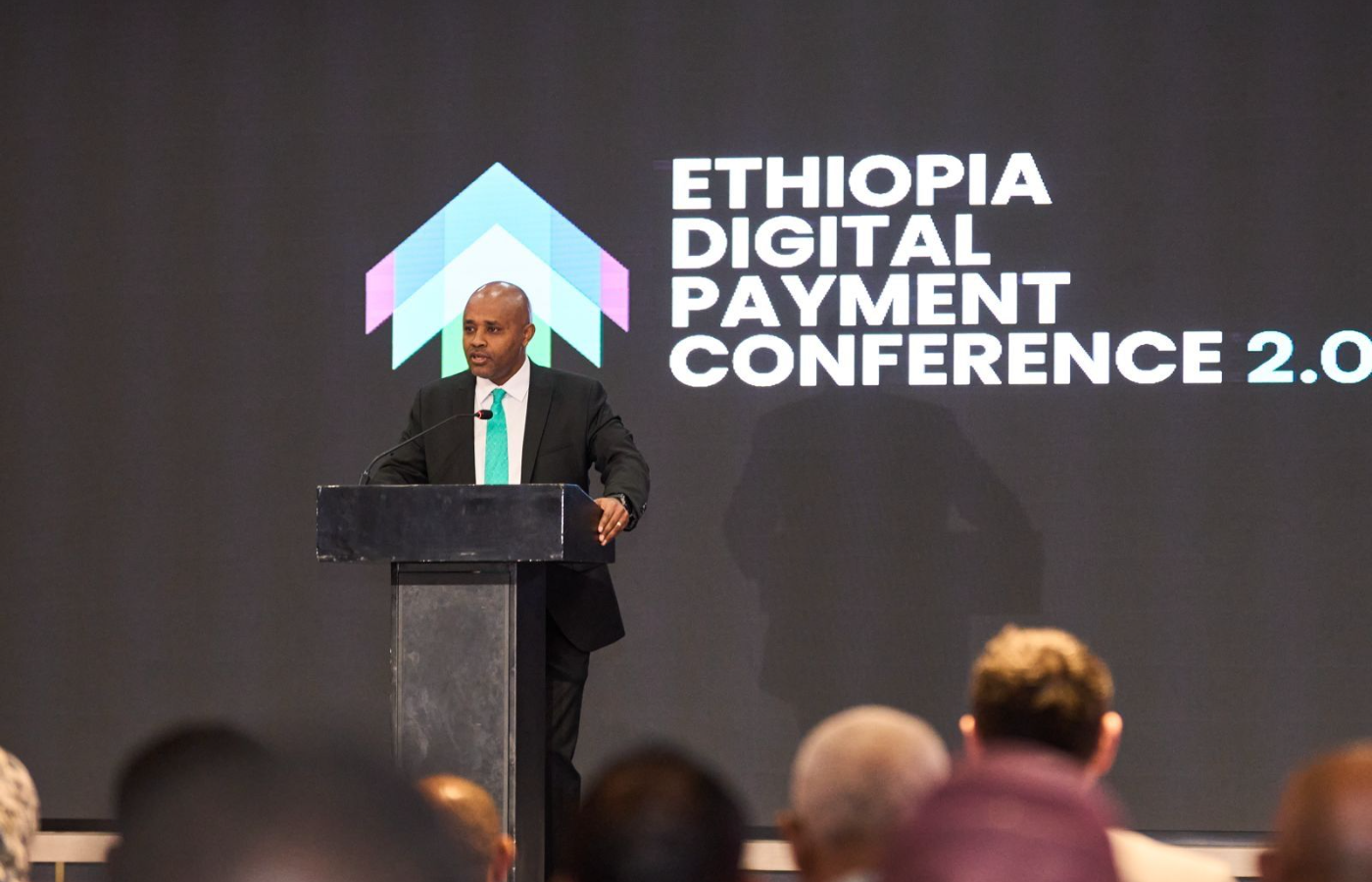
The National Bank of Ethiopia (NBE) has unveiled the draft National Digital Payments Strategy 2026–2030, setting a target to increase the value of digital payments from 82 percent of GDP in 2024 to 750 percent by 2030.
The announcement was made at the Ethiopia Digital Payment Conference in Addis Ababa, attended by Deputy Prime Minister Temesgen Tiruneh, NBE governor Eyob Tekalign (PhD), Minister of Planning and Development Fitsum Assefa (PhD), Wamkele Mene, the secretary general of the African Continental Free Trade Area, and senior officials from government institutions and the private sector.
During his opening remarks, Governor Eyob Tekalign (PhD) said digital transactions had grown from one million in 2022 to a total of 128 million by 2025. He added that gaps and challenges persisted under the previous strategy, noting that twenty-one percent of adults were unable to receive payments digitally and that many women lacked access to mobile phones. He highlighted limited adoption in rural communities, low merchant acceptance, and challenges in cybersecurity and fraud. “It’s with this amidst we’re presenting the draft strategy,” he told participants. He added that the strategy is aligned with ISO 2022 cybersecurity management system standards to foster trust among consumers.
The draft strategy outlines six phases to strengthen Ethiopia’s digital payments ecosystem. A centralised data-exchange platform is to be established by 2030 to enable interoperability across banks, mobile wallets, and merchant systems, while reducing duplication and improving efficiency in service delivery.
The plan sets quantitative goals for inclusion. The rural-urban divide in digital-payment usage is targeted to fall to eight percentage points or less, while the gender gap is expected to narrow to below three percentage points.
Transaction volumes are also a focus. Ethiopia recorded fifty-four digital transactions per adult in 2025, up from sixteen in 2023. The strategy projects two hundred seventy-five transactions per adult annually by 2030, reflecting expected growth moderation as adoption matures.
Other objectives include raising the thirty-day active-use rate for transactional accounts from sixteen percent to sixty percent, and increasing merchant-payment participation from twenty-four percent to sixty percent by 2030, based on regional benchmarks.
The draft further prioritises human-capacity development to reduce literacy and digital-skills barriers and introduces standardised fraud detection and reporting protocols with a ninety percent compliance target.
Digital financial products are targeted for expansion. Credit, savings, and insurance currently represent less than one percent of digital transaction value; the strategy sets a 2030 target of three percent. E-commerce transactions facilitated by the digital payments ecosystem are projected to reach four percent of total digital transactions.