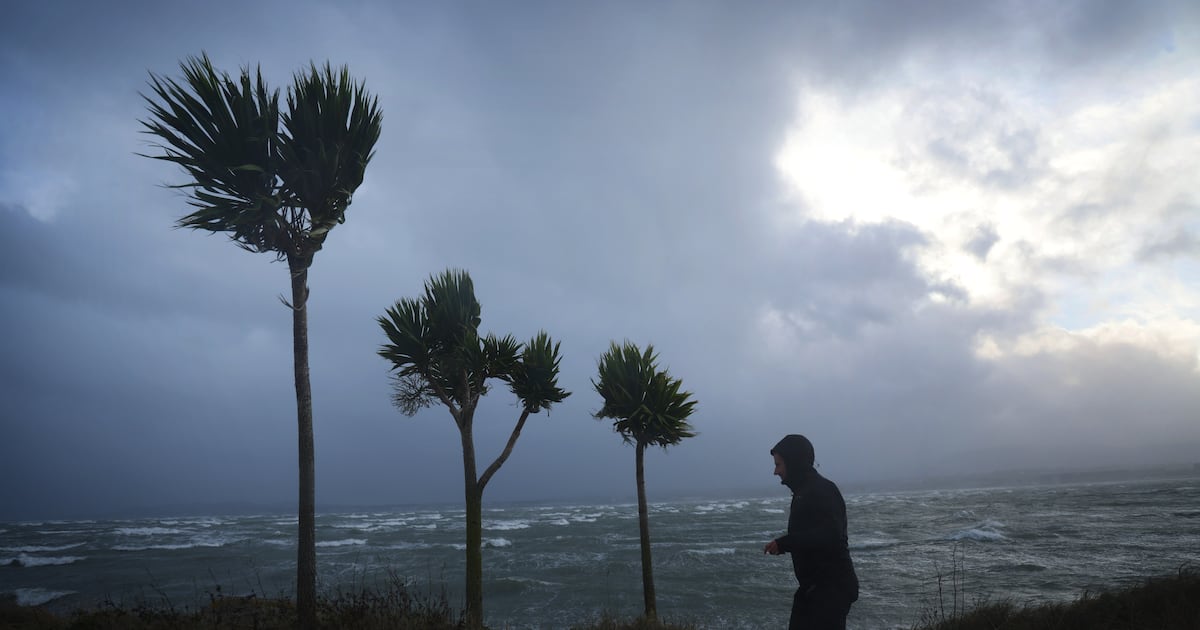
Met Éireann has said a temperature of 17.2 degrees was recorded at its weather station in Dublin’s Phoenix Park during Storm Bram.
The temperature, which is subject to verification, was the highest December level recorded at the weather station since December 7th, 2016, when a figure of 16 degrees was noted.
The highest verified temperature recorded in Ireland in December is 18.1 degrees which was noted at Dublin’s Peamount weather station on December 2nd in 1948.
Met Éireann meteorologist Matthew Martin said the high temperature in the Phoenix Park was associated with Storm Bram, which drew warm and moist air north from the Azores.
Mr Martin said the high temperature could have been caused by a weather phenomenon known as the Foehn, or Föhn, effect.
This effect is where air is forced up and over a mountain, in this case the Dublin and Wicklow mountains. As it rises, it cools and drops its moisture on the windward side, before descending the leeward side – in this case the Dublin side – becoming compressed and creating rapid warming.
Mr Martin said a spell of sunshine in the Dublin area could also have contributed to the rapid warming of the air temperature.
Met Éireann has also issued a new weather warning for strong and gusty southerly winds mainly affecting coastal parts of Galway, Mayo and Kerry, for Thursday morning from midnight to 7am.
The forecaster said potential impacts include debris, displaced loose objects, some fallen trees and branches, and difficult travelling conditions
Meanwhile, ESB Networks said 8,000 homes, farms and businesses remain without power as public transport returns to normal following Storm Bram.
The worst of the power outages occurred in counties Wexford, Wicklow, Dublin, Laois, Kilkenny, Offaly and Tipperary.
Graeme McQueen, a spokesman for Dublin Airport, said more than 100 flights had been cancelled. A further 20 flights were temporarily diverted to other airports.
Just one flight was cancelled at Ireland West Airport at Knock, Co Mayo, as the storm was focused on the south and east of the island.
There was also flooding in coastal towns and villages from Blackrock, Co Louth, to Clontarf promenade in Co Dublin to Tramore and Dungarvan in Co Waterford and the Cork City quays.
Most of the flooding was in coastal areas at times of high tides as wind speeds rose, particularly in the southeast of the island, moving northwest as the day progressed.
Sherkin Island, off the coast of Cork, registered the highest wind speed on Tuesday at 119km/h.
Roches Point registered 117km/h, as did Malin Head, while Cork airport had wind speeds of up to 100km/h, according to Met Éireann.
The Department of Education said about 70 schools closed their doors on Tuesday due to the status orange and yellow wind warnings that affected the entire country. Most of these schools were in western coastal areas.
Irish Rail confirmed disruption across its network, including the suspension of services between Greystones and Wicklow town from about 3pm on Tuesday due to flooding. In Dublin, a tree blocked the line and damaged overhead wires between Grand Canal Dock and Lansdowne, affecting operations. Both lines reopened on Tuesday night.
There were widespread reports of trees falling and minor road closures. The Road Safety Authority advised drivers to proceed only with all possible care. In Dublin, a tree fell across the bus lane of the N11 dual carriageway at Stillorgan.
A marine weather warning remains in place for coastal waters from Mizen Head to Slyne Head to Fair Head, and intending ferry passengers on the Irish Sea have been advised to check with their ferry operator for the latest information and details regarding alternative sailings.