For decades, doctors had wanted to offer health services over the phone – telehealth – but it took a global pandemic before it finally happened.
Being able to provide Medicare-funded services via video or phone calls, rather than in person, was incredibly helpful during a time of crisis. Years later, medical clinics continue to provide easier access to doctors and nurses through online platforms.
In Australia, the purpose of telehealth is to enhance patients’ access to ongoing care from healthcare professionals they have previously consulted with, without requiring in-person visits.
Most medical clinics and public hospitals offer telehealth consultations, and this is especially important for people living in rural and remote areas of Australia where little or no access to healthcare was previously available.
Improving accessibility to your own usual doctor has been a major benefit of telehealth, but at the same time we’ve also seen the rise of online clinics providing medical certificates, targeted prescriptions or even the delivery of medication to your doorstep after just a few clicks on a questionnaire.
While virtual appointments can be more convenient than in-person consultations, they also carry certain risks. Doctors are trained to observe our patients carefully, but this is difficult to achieve through video or phone calls.
For instance, when you visit a clinic, your consultation begins the moment your doctor sees you in the waiting room. We watch how you get up from your chair and move down the corridor, noting any limp, muscle weakness, tremors or signs of pain.
Subtle changes – such as a change in weight, skin colour, facial expression and even the smell of your breath – can provide vital clues about your health. Many of these assessments have already occurred before you’ve even sat down in your doctor’s office.

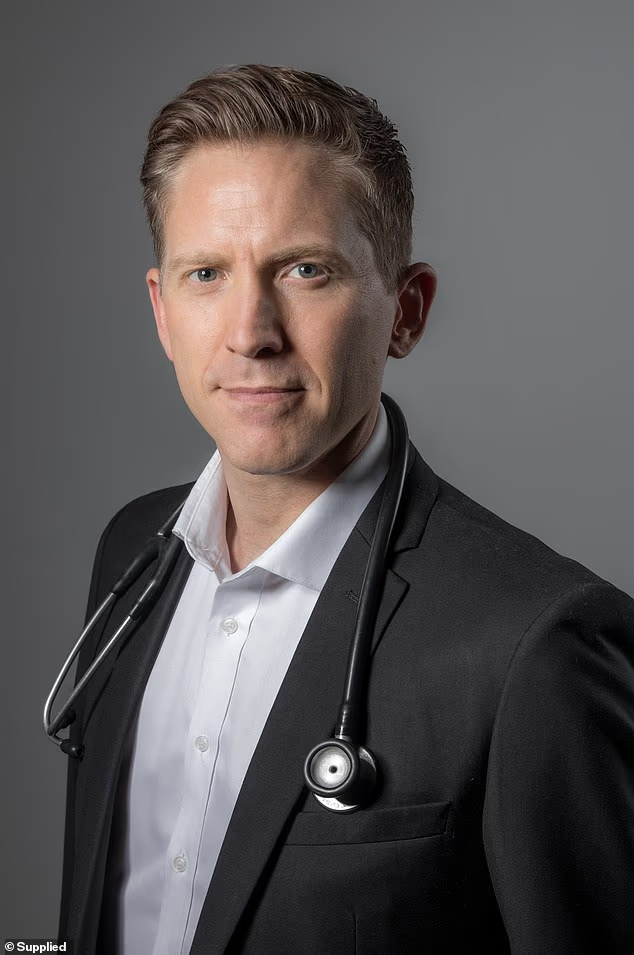
Telehealth appointments and online doctors can be convenient, but Dr Brad McKay says an in-person assessment is always the best option if you’re unwell or curious about new medication
In contrast, virtual consultations present challenges for doctors. We can’t perform physical exams, check your heart rate, listen to your lungs, test your reflexes or smell your breath.
While video calls might allow us to see your facial expressions, we might not be able to tell if you look pale or jaundiced through the pixelated screen – and phone consultations are even more limited.
It’s easy to miss important clues while using telehealth, especially if the doctor isn’t familiar with you or does not know your medical history.
I’m a big advocate for telehealth appointments, but only when they’re used appropriately. As an experienced GP, I understand both my limitations and the limitations of telehealth consults.
When something doesn’t seem right or if questions remain unanswered, I’m comfortable asking my patients to come in for an in-person assessment. If that’s not possible, I refer them to a nearby medical clinic for a thorough physical examination. I’m cautious to prioritise patient safety and appropriate medical care over the convenience of telehealth.
Some online clinics offer niche health services for patients, including treatment for erectile dysfunction, hair loss, weight reduction and testosterone therapy. They often claim convenience and confidentiality as benefits, but charge a premium for being the middleman for a prescription. You avoid these costs simply by going directly to a GP.
I’ve also seen many distressed patients from online clinics seeking urgent help when things haven’t worked out as planned. Whether it’s the wrong medical advice, medication prescribed inappropriately, side effects, or charging exorbitant fees, it always takes time, patience, and sometimes even more expense, to fix problems that weren’t there at the start.
Crucially, it’s also difficult for patients to follow up with their online clinic, particularly if the clinic doesn’t answer phone calls, ignores emails or mysteriously disappears overnight.

The rise of telehealth services and online GPs has spawned specialised companies that facilitate prescriptions for weight loss jabs, ED pills and hair-loss solutions (stock image)
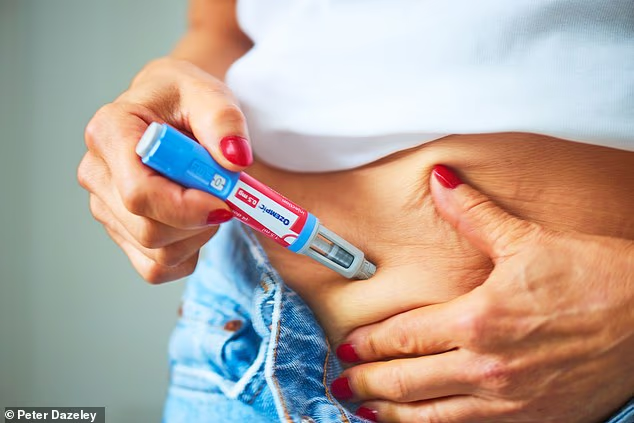
Online doctors often claim convenience and confidentiality as benefits, but charge a premium for being the middleman for a prescription. You avoid these costs simply by going direct to a GP
In many ways, telehealth services have quickly become an important option for many Australians, particularly for people living in remote areas. But if you’re given the option of a virtual doctor’s appointment or a face-to-face consultation, it’s generally better to see your doctor in person.
Why it’s important to have a regular GP
When anyone walks into a GP clinic, their doctor aims to take a holistic approach. We strive to understand all aspects of their health: the medications, vitamins or supplements taken, who prescribed them, and any side effects experienced.
We also need their complete medical history and any relevant health issues faced by their family. With this full picture, we can make an accurate diagnosis and create an effective and individualised management plan.
But when patients frequently switch from one doctor to another, it’s hard to keep track of their medical history. Pathology results, imaging reports and medical records are hard to find.
The best medical decisions are made when doctors have access to comprehensive and accurate information. That’s why it’s so important to have a single doctor who manages all your medical records in one place.
Building a long-term therapeutic relationship with your GP is crucial to having good health. This continuity allows your doctor to develop a complete understanding of your health and recognise subtle changes early on.
We can provide preventive care at the right stages of your life and diagnose new medical issues faster than when you see a doctor for the first time.
Medical records accumulate over time, and your GP is able to note down which medications have been tried and what side effects have occurred in the past. This way, patients can avoid going around in circles, retrying treatments that have already failed them in the past.
Like many aspects of life, consistency is key – and it’s certainly the case with your health.
Telehealth appointments and managing weight loss
The rise of online clinics has seen a number of weight loss telehealth services pop up around the country. After completing an online form, advising the clinic of your height and weight, and having a quick consultation with a doctor, you can have medication posted directly to your letterbox.
You’re given simple instructions on how to inject the drug yourself, and you’re apparently on your way to a thinner body.
Although it’s admirable to provide some people with access to potentially life-saving medication, as a general practitioner who provides holistic healthcare, I find this type of online clinic tends to fragment continuity of care.
If everything works according to plan, then there are no problems.
But the human body is complicated, and medication effects can be unexpected and tumultuous.
Recently, the Therapeutic Goods Administration (TGA) identified a potential association between GLP-1 receptor agonist medications and an increased risk of suicidal thoughts.
These medications are commonly prescribed to patients managing type 2 diabetes and for weight management. They include Ozempic and Wegovy (semaglutide), Saxenda (liraglutide), Trulicity (dulaglutide) and Mounjaro (tirzepatide).
While there’s not enough evidence to conclude that these drugs directly cause changes in mood and behaviour, patients should certainly tell their doctor if they are experiencing a lowered mood or an increase in suicidal thoughts.
But patients receiving medication from an online clinic may not have ongoing monitoring of their mental health as part of the service.
And if a patient attends their GP appointment with a low mood, they might not think to tell their doctor about the medication they accessed via an online clinic. This makes it more difficult to connect the dots.
Building a therapeutic relationship with your GP over time, and having your medical care delivered through the same clinic, can provide a full picture of your health, streamline your healthcare, and essentially help you live longer.
Are instant medical certificate sites legit?
Some online clinics offer medical certificates without an appointment. Pop in your details, tick a few boxes, and you’ll have a medical certificate sent to your email inbox within a few minutes.
The most generous perspective on medical certificates is that they were originally intended to encourage sick employees to consult with their doctor, undergo an examination, and receive an accurate diagnosis, ensuring they received proper care and an estimate of when they could return to work.
Conversely, a more cynical view is that they serve as an obstacle to discourage people from taking time off work.
While medical certificates issued by online clinics are valid, you could argue that they impose an unnecessary administrative burden while people are unwell, and contribute to a sense of distrust between employees and employers.
Should you trust medication from online clinics?
So, you’ve received medication in the mail from an online clinic but you don’t actually know what’s in it or where it’s come from.
There are quite a few safety concerns if you’ve bought oral tablets, but even more concerns if you’ve got some liquid to inject into yourself. Has it been made in a reputable lab in a sterile environment? Has it been stored at the right temperature? Is the medication actually the same as what’s on the label?
There are many stories around the country from people buying medication online, only to find out it’s been created in a filthy home kitchen. It’s okay to take a few calculated risks in life, but I’d suggest that self-injecting an unidentified fluid is not one of them.
Seeing a doctor at a physical clinic and purchasing medication from a reputable pharmacy provides much more reassurance than buying online.
The TGA works tirelessly to keep the public safe from dodgy clinics and unreliable medication. However, it’s a giant game of whack-a-mole – once one clinic is closed down, another one pops up.
What does the future of healthcare look like?
For all its benefits and flaws, telehealth medicine is here to stay. But our healthcare system needs to keep up with patient demand and new technology.
While the rest of the world has embraced artificial intelligence, Australian clinics still rely on fax machines.
Our government promised a health information utopia through the introduction of myHealthRecord (myHR). Unfortunately, years later, myHR continues to be an information wasteland, occupied by digital tumbleweeds instead of useful data.
Pathology results, imaging reports, past medical history, hospital discharge summaries and medication lists should all be uploaded to a central access point, but the rollout process has been slower than expected.
Medical receptionists are still required to hunt down previous clinics our patients have visited and fax off requests for critical information. This is time-consuming and labour-intensive, especially when trying to teach a young receptionist how to use a fax machine.
The government is encouraging public hospitals, pathology labs and medical imaging services to upload information onto their patients’ myHR, but it’s been a slow and highly resistant process. We’ll get there one day!
Telehealth has its place, but face-to-face consults will continue to be the gold standard for the foreseeable future.
We’re hopefully not too far off from confidently and confidentially using AI to optimise and personalise healthcare. AI also shows significant potential for improving medical research and streamlining pathways through health services. Unfortunately, our back-up communication method will continue to be the humble fax machine.
Dr Brad McKay is a medical practitioner, author, TV host and media commentator. This article contains general information only and is not a substitute for medical advice. Always consult your doctor for guidance tailored to you.