
A $10 trillion valuation will require a ton of growth.
Nvidia (NVDA +0.50%) is the only company to reach the $5 trillion valuation threshold, but it has pulled back from that level. Other companies like Apple, Alphabet, and Microsoft are worth around $4 trillion right now. Those are the primary candidates investors should look for when searching for the first company that will be worth $10 trillion.
I think there’s really only one candidate in this cohort that will be the first $10 trillion company, and it may reach that threshold quicker than many investors realize.

Image source: Getty Images.
Growth is the only catalyst to drive these companies to a $10 trillion valuation
While companies can get inflated valuations to drive their market cap higher, it can only take a stock so far. What’s required to reach the $10 trillion threshold is serious growth, and only one of these stocks has it.
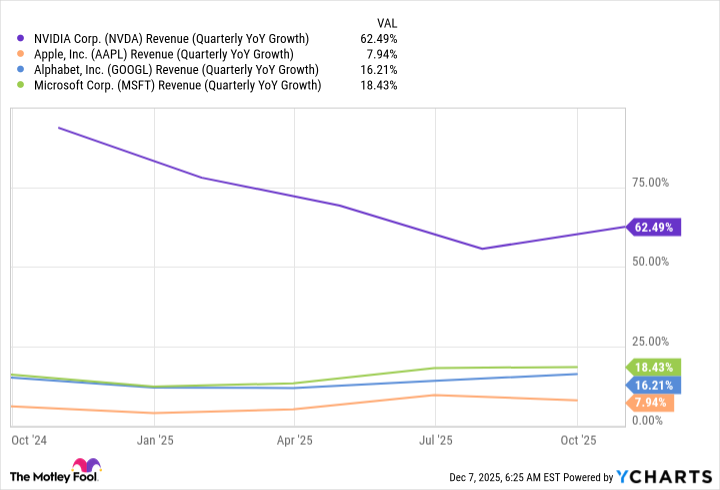
NVDA Revenue (Quarterly YoY Growth) data by YCharts
While Microsoft and Alphabet are putting up impressive growth figures, it’s nothing compared to what Nvidia has delivered. Furthermore, Nvidia is expected to keep these elevated growth rates up for some time. As a result, Nvidia is really the only option in this group to reach the $10 trillion valuation point in a short time frame.
But what will it require?
The pace of AI capital expenditures
Nvidia’s CEO Jensen Huang made some bold predictions regarding the direction of data center capital expenditures over the next few years. By 2030, he expects global data center capital expenditures to reach $3 trillion to $4 trillion, up from $600 billion in 2025. While that may sound outlandish, other projections back up Nvidia.
One of Nvidia’s biggest rivals is AMD. It expects a $1 trillion compute market by 2030. While those two sound like contradicting projections, they’re not. Nvidia’s projection includes total data center capital expenditures, while AMD’s is just compute. This means that AMD and Nvidia’s projections are fairly close to each other, and I think investors should trust them.

Today’s Change
(0.50%) $0.90
Current Price
$181.83
Key Data Points
Market Cap
$4397B
Day’s Range
$181.00 – $182.18
52wk Range
$86.62 – $212.19
Volume
261K
Avg Vol
190M
Gross Margin
70.05%
Dividend Yield
0.02%
AMD and Nvidia have more information than the average investor. Nvidia told investors during its third quarter results that it was “sold out” of cloud GPUs. This means that any company wanting to get their hands on Nvidia’s graphics processing units (GPUs) must be placing orders years in advance. While I doubt they have orders for 2030, it’s likely that orders for 2027 to 2028 are trickling in. If language from its largest clients suggests that this still won’t be enough computing power, Nvidia can make this bold projection for the future.
Should the 2030 global data center capital expenditures total $3 trillion, Nvidia could generate $1 trillion in revenue. Wall Street analysts estimate that Nvidia’s revenue this year will total $213 billion. So, Nvidia would receive about 36% of total spending if its $600 billion estimate this year is correct. If Nvidia can maintain its current 50% profit margin and be valued at 25 times earnings, Nvidia’s stock would have a market cap of $12.5 billion.
That’s well above the $10 billion threshold we’ve established, which means Nvidia could hit the $10 trillion valuation point sometime in 2029. Obviously, that requires incredible data center capital expenditure growth, and its biggest clients must continue their spending habits. If they do, then I think the $10 trillion mark is attainable. If they don’t, then Nvidia could be in trouble, as nearly all of its revenue, $51.2 billion of $57 billion in Q3, comes from data center computing hardware.
Personally, I think this spending will continue, but shareholders demanding an immediate return on investments from the AI hypescalers may have different opinions.
Keithen Drury has positions in Alphabet and Nvidia. The Motley Fool has positions in and recommends Advanced Micro Devices, Alphabet, Apple, Microsoft, and Nvidia. The Motley Fool recommends the following options: long January 2026 $395 calls on Microsoft and short January 2026 $405 calls on Microsoft. The Motley Fool has a disclosure policy.