European Union states have agreed to use emergency powers to bypass Hungarian far-right prime minister Viktor Orban’s ability to veto the renewal of economic sanctions on Russia. The move is a key step in a plan to use Russian state cash frozen in Europe to fund a loan to Ukraine.
The EU’s sweeping regime of sanctions targeting Russia has to be renewed every six months. It creates persistent tensions in Brussels between Hungary and most other governments over Mr Orban’s repeated threats to block the continuation of the sanctions.
On each occasion Mr Orban has backed down, but not before Hungarian diplomats sought to extract concessions elsewhere in exchange for extending the economic sanctions, which are intended to hamper Moscow’s ability to wage war in Ukraine.
Firming up the stability of the sanctions is seen as crucial to a contentious plan to use €200 billion of Russian state assets, frozen in Europe, to finance a loan for Ukraine.
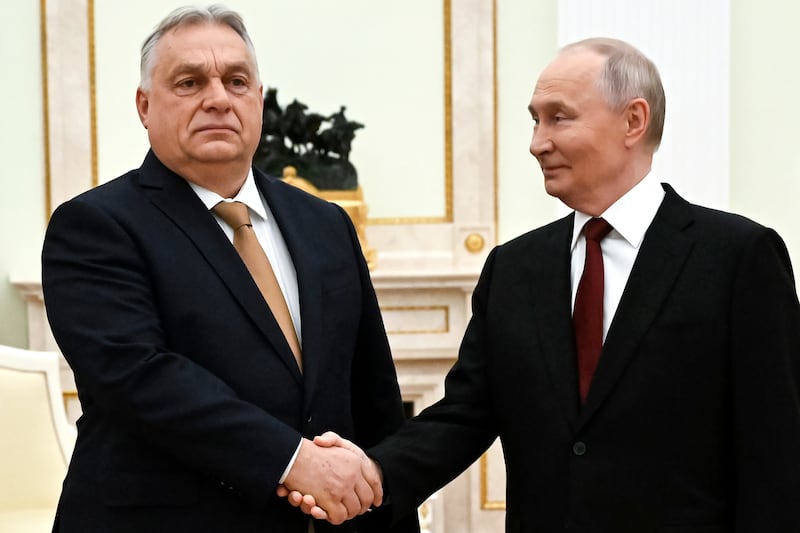 Hungarian prime minister Viktor Orban with Russian president Vladimir Putin (right). Photograph: Alexander Nemenov/AP
EU states on Friday approved the use of emergency powers to override Hungary’s veto, and change how the sanctions are approved in future. The sanctions will only require a sizeable majority of member states, rather than the support of all 27.
“I think it’s good that we found a legal way to stop the six-monthly kerfuffle,” a diplomat from one EU state said.
The changes only apply to sanctions keeping Russian central bank assets “frozen” and not other measures targeting Russian industries or individuals with ties to Russian leader Vladimir Putin’s regime.
European leaders have put a lot of stock in a complex plan to use Russian state assets to help Ukraine. The EU hopes to use sanctioned Russian central bank bonds trapped in Europe to fund a €90 billion loan to finance Ukraine’s efforts on the battlefield.
[ Ukraine could join EU next year under draft peace planOpens in new window ]
The assets were in Euroclear, a Belgian securities depository that holds government bonds, when they were immobilised by EU sanctions following Russia’s 2022 full-scale invasion of Ukraine.
The proposal to use the assets to finance a loan for Ukraine has infuriated Moscow.
The money would only be repaid to Russia if it agreed to compensate Ukraine for damage caused by the war.
The Belgian government has withheld its support for the so-called “reparations” loan, fearing it will face possible Russian retaliation and costly legal challenges. Belgian officials are concerned the plan could worry other countries and entities who have financial assets invested in Belgium.
Negotiations are continuing behind the scenes to get Belgium to buy into the loan plan, with a decision expected at a summit of EU leaders in Brussels on Thursday.
Russia’s central bank has filed a legal case in Moscow seeking damages from Euroclear over the freezing of its assets, the Financial Times has reported.
Europeans allies are concerned Ukraine will run short of money in the coming months. The loan idea would shore up Ukraine’s finances for at least two years.
The changes to the way the EU renews sanctions on Russia was criticised by Mr Orban as an “unlawful” circumvention of the requirement to take foreign policy decisions by unanimous agreement.
Slovakia’s populist prime minister Robert Fico said he will not support any proposal that involves “covering Ukraine’s military expenses”.
Mr Fico, who has been a consistent opponent of EU support to Kyiv, said using the sanctioned Russian assets could “directly jeopardise” US efforts to broker a peace.
The loan would require the backing of a large majority of EU leaders. It is unlikely the plan could go ahead without the approval of Belgium.
The Financial Times has also reported that Ukraine could join the EU by January 1st, 2027, under proposals being discussed in US-mediated talks on ending the war.
Talks on EU accession, a long-held goal for Kyiv as it seeks to move further out of Moscow’s orbit, usually take many years.
A European diplomat briefed on the plan said Ukrainian accession would be “extremely difficult” to achieve by 2027 and that it was not clear whether the EU leadership backed this.
Several other European officials and diplomats said the target date was “absolutely impossible.” – Additional reporting Reuters