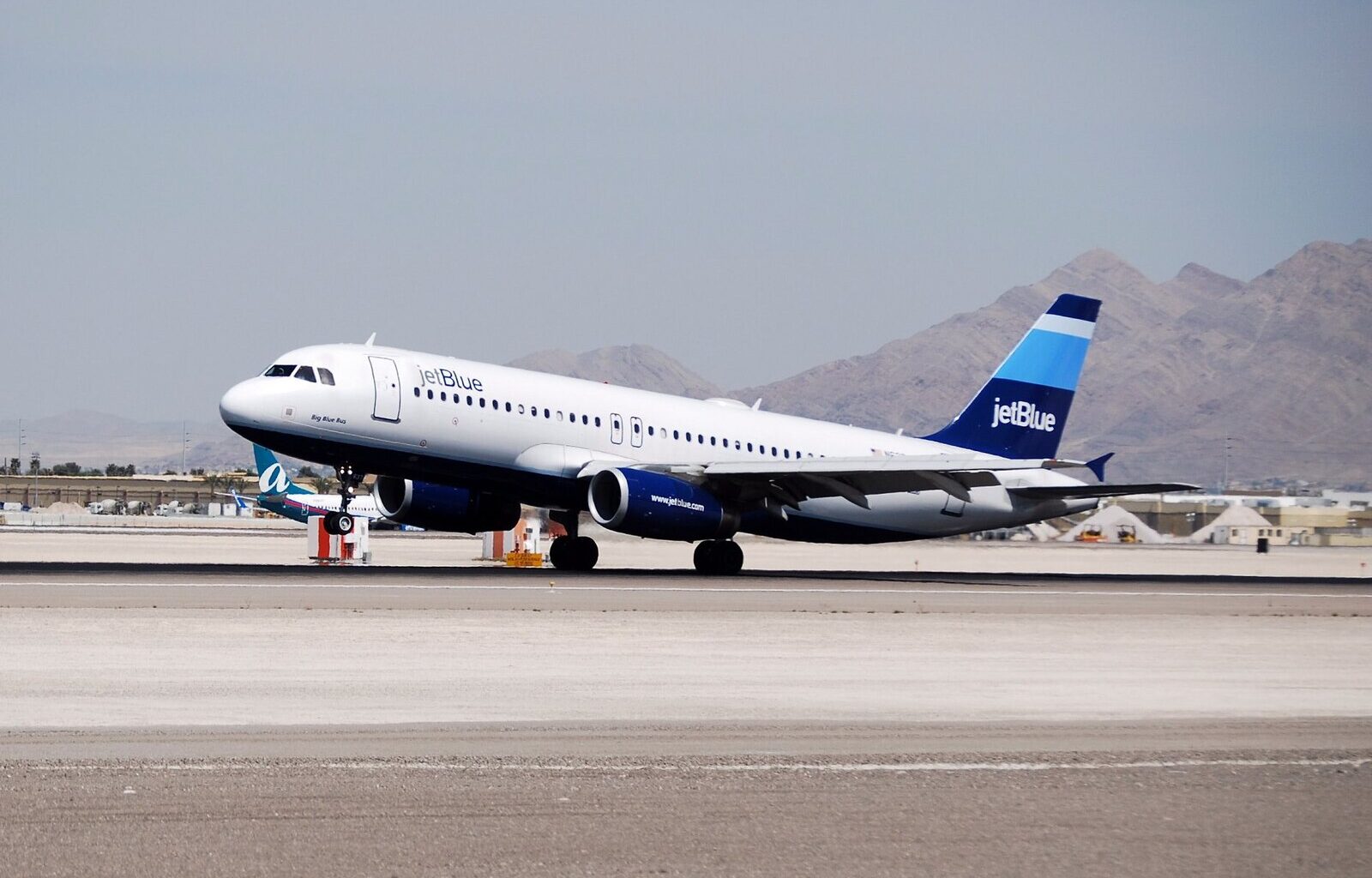
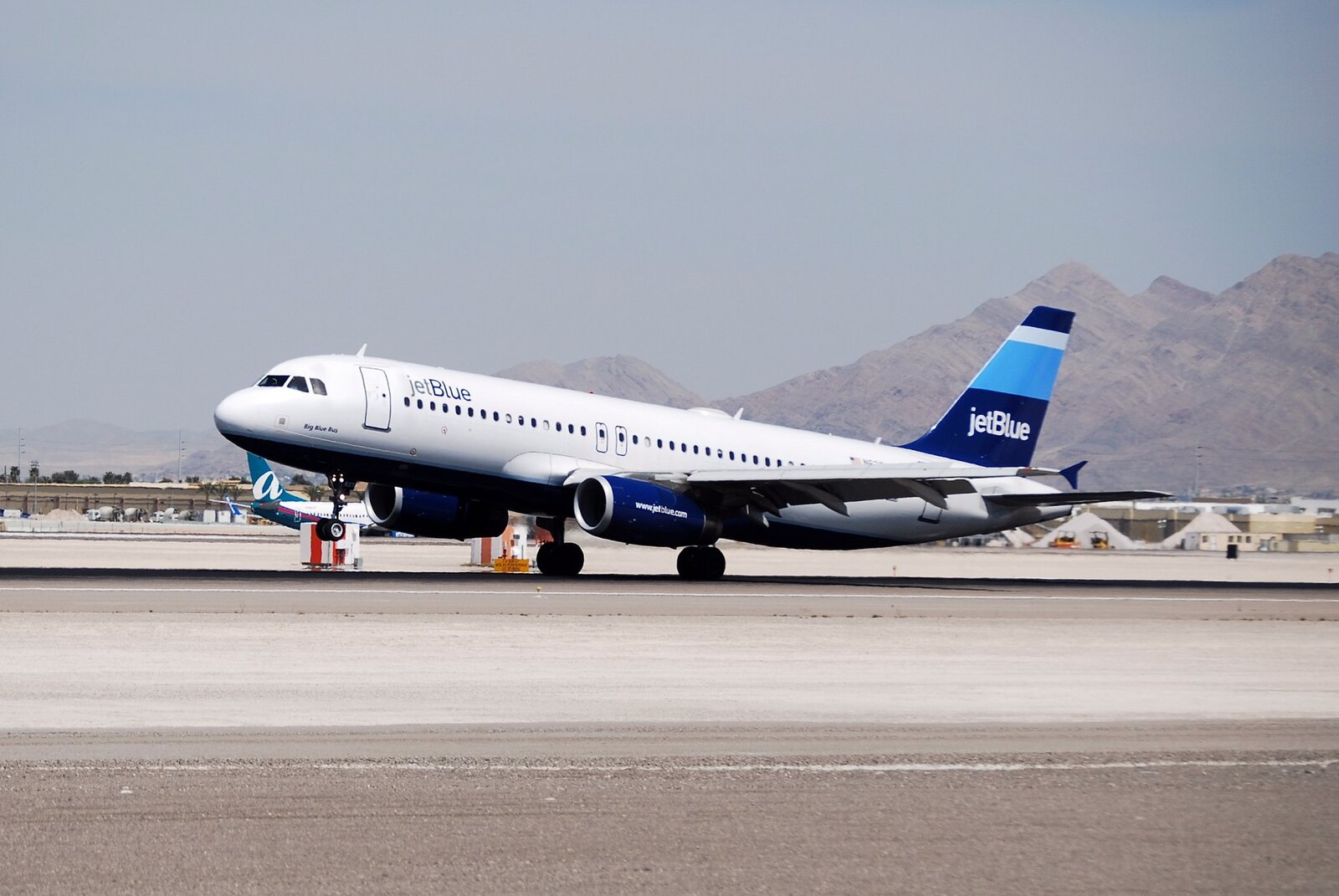
A JetBlue Airbus A320 takes off in Las Vegas. The airline’s flight 1230 became the center of an investigation in October 2025 after a suspected solar radiation glitch caused a sudden, uncommanded drop in altitude. Credit: Eddie Maloney from North Las Vegas, USA, CC BY-SA 2.0, via Wikimedia Commons
- European regulators issued an Emergency Airworthiness Directive grounding specific Airbus A319, A320, and A321 aircraft after an “uncommanded and limited pitch down” incident on a JetBlue flight, where a malfunction in the Elevator Aileron Computer (ELAC) was identified as a probable factor attributed by Airbus to intense solar radiation.
- The vulnerability of aircraft electronics, specifically modern, smaller microchips, arises from high-energy radiation particles causing “single-event upsets” or bit flips, a risk amplified at aviation altitudes due to reduced atmospheric shielding.
- Despite the implementation of mitigation strategies such as dissimilar redundancy and voting logic across multiple independent flight control computers, these systems are not entirely impervious to radiation-induced glitches, as evidenced by past events and the current ELAC unit susceptibility.
- Ongoing scientific investigation questions whether solar radiation was the direct cause of the JetBlue incident, noting normal solar conditions on the event date and suggesting galactic cosmic rays as an alternative culprit, thereby underscoring the broader susceptibility of critical modern infrastructure to space weather, particularly during the current solar maximum.
Last month, European regulators grounded thousands of Airbus jetliners, citing an unusual reason: solar radiation. The planes’ electronics, the manufacturer said, were vulnerable to the charged particles streaming from the Sun and into Earth’s atmosphere, which could cause a plane to lose control and, in a worst case scenario, subsequently break apart in midair.
The Nov. 28 order, known as an Emergency Airworthiness Directive, was issued by the European Union Aviation Safety Agency and required operators of specific Airbus A319, A320, and A321 aircraft to replace their onboard Elevator Aileron Computers (ELAC) — units responsible for controlling the aircraft’s pitch and roll.
The regulatory action followed an event on Oct. 30, 2025, involving a JetBlue flight traveling from Cancun, Mexico, to New Jersey. The aircraft suddenly lost altitude in what the directive called an “uncommanded and limited pitch down”. The directive notes that while the crew regained control, the loss of altitude did result in passenger injuries. According to reporting from CNN, 15 passengers were hospitalized.
A preliminary technical assessment by Airbus identified a malfunction in the ELAC unit as a probable contributing factor. In a press release, Airbus stated that “intense solar radiation may corrupt data critical to the functioning of flight controls.”
As a precautionary measure, Airbus advised operators to replace affected units with an older, serviceable version. For most of the fleet, this meant rolling back a recent software update. In a Dec. 1 update, the manufacturer confirmed that approximately 6,000 aircraft were potentially impacted by the issue. Airbus also reported that the “vast majority” had already received the necessary modifications, with fewer than 100 aircraft remaining to be fixed before returning to service.
Researchers say it’s still unclear whether the Sun was the culprit behind the JetBlue incident. But, they say, the incident highlights the very real potential for space radiation to corrupt computer data as it zips through microchips — something that satellites and airliners are designed to mitigate. It also highlights the potential impact that space weather can have on the infrastructure underpinning our modern world.
Flipping a bit
Airplane electronics are particularly susceptible to solar radiation because there is less atmospheric shielding at altitude than on the ground. This means it’s easier for radiation to pass through the microchips onboard an aircraft — like those in the A320’s ELAC — and cause problems.
Matthew Owens, a space physicist at the University of Reading, tells Astronomy, “In general, more modern aviation electronics are typically smaller and lighter than in the past. This makes it easier for particles to penetrate and cause issues.”
In a University of Reading press release following the EAD, Owens explained that when a high-energy radiation particle “passes through a microchip, it can flip a tiny ‘bit,’ the smallest unit of digital information in the microchip, stored as a 0 or a 1. This creates a glitch known as a single-event upset, which can make an electronic system behave in unexpected ways.” Owens added that we still don’t know whether this is what actually happened to the JetBlue flight, as investigations are ongoing.
Mitigation strategies
Engineers have spent decades designing systems to withstand bit flips from the invisible bombardment of radiation. Since the risk of radiation damage rises dramatically with altitude, both spacecraft and aircraft rely on layered defenses to ensure a single-event upset doesn’t lead to disaster. However, the battle is never fully won. High-energy particles can still find gaps in the armor.
Electronic components for spacecraft are exposed to far more radiation than aircraft. For that reason, they are radiation-hardened, meaning they are built to resist the effects of radiation. Components are designed with redundant circuits to ensure a single-event upset does not cause the whole system to fail. Materials are selected for their radiation resistance, and some components are subjected to “doping” — purposefully adding impurities in small amounts to increase radiation resistance. Electronics are also shielded from radiation in heavy, resistant materials like lead or tungsten.
Hardware alone isn’t enough. Software for critical systems often employ a strategy called triple modular redundancy, a voting logic where three separate computers process the same task simultaneously. If radiation corrupts one processor’s decision, the other two overrule it.
These mitigation strategies are complex and expensive, but they’re also not perfect. According to a study published in HotNets ‘23 led by Haoda Wang, a computer science PhD candidate at Columbia University, radiation has even put the most advanced Mars rover to date, Perseverance, out of service: “Anecdotally, a flight software error causing data loss on the Perseverance Mars rover has been traced to a radiation upset and has put a pause on multiple days of rover operations.”
Commercial aviation takes a slightly different approach to radiation mitigation. Because airliners are somewhat protected by Earth’s atmosphere, they rely less on physical shielding and more on software strategies and redundancy. This often involves “dissimilar redundancy,” where flight computers use different hardware and software architectures from different manufacturers to ensure a single-event upset doesn’t affect all systems simultaneously.
On the A320, this takes the form of multiple, independent flight control computers: two Elevator Aileron Computers (ELACs) and three Spoiler Elevator Computers (SECs). These units constantly cross-check each other’s calculations. If one computer generates a command that disagrees with the others, the system is designed to vote it out and ignore the erroneous data, ensuring the plane remains under control (similar to triple modular redundancy).
Even with these guardrails in place, accidents can still happen. In 2008, Qantas Flight 72 experienced a violent, uncommanded nose-down pitch similar to the recent JetBlue incident. While the exact cause of that incident remains unknown, investigators determined that radiation may have flipped a bit in another of the plane’s flight control computers: one of the three Air Data Inertial Reference Units (ADIRU), creating a false angle-of-attack reading that overwhelmed the software’s built-in redundancies. According to a report from the Australian government, this was the only such incident in over 28 million flight hours with the software, demonstrating that while they can happen, accidents from single-event upsets are exceedingly rare.
A scientific puzzle
Some researchers have questioned whether the Sun was responsible for the JetBlue incident, arguing that the real culprit could be farther afield. Researchers at the University of Surrey’s Space Centre agree with Owens that more information is needed. In a Nov. 29 press release, they stated that according to their data, the likelihood that solar radiation is to blame for the mishap is “somewhat puzzling.” The researchers analyzed solar conditions surrounding the grounding. They noted that on Oct. 30, the date of the JetBlue incident, “the aircraft concerned would only have experienced normal radiation levels for that altitude — there was no solar event of concern and no increase above normal.”
In lieu of any recorded increase in solar activity, it is possible the electronics were compromised by another perpetrator: galactic cosmic rays. These high-energy particles impact Earth almost constantly and develop far outside the solar system, likely formed from powerful events like supernovas. In comments to Astronomy, Owens says it’s true that, “There was no space weather of note on Oct 30. But there’s also a constant stream of particles from outside our solar system called galactic cosmic rays. These are much fewer in number than solar particles during a big space weather event. But they can still occasionally cause the same electronics issues.”
There are also questions about what changed in the Airbus software to necessitate the rollback. If the radiation environment was typical, the variable that changed was likely the aircraft’s ability to tolerate these strikes. “Again, we don’t know the details. But it’s difficult to see how a software update could affect the interaction of particles with microchips. So presumably the software [rollback] ensures the resulting glitch is not serious,” Owens speculates.
On the surface, a software rollback is an odd fix for what appears to be a hardware problem. However, if the update introduced a flaw that somehow overrode the redundancies — effectively defeating the safeguards designed to protect the plane — reverting to the older, proven code is a quick and viable solution.
Further investigation is still required to determine whether the incident was caused by solar radiation, cosmic rays, or something else altogether, and why the newer ELAC unit was susceptible while the older version was not.
Solar radiation’s threat to infrastructure
The A320 incident illustrates a problem that goes beyond aviation: the increasing dependence of our infrastructure on technologies like microchips and satellites is threatened by solar radiation. In a 2024 interview with PBS NewsHour, Bill Murtagh of NOAA’s Space Weather Prediction Center highlighted the vulnerability of systems we rely on daily. He explained that the electromagnetic energy released during these storms can scramble satellite signals, reducing the accuracy of global positioning systems (GPS) and interrupting telecommunications. On the ground, these magnetic shifts can drive surges of electricity through power lines, potentially overwhelming grids — a phenomenon famously observed during the 1859 Carrington Event when the strongest geomagnetic storm in modern records caused telegraph wires to spark.
RELATED: Our atmosphere is responding differently to solar storms, and satellites will feel the effects
The risks to technology posed by solar radiation are heightened by the current state of the sun. In October 2024, NASA and NOAA representatives announced that the sun had reached its “solar maximum” phase. During this period, the star’s magnetic poles reverse polarity, a process accompanied by a surge in surface activity. This is visible to astronomers as an increase in sunspots — dark, cooler patches that mark areas of intense magnetic fields, and are often the source of solar eruptions. The Solar Cycle Prediction Panel noted that sunspot activity during this current cycle, Solar Cycle 25, has “slightly exceeded expectations,” triggering more visible auroras, but also creating a more turbulent space weather environment for satellites and aviation. For instance, during a massive geomagnetic storm in May 2024, NASA’s ICESat-2 satellite was forced into “safe mode” to protect its instruments from erratic drag and interference.