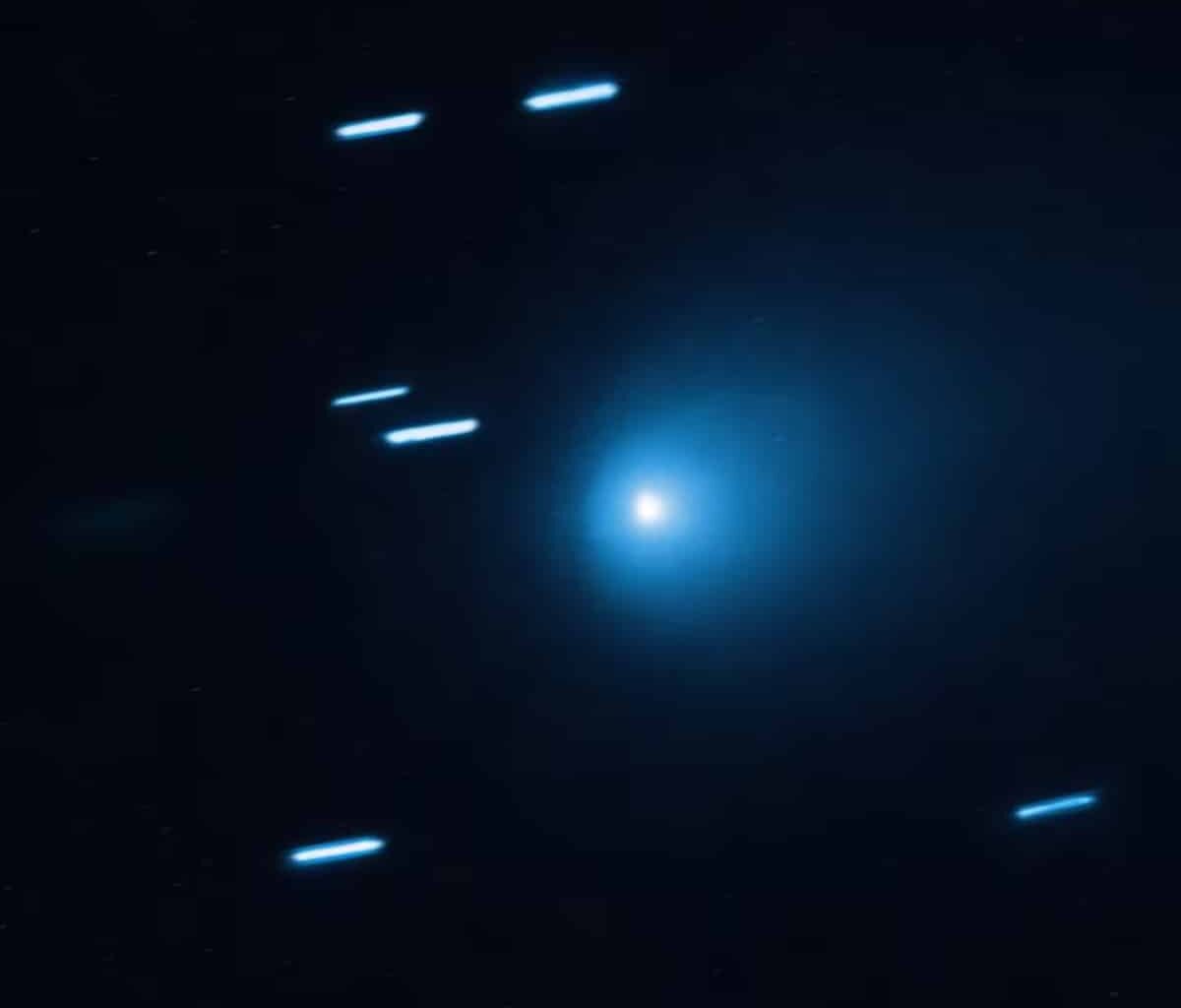
The interstellar comet known as 3I/Atlas was first spotted in July 2025—and ever since, it’s been full of surprises. Each new observation seems to reveal another astonishing feature. This time, scientists have discovered something spectacular: erupting volcanoes made of ice.
Only the third interstellar object ever observed in our Solar System, 3I/Atlas has quickly become a celestial celebrity. Its arrival offers astronomers a rare glimpse into conditions that exist around distant stars—and perhaps into the early history of our own cosmic neighborhood. Researchers even believe the comet could be billions of years older than the Sun itself.
Last October 30, 3I/Atlas made its closest approach to our star—its perihelion, in scientific terms. By next year, it will already be on its way out of the Solar System. Determined to make the most of this fleeting visit, scientists from Spain’s Institute of Space Sciences turned the Joan Oró telescope at Montsec Observatory toward the comet as it drew nearer to the Sun.
#COMET #3IATLAS MONITORED TONIGHT from #MontsenyObservatory. The antitail keeps being the most relevant feature, but nuclear activity exhibits many active, bended jets
Just a transitional #comet, our research paper
➡️https://t.co/MAVDRxLWma
Outreach text⤵️https://t.co/K0xqGPyz5v pic.twitter.com/EDamqZvSNO— Dr. Josep M Trigo ⭐🌛#PlanetaryDefense #DART HERA (@Josep_Trigo) December 1, 2025
Ice volcanoes on an alien world
‘We were all surprised,’ said Josep Trigo-Rodríguez, lead author of a new study awaiting peer review. His team detected multiple cryovolcanoes erupting on the comet’s surface—an astonishing find for an object that didn’t even form in our Solar System. Even more surprising, its chemical makeup looks remarkably similar to the frozen bodies that orbit beyond Neptune.
As a comet nears a star, its ice naturally heats up and sublimates into gas, which astronomers can observe and analyse. Cryovolcanism typically occurs on ice-rich worlds like trans-Neptunian objects, where internal heat melts the frozen layers. Just like fiery volcanoes on Earth, these frozen counterparts eject vapor and dust into space.
PRE-PERIHELION STUDY OF #COMET #3IATLAS with our findings about its spectroscopic similitude with CR carbonaceous chondrites. Manuscript submitted for publication in which we propose it is a #TNO-like body experiencing #cryovolcanism
The @arxiv preprint:
➡️https://t.co/5h7KhRWJAP pic.twitter.com/KOoS22Bg6n— Dr. Josep M Trigo ⭐🌛#PlanetaryDefense #DART HERA (@Josep_Trigo) November 25, 2025
A resemblance that raises questions
For 3I/Atlas, the process intensified about 378 million kilometers from the Sun. Scientists believe the cryovolcanism results from chemical corrosion of ancient materials sealed inside the comet. Under solar heat, solid carbon dioxide (CO₂) began turning into gas, allowing an oxidizing liquid to seep inward, where it reacted with iron and nickel particles and various sulfides.
To confirm their theory, the researchers compared their data with samples from meteorites known as carbonaceous chondrites. Their analysis showed that 3I/Atlas’s composition closely matches that of a fragment of a trans-Neptunian object retrieved by NASA in Antarctica. Despite its clearly interstellar origin, the comet seems to share the same building blocks as bodies from our own Solar System—possibly similar to those that once helped spark life on Earth. Imagine where that discovery could lead next.

Nathalie Mayer
Journalist
Born in Lorraine on a freezing winter night, storytelling has always inspired me, first through my grandmother’s tales and later Stephen King’s imagination. A physicist turned science communicator, I’ve collaborated with institutions like CEA, Total, Engie, and Futura. Today, I focus on unraveling Earth’s complex environmental and energy challenges, blending science with storytelling to illuminate solutions.