EYES TO THE HEAVENS:
Taiwan’s space agency aims to launch a locally built rocket into orbit within a decade as the agency considers the future of the nation in space
-
By Shelley Shan /
Staff reporter
Taiwan aims to launch its first locally built rocket into orbit by 2034, the Taiwan Space Agency (TASA) said yesterday, adding that it is exploring opportunities to build data centers in space.
The agency made the remarks during a meeting of the legislature’s Education and Culture Committee, at which lawmakers focused on the government’s strategy for aerospace technology following the launch of the first satellite of Formosat-8, the nation’s home-built optical remote-sensing satellite, at the end of last month.
Democratic Progressive Party legislators Chen Hsiu-pao (陳秀寶) and Jean Kuo (郭昱晴), and Chinese Nationalist Party (KMT) Legislator Ko Ju-chun (葛如鈞) asked TASA and National Science and Technology Council (NSTC) officials about the nation’s progress in building rockets and whether the government has plans to build data centers in space.
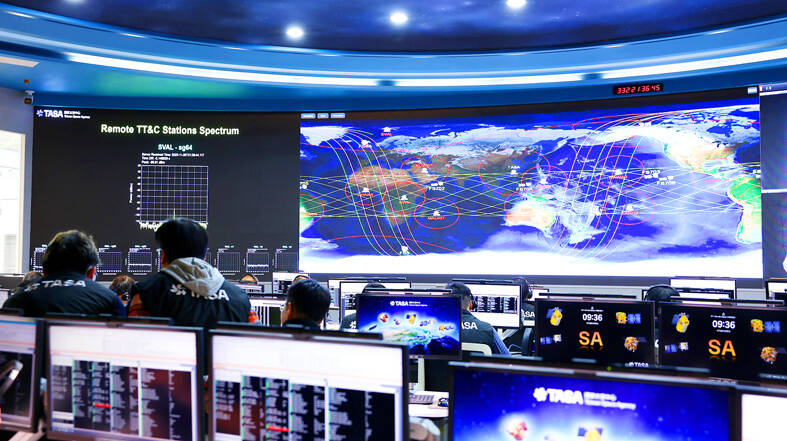
Photo courtesy of the Taiwan Space Agency via CNA
They also expressed concerns about whether the government could offer sufficient incentives to attract more talent to the field, which encompasses many emerging areas of interest.
Taiwan is exploring the opportunities of building data centers in space, TASA Director-General Wu Jung-shinn (吳宗信) said.
One of the three privately built satellites in the Formosat-8 payload carried a graphical processing unit, an essential component of a data center, Wu said, adding that the company that built the satellite is monitoring the hardware’s performance in a vacuum with high radiation exposure and severe temperature fluctuations.
“Initial results of the experiment are expected soon, which would be key in our assessment,” he said.
South Korea’s transition into the commercial space model following the successful launch of its fourth homegrown rocket last month was also brought up as an example during the meeting.
Wu said that TASA has a 10-year satellite payload development program which began in 2023, with the goal of launching Taiwan-made rockets by 2034.
The agency is working with 50 rocket supply chain contractors, mostly in Tainan, Kaohsiung and Pingtung County, Wu said.
The most challenging part of the program is to develop liquid-propellant engines, Wu said.
NSTC Deputy Chairman Lin Faa-cheng (林法正) said it took South Korea 20 years and billions of US dollars to reach where it is.
“We hope to reach the goal with a shortened timeline and limited funds leveraging Taiwan’s strong capabilities in information and communication technology and precision machinery,” Lin said.
Kuo said that the budget allocated to the Phase III of the nation’s space project has reached NT$70 billion (US$2.2 billion), adding that the successful launch of the first satellite of Formosat-8 has proven the feasibility of a modular, lightweight platform.
TASA should assist the private sector in promoting the use of the platform in the international
community, she said.
Wu said that the agency is promoting the use of its self-developed standardized satellite bus system, which could be used to help the Ministry of Environment launch four satellites to observe changes in greenhouse gases.
The agency is also engaging in the Big 5G project to bolster the resilience of low-Earth orbit communications, Wu said, adding that the goal is to establish a comprehensive original design manufacturing ecosystem of low-earth orbit satellite payloads.
Chen and Kuo said that talent needed to develop space technology could also be applied in the semiconductor industry.
Aside from offering more desirable incentives, the government should track the movement of graduates of university aerospace programs, they said.
“The last thing we want is that we end up training skilled personnel for other countries,” Kuo said.
Ko asked the council to study Singapore, which ranked first in this year’s Global Talent Competitiveness Index, and submit a report to the committee in three months on how the government can attract, train and retain talent.