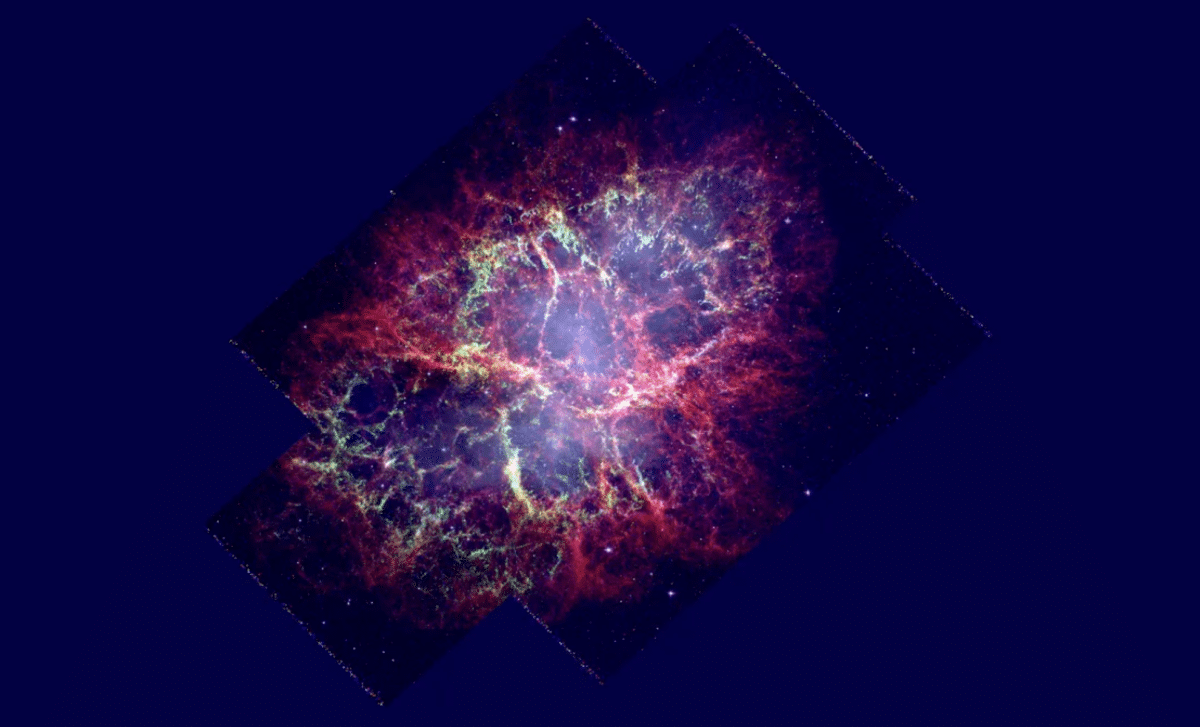
The Crab Nebula, one of the most studied remnants of a supernova explosion observed nearly a thousand years ago, has been revisited by the Hubble Space Telescope. In a recent study available on ArXiv, scientists analyzed the nebula’s expansion and the emergence of mysterious “knots” that were previously overlooked. This new research, building on observations from the 1999-2000 Hubble mission, provides fresh insights into the dynamic nature of the nebula and paves the way for further investigation into its complex structure.
A Long-Awaited Revisit: The Crab Nebula Expands
The Crab Nebula, the aftermath of a supernova witnessed in 1054 CE, has been a subject of fascination for astronomers for decades. Despite being one of the most studied objects in the sky, it remains a rich source of scientific mystery. The nebula’s pulsar— the rapidly rotating neutron star at its core—continues to captivate researchers as they study its intricate plasma shells, knots, and filaments.
The recent study, led by Professor William Blair from Johns Hopkins University, and available on ArXiv, marks a significant moment in this ongoing exploration. It focuses on data collected by the Hubble Space Telescope in 2025, the first detailed observations in nearly 24 years. As Professor Blair pointed out in an interview with IFLScience,
“The main reason was that on a detailed scale, the nebula is expanding, so that over time the knots and filaments move in position on the sky. As more recent data [from other telescopes] are obtained, it is hard to compare directly.”
The team aimed to update existing knowledge by closely examining the expansion of the nebula and changes in its structure.
This is an important observation because the Crab Nebula is not a static object; it is constantly evolving. The data collected will now serve as a new baseline for future studies. The expansion of the nebula over the past two decades is visible, and researchers are keen to understand how these changes reflect on the nebula’s dynamic nature. While no dramatic shifts in brightness were observed, the discovery of new features offers fresh insights into the nebula’s ongoing transformation.
The Quest for Change: Did the Nebula’s Features Shift?
Astronomers had expected some changes over the 24-year gap between detailed observations. In some supernova remnants, such as Cassiopeia A and Kepler’s supernova, features have been observed to shift in brightness or position over a decade. “Secondly, again over 24 years, one might have expected some features to get brighter or fade, as has been seen for knots and filaments in Cassiopeia A and Kepler’s supernova remnant, which are seen to change over roughly a decade,” Professor Blair explained.
Despite these expectations, the Crab Nebula showed fewer dramatic changes than anticipated. This lack of noticeable shifts might seem underwhelming, but it is important in the broader context of cosmic studies. Observing minimal changes tells astronomers that the nebula is relatively stable in its observable characteristics. The continued presence of the same knots and filaments, albeit expanding, confirms the long-term nature of their existence.
However, this does not mean the nebula is devoid of surprises. The most exciting finding was the identification of two previously unnoticed groupings of knots. These new features were captured in high-resolution images from the Hubble Space Telescope and stand out from other elements of the nebula due to their unusual characteristics.
The Mystery of the Knots: What Are They?
The newly identified knots are intriguing, not only because they had previously flown under the radar but also because they are positioned in a way that suggests a deeper connection to the pulsar at the center of the Crab Nebula. “Our new observations have revealed two groupings of knots that ‘stand out from the crowd,’ so to speak,” Professor Blair told IFLScience. “They are present in earlier data if one looks carefully, but they jump out in the way our data are displayed. These two filament groupings are similar to each other in their characteristics, and are nearly diametrically opposed to the pulsar position.”
These knots, positioned almost directly opposite the pulsar, could hold vital clues to understanding the nebula’s internal dynamics. Though they were visible in earlier data, they were not immediately obvious. Their sudden prominence in this new set of high-resolution images opens the door for further research. The team is already planning follow-up studies to track the motion and composition of these knots to determine what causes them to appear so unique compared to other structures in the nebula.
For now, the exact nature of these enigmatic knots remains a mystery. Are they the result of interactions between the pulsar and surrounding gas? Or do they reflect a deeper, as yet unknown, cosmic process at work within the supernova remnant? These are questions that astronomers are eager to answer as they continue their study of this fascinating object in the sky.