CLEVELAND, Ohio — The first thing visitors see when they enter the Cleveland Museum of Art’s “Renaissance to Runway” fashion exhibition isn’t a gown or a painting. It’s a 2-minute, 45-second video projected on a 20-foot wall. The sequence shows lifelike figures in garments featured in the exhibition running through historical and dreamlike settings leading to the museum.
A placard next to the video, titled “Renaissance Remixed” by Francesco Carrozzini and Henry Hargreaves, explains what visitors are watching and why.
“Using AI and emerging technology, rare archival garments — too delicate to wear — are brought back to life,” the sign reads. “Artists have used AI to show how these garments once moved and flowed when worn.”
The video solves two challenges at once. First, how to show the pieces in action without putting them on models and at risk. The museum takes conservation seriously and didn’t want a scenario like the one at the Met Gala in 2022, when Kim Kardashian wore and ultimately damaged Marilyn Monroe’s “Happy Birthday, Mr. President” dress.
“It was a way to bring these objects to life and see them flow and move in a way that wouldn’t be possible through a fun, animated story,” said Jane Alexander, CMA’s chief digital information officer.
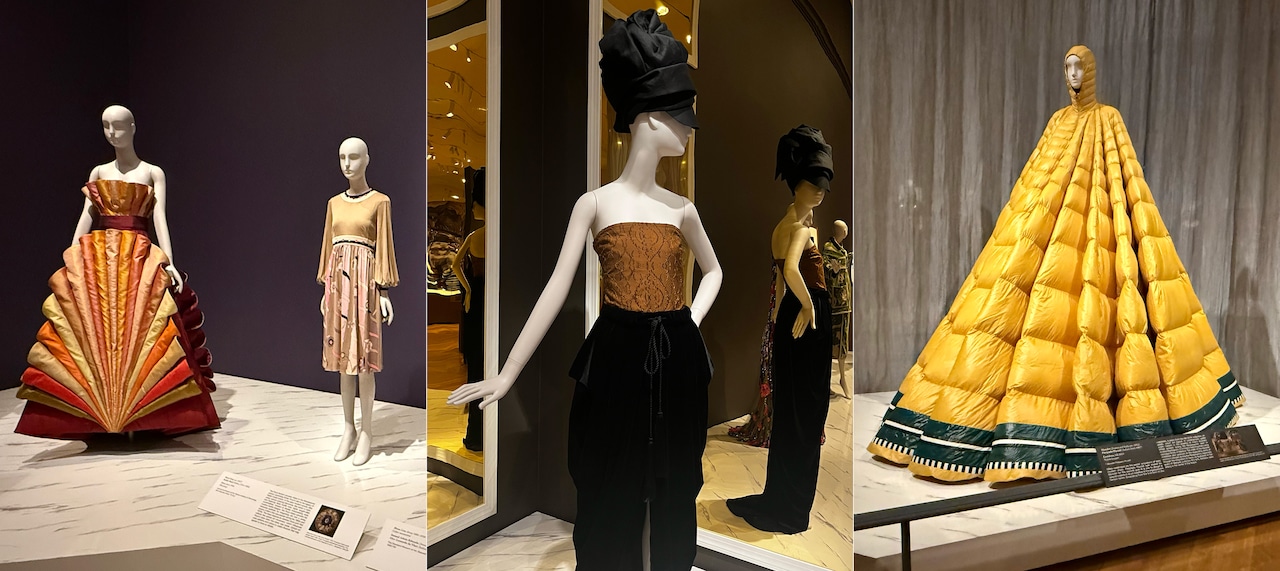
At the same time, curator Darnell-Jamal Lisby set out to create the feel of a cool, cutting-edge runway show you’d see in Milan or Paris. The video does that, giving audiences a taste of what they’re about to see. The exhibition, the largest of its kind to date at the museum, examines how Italy’s artistic past informs its modern designers. It pairs Renaissance and Baroque masterpieces from the museum’s collection with clothes by Versace, Valentino, Armani, Ferragamo and Gucci.
“He wanted to have a vibe for this show,” Alexander said. “It’s very different than anything we’ve ever done.”
The museum knew the use of generative AI might spark criticism. The technology has become increasingly controversial, raising questions about how the work was created, who owns the content and whether jobs are being displaced. Alexander emphasized that the video was created by paid artists and fine-tuned in collaboration with the museum over a period of months. It wasn’t generated by someone simply entering a prompt into ChatGPT.
“The idea is that this is a tool that artists can use,” added Todd Mesek, CMA’s chief marketing officer. “Our goal is always to support the artists. This is a tool for them, not a replacement.”
In their view, the video is the art; AI is a means, like a paintbrush or a chisel. Still, the museum prioritized transparency, along with ethical practices and environmental responsibility. That meant being clear about how the video was created, making sure images were properly licensed and the project used minimal energy.
“We don’t use technology for technology’s sake,” Alexander said. “We use it when it solves a problem and makes art more relatable to more people.”
“Renaissance to Runway” isn’t the museum’s first — or last — use of artificial intelligence. In fact, it was an early adopter of AI when it opened Gallery One in 2012. The space, now known as ArtLens, uses interactive exhibits to engage visitors with the museum’s permanent collection.
There, they can explore artworks digitally and discover similar pieces through AI-generated recommendations, helping them move from browsing on a screen to seeing the objects in real life. The museum also uses the technology to produce detailed visual descriptions for artworks on its website to make the collection more accessible. This summer, the ArtLens gallery will add a new AI-powered storytelling feature that lets visitors “talk to art,” Alexander said, and even create their own works using open-access objects.
“We’ve got this amazing collection, one of the best in the world,” Mesek said. “We’re trying to use the technology to bring people deeper into it, increase accessibility, make them more comfortable in a museum and maybe teach them in a fun way.”
“Renaissance to Runway: The Enduring Italian Houses” runs through Feb. 1 at the Cleveland Museum of Art, 11150 East Blvd., Cleveland. Advance tickets are required and available for $8-17 at clevelandart.org.