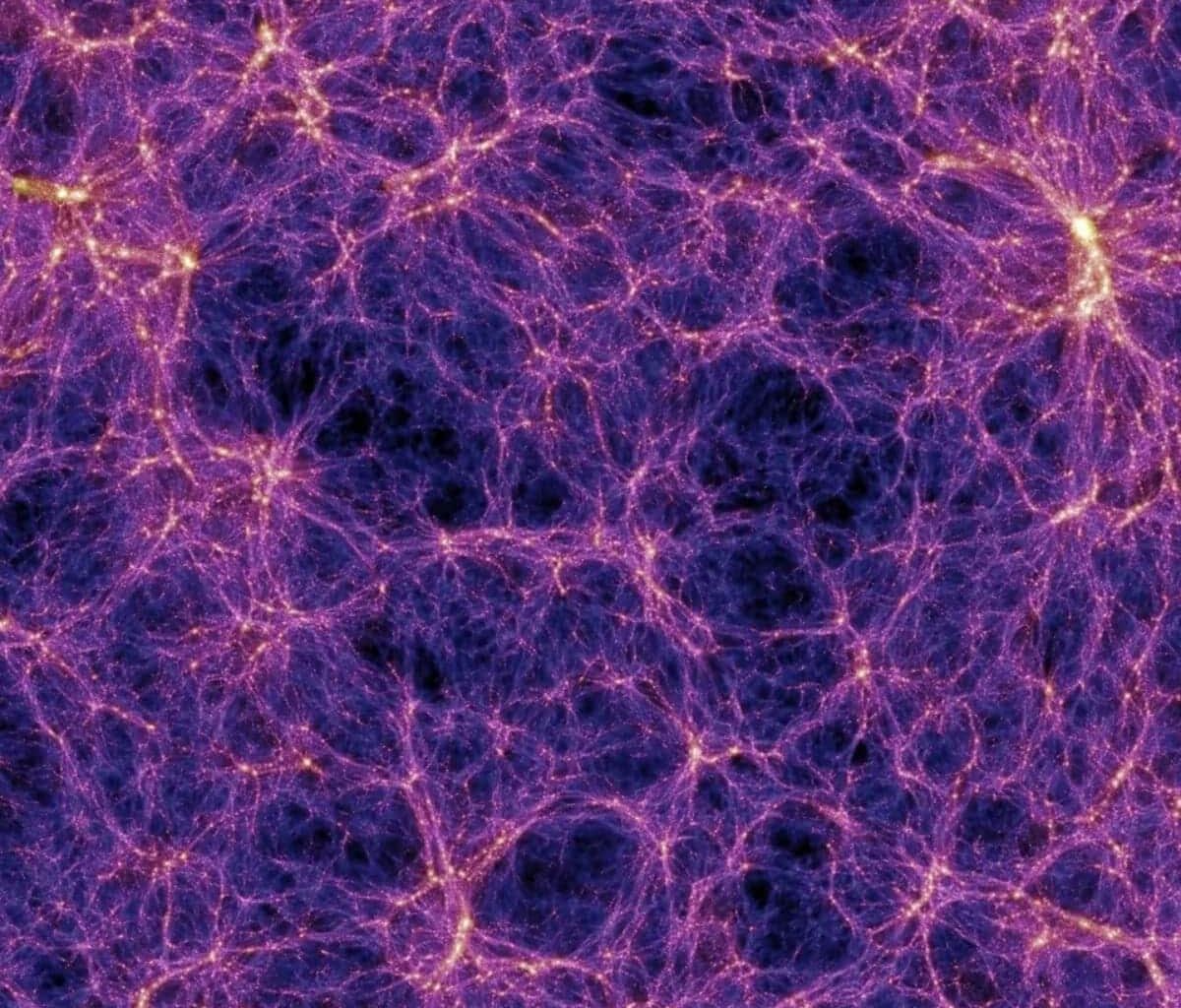
A new study has revealed something extraordinary at the heart of the cosmic web: a massive chain of galaxies, 140 million light-years away, all rotating in perfect sync. The finding challenges long-held theories about how galaxies form and move—and could reshape our understanding of how the Universe evolved.
Published in the Monthly Notices of the Royal Astronomical Society, the research comes from an international team led by the University of Oxford. Their work describes a chain of galaxies embedded in a spinning cosmic filament—the largest rotating structure ever observed. Based on dynamic models, the team calculated a rotation speed of about 110 km per second.
The Universe’s cosmic scaffolding
Cosmic filaments are the biggest known structures in existence. Made up of galaxies and dark matter, they form the vast network of threads—often called the “cosmic web”—that shapes the large-scale structure of the Universe. These filaments act like highways, carrying matter and energy toward galaxies. Studying them helps scientists understand how galaxies acquire both their spin and the gas they need to form stars.
Discovery of a spinning chain of galaxies
In this case, the researchers identified a line of 14 hydrogen-rich galaxies stretching 5.5 million light-years long and 117,000 light-years wide, all within a larger filament spanning 50 million light-years. The same structure contains more than 280 galaxies.
What’s most remarkable is that most of these galaxies rotate in the same direction as the filament itself—a phenomenon that current models can’t fully explain.
NEW: Researchers have found a ‘razor-thin’ string of galaxies rotating together inside a giant cosmic filament 140 million light-years away – one of the largest spinning structures ever seen.
Find out more ⬇️ pic.twitter.com/DsQKGTPibj
— University of Oxford (@UniofOxford) December 4, 2025
What it means for galaxy formation
The discovery suggests that the flow of matter through cosmic filaments may influence galaxy rotation far more than previously thought—and for a much longer time. The young, gas-rich galaxies studied here are still forming stars, offering scientists a rare opportunity to observe galactic evolution in progress.
This breakthrough gives astronomers a clearer picture of how galaxies gain their rotation and evolve within the grand architecture of the cosmos. It’s a major step forward in understanding the forces that have shaped the Universe since its earliest days.
Dr. Lyla Jung, co-lead author of the study and a physicist at Oxford, explains it this way: “What makes this structure so extraordinary isn’t just its size—it’s the way everything spins together. Imagine a carousel of teacups at an amusement park. Each galaxy spins like a teacup, but the entire platform—the cosmic filament—is rotating too. That dual motion gives us an unprecedented glimpse into how galaxies inherit their spin from the larger structures around them.”
The research relied on data from South Africa’s 64-antenna MeerKAT radio telescope, combined with other radio and optical observations. Together, these insights offer the most detailed look yet at the complex structure and movement of the cosmic web.

Rémy Decourt
Journalist
Born shortly after Neil Armstrong’s first steps on the Moon in 1969, my journey into space exploration has been entirely self-taught. A military stay in Mururoa sparked my formal education in space sciences, and early sky-watching experiences in an astronomy club ignited my passion. I founded flashespace.com, transitioning from sky observation to a deep interest in space missions, satellites, and human and robotic exploration. Since 2010, I’ve been part of Futura’s editorial team, covering space news and working as a freelance writer with extensive international field experience in space-related sites.