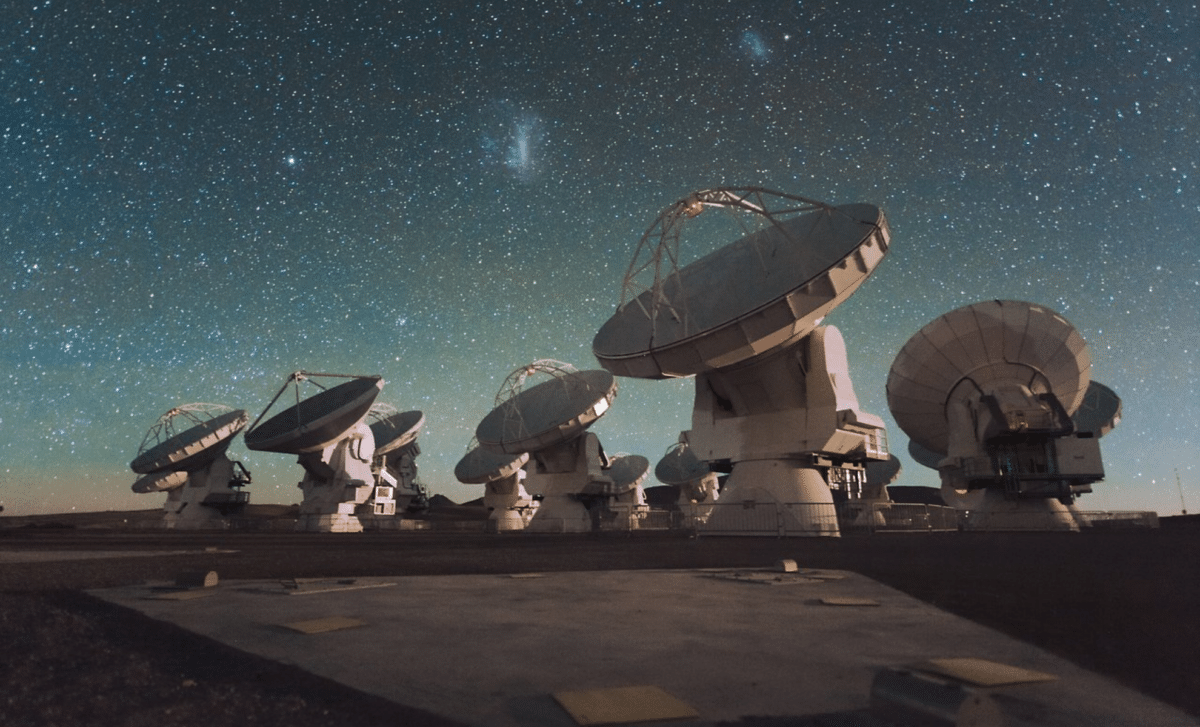
The ALMA (Atacama Large Millimeter/Submillimeter Array) radio telescope, located in the Chilean Andes, has long been a key tool for astronomers seeking to understand the universe’s most distant and enigmatic regions. A recent breakthrough in its capabilities is the installation of 145 state-of-the-art low-noise amplifiers (LNAs), which will enhance its ability to measure millimeter and submillimeter radiation.
Breakthrough Technology Enhances ALMA’s Sensitivity and Performance
At the heart of ALMA’s success in probing the cold, distant reaches of the universe lies its ability to detect extremely faint signals. The addition of the 145 LNAs for Band 2, covering wavelengths from 2.6 to 4.5 mm, is a game-changer for the telescope’s sensitivity. These amplifiers allow ALMA to measure the faintest millimeter and submillimeter radiation emitted by objects billions of light-years away, offering scientists the ability to explore phenomena that would otherwise remain invisible. The technology is built on a foundation of monolithic microwave integrated circuits (MMICs), utilizing indium gallium arsenide (InGaAs), which is renowned for its ability to amplify signals with minimal added noise.
Dr. Fabian Thome, head of the subproject at Fraunhofer IAF, emphasizes the critical role these amplifiers play in enhancing ALMA’s sensitivity: “Our technology is characterized by an average noise temperature of 22 K, which is unmatched worldwide.” This extremely low noise temperature is key to boosting the performance of ALMA’s receivers, which are designed to detect the faintest signals from the depths of space. This innovation positions ALMA as an even more powerful tool in the search for answers about the origins of the universe.
The Role of Low-Noise Amplifiers in ALMA’s Success
Low-noise amplifiers (LNAs) are essential components of radio telescopes, responsible for amplifying weak signals while minimizing the introduction of background noise. In the case of ALMA, these amplifiers are the first stage in the receiver chain and determine the overall quality of the data captured by the telescope. As such, the performance of the LNA directly influences the telescope’s ability to detect and analyze distant cosmic signals with clarity.
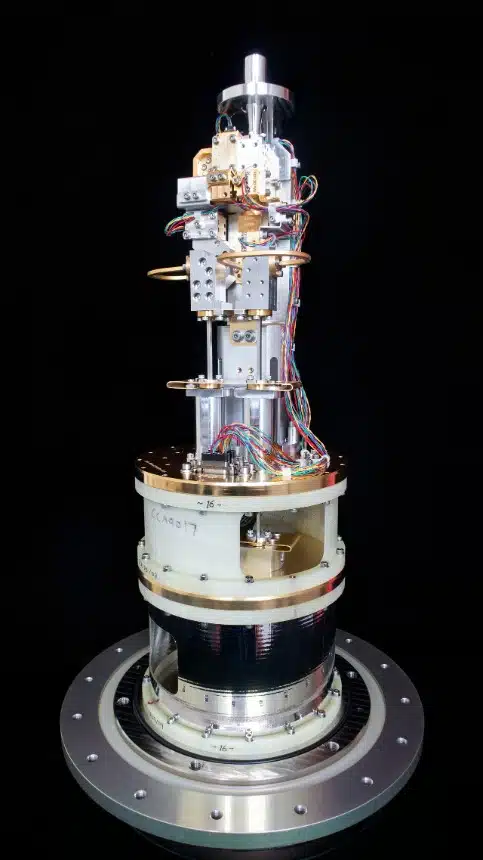 ALMA Band 2 high-frequency receiver. Credit: NOVA/ESO
The latest advancements in LNA technology for ALMA’s Band 2 are based on cutting-edge metamorphic high-electron-mobility transistors (mHEMTs), a type of semiconductor that offers exceptional noise reduction capabilities. This technology enables ALMA to capture radio signals from molecular clouds, which are cold, dense regions of space where stars are born. By improving ALMA’s ability to detect these faint signals, scientists can now explore star-forming regions, galaxies, and even the building blocks of life with greater precision.
Collaboration between Fraunhofer IAF and MPIfR Brings Unmatched Innovation
The successful development and integration of these low-noise amplifiers is the result of a close collaboration between Fraunhofer IAF and the Max Planck Institute for Radio Astronomy (MPIfR). Fraunhofer IAF, renowned for its expertise in semiconductor technology, was responsible for designing and producing the amplifiers’ core components. MPIfR, which operates ALMA in partnership with the European Southern Observatory (ESO), handled the final assembly, testing, and qualification of the modules.
“This is a wonderful recognition of our fantastic collaboration with Fraunhofer IAF, which shows that our amplifiers are not only ‘made in Germany’ but also the best in the world,” says Prof. Dr. Michael Kramer, executive director at MPIfR. Their combined efforts have resulted in a significant technological leap for ALMA, further solidifying its position as one of the most powerful radio telescope arrays in existence.
ALMA’s Strategic Location Enhances Its Observational Power
One of the key factors that sets ALMA apart from other radio telescopes is its location on the Chajnantor Plateau in the Chilean Andes. Situated at an altitude of 5000 meters above sea level, ALMA is ideally positioned to capture millimeter and submillimeter radiation with minimal interference from the Earth’s atmosphere. The dry, high-altitude conditions ensure that the radiation from distant cosmic sources is less attenuated by water vapor, which typically absorbs and scatters electromagnetic signals at these wavelengths.
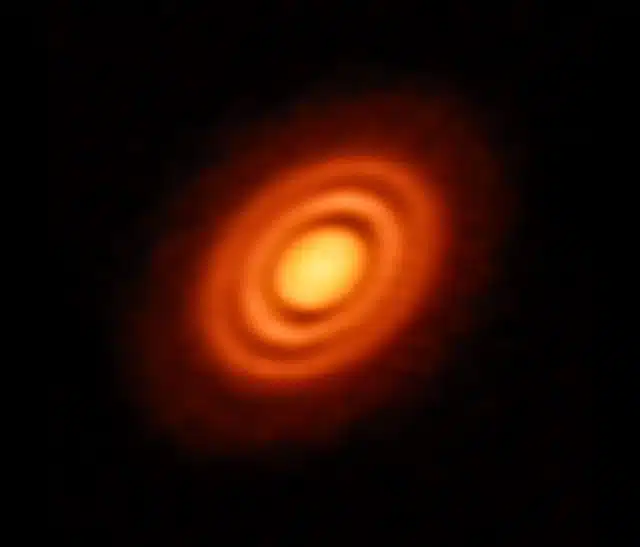 Young star HD 163296, surrounded by concentric rings of gas and dust; image taken by ALMA in 2016. © ESO, ALMA (ESO/NAOJ/NRAO); A. Isella; B. Saxton (NRAO/AUI/NSF)
This unique location allows ALMA to conduct radio astronomy measurements with unparalleled clarity, enabling it to probe regions of space that are otherwise difficult to study. The addition of advanced low-noise amplifiers enhances ALMA’s ability to measure signals that have traveled across vast distances of space and time, providing scientists with clearer and more accurate data to investigate the origins of stars, galaxies, and possibly life itself.
Understanding the Cold Interstellar Medium with ALMA’s Band 2
One of the primary scientific goals of ALMA’s Band 2 is to study the cold interstellar medium (ISM)—a mixture of gas, dust, radiation, and magnetic fields that plays a crucial role in the formation of stars and galaxies. This component of the universe is difficult to observe, as it emits very faint radiation, making it challenging for traditional telescopes to detect.
With the new low-noise amplifiers in place, ALMA’s Band 2 is now equipped to study these cold regions with unprecedented detail. Scientists are particularly interested in understanding the processes that lead to star formation and the emergence of complex organic molecules, which are considered precursors to the building blocks of life. By observing these processes in nearby galaxies and molecular clouds, ALMA’s advanced capabilities are expected to shed light on some of the most fundamental questions in astrophysics.