Steven McKenzieHighlands and Islands reporter
 Getty Images

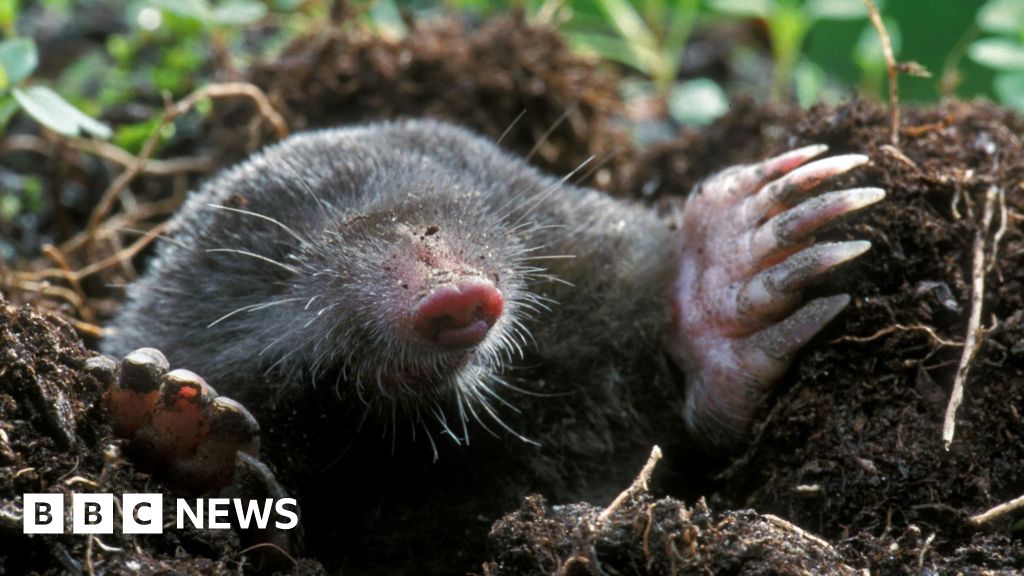
Molehills – the mounds of earth moles dig up and leave on the surface as they tunnel underground – are the closest most people are likely to get to one of Britain’s most elusive animals.
Out of Doors co-host Rachel Stewart said her senior producer was intrigued by why she had seen more hills than usual at this time of year.
The show’s guest – Joanna Peaker, of Montrose Basin Visitor Centre – said she hadn’t noticed anything exceptional herself, but suggested the explanation could be weather-related.
“I suppose it’s going to vary where you are in the country,” she said.
“It could be an effect of a milder winter because when it is frosty the moles will go deeper down to find invertebrates.
“If it’s not very frosty then they will stay closer to surface level.”
Is it because of climate change?
Matt Larsen-Daw, chief executive of The Mammal Society, says there can be a few reasons why moles might go through a phase of tunnelling later in the year.
But he said this happening even for a couple of consecutive years did not mean climate change was to blame.
“A mild year may mean that some females have a second litter in the autumn, especially if the first litter was early due to an early spring,” he said.
“This could mean that some young moles are establishing their tunnel system in a new territory in the winter.”
“Again, this could happen as a one-off, it is a rare occurrence – moles usually have one litter a year.
“But if climate change leads to the conditions that allow this being more frequent then it could become more common.”
‘Mole fortresses’
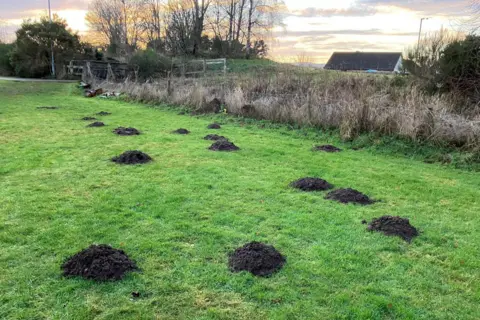
Molehills in Inverness this week when it has been raining heavily
Mr Larsen-Daw said the size of the molehills offered another clue to what was going on.
“If you have seen any particularly large ones they could be ‘mole fortresses’,” he said.
“When the water table rises so high after heavy rain that the ground is saturated, moles dig out soil to create a large above-ground mound in which they can have a tunnel system in which to shelter, breed and store food above the waterlogged ground.”
He said smaller, normal size molehills could be being dug for the same reason.
“Given the amount of recent rainfall this is a possible explanation this year,” he said.
Mr Larsen-Daw added: “Moles are fascinating and very ingenious in so many ways – they are not given as much attention as they deserve simply because people so rarely see them due to their fossorial lifestyles.”