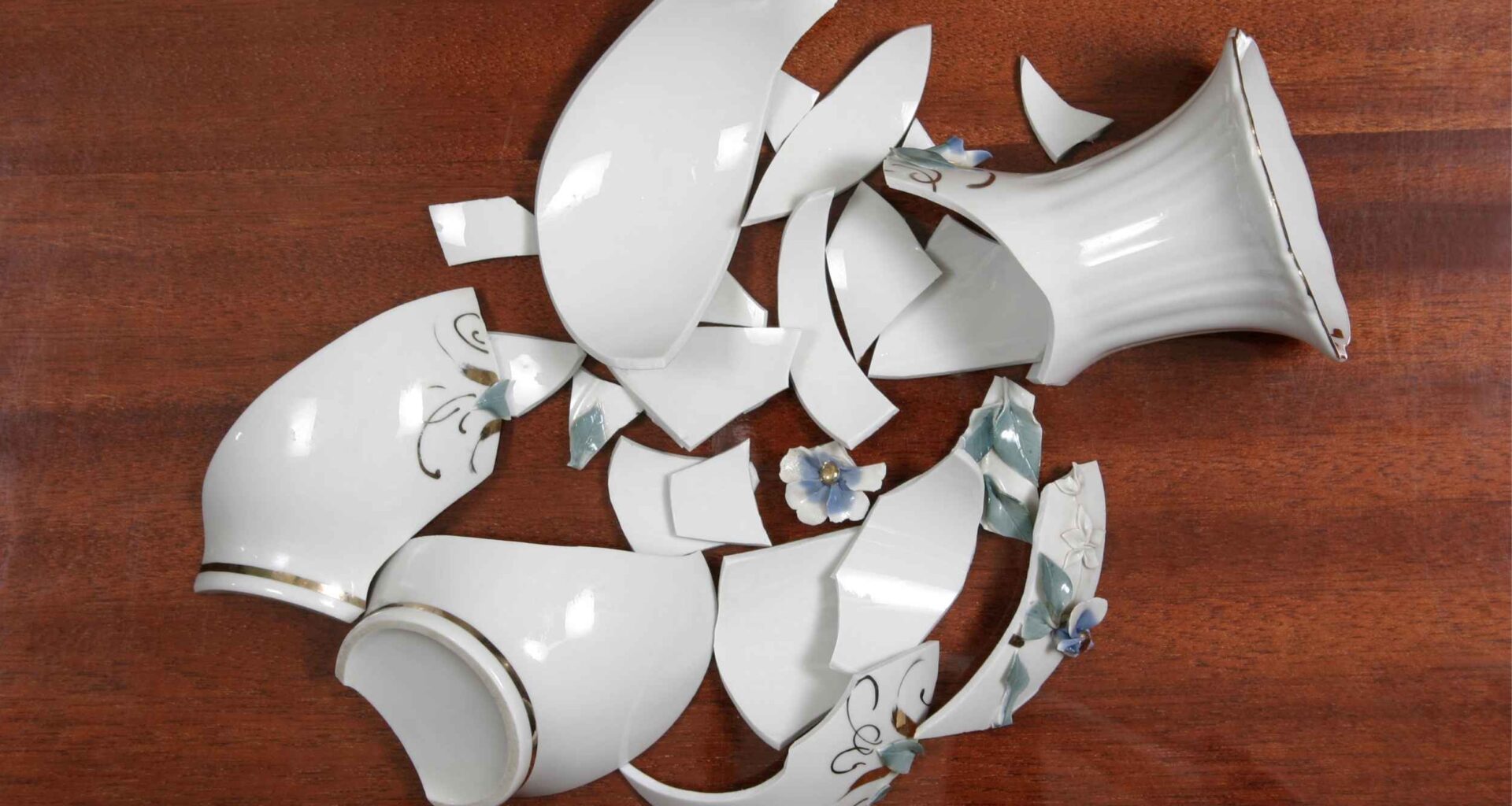
A single equation may predict how many fragments a brittle object makes when it shatters. In Marseille, France, physicists treated shattering as a statistics problem, and they found a rule that matches many tests.
The work was led by Prof. Emmanuel Villermaux at Aix-Marseille University. He studies how solids and fluids break apart. His group looks for rules that hold across materials, even when the break looks chaotic and noisy.

This fragmentation, the breakup of one object into many pieces, often follows a rule where shape matters more than material evidence.
Villermaux used entropy, a measure of how many outcomes are possible, and he turned that idea into a simple equation.
A vase splitting into four equal pieces is possible, yet the math favors uneven breaks because they outnumber tidy ones.
Fragments and conservation law
The model assumes maximal randomness, where many tiny details average out, so the most probable breakup looks messy.
From that assumption, fragment numbers fall into a power law, which is a pattern where small pieces are far more common.
The steepness of that curve depends on an exponent, a number that controls how quickly big fragments disappear.
In the new law, the exponent comes mainly from dimensionality, whether the object behaves like a line, sheet, or volume.
The equation also relies on a conservation law, a rule that stays true during change, for the pieces as they separate.
In his setup, the summed logarithm, a math scale that turns multiplication into addition, of fragment sizes stays fixed during the internal scramble.
Cracks travel quickly compared with the slow motion of separating chunks, so the object hardly expands before the final pieces exist.
That constraint narrows the possible outcomes, and maximal randomness picks the most likely one without detailing how each crack branched.
Fragment size distribution
For rod-like breaks, the model predicts an exponent near 1.3, while plates trend near 2.4, and solid chunks trend near 3.5.
A larger exponent means big fragments become rarer, and most of the count piles up in the small stuff.
The same material can land in different categories because a thin sheet breaks mainly across its surface, not its thickness.
Geometry and randomness matter more than the hammer, drop or explosion, as long as the breakup stays messy.
To test the idea, Villermaux compared the equation with earlier measurements from glass bars, spaghetti, plates, ceramic tubes, ocean plastic, and breaking waves.
In water and air, turbulence – the chaotic swirling motion in a moving fluid – can also drive breakup into a wide range of sizes.
Across that mix of settings, the fragment-size distribution kept the same basic shape, even though the materials and forces differed widely.
When the rule holds, it offers a shortcut for predicting fragment counts, which can help models run faster and stay realistic.
Sugar cubes and hard floors
He also crushed a sugar cube about 1 inch (2.5 centimeters) across by dropping a weight from different heights onto a hard floor.
“That was a summer project with my daughters,” said Prof. Villermaux, explaining that the sugar-cube experiment started as family time.
Because impacts have limited energy, the model adds fracture energy, energy needed to create new crack surfaces, which sets a smallest piece.
That limit trims the tiniest fragments, giving the curve a natural cutoff and keeping the total number of pieces finite.
When the rule fails on purpose
One experiment on polypropylene found a fragment-mass exponent close to 1.2, placing plastics in a different breakup class.
The authors blamed shear – the sliding force that makes layers move sideways – and crack healing, which keep some fragments stuck together.
In a smooth liquid jet, predictable physics sets droplet sizes, so the breakup does not explore many random outcomes.
Even in solids, strong interactions between neighboring pieces can steer the result, so the law works best when fragments separate cleanly.
Implications for mining and hazards
Industries that crush rock for ore depend on fragmentation, because piece size controls how easily material moves through crushers, mills, and screens.
If engineers can predict the full spread of fragment sizes, they can tune energy use and avoid over-grinding valuable material.
Rockfalls also break boulders into flying debris, and safety barriers work better when planners know how many medium and small pieces to expect.
A simple law cannot replace site measurements, yet it can provide a starting point when field data are scarce or hard to collect.
Small fragments, big problems
In the ocean, plastics can break into microplastics, pieces smaller than about 0.2 inches (0.5 centimeters), which spread far and enter food webs.
Fragment size helps decide whether plastic sinks, floats, or stays suspended, and it also affects which animals can swallow it.
NASA used airburst models – models that track an explosion in the atmosphere before impact – to track fragment clouds during meteor entries.
Meteor modelers still need chemistry and heat transfer, yet better fragment statistics could help connect shatter experiments in the lab to events in the sky.
Shapes, limits, and better models
Villermaux says that these patterns still leave two important questions unresolved about how shapes vary and what sets the smallest possible fragment.
A 2015 study found that many freshly produced rock fragments share similar shape patterns across materials.
The minimum size may depend on crack energy and material structure, and it may also vary with how the impact delivers energy.
Better measurements and broader shatter tests across diverse materials could clarify where this law applies reliably and where other processes may dominate.
The study is published in Physical Review Letters.
—–
Like what you read? Subscribe to our newsletter for engaging articles, exclusive content, and the latest updates.
Check us out on EarthSnap, a free app brought to you by Eric Ralls and Earth.com.
—–