Published December 22, 2025 06:00AM
A guide to balancing your leg strength for more efficient cycling
In triathlon, speed comes from our aerobic engines, muscular force and endurance, and efficiency of movement. While swim and run form often get attention, a smooth, efficient, balanced pedal stroke in cycling tends to get overlooked.
While all three disciplines interact to produce the central cardiovascular adaptations that improve our aerobic engines, muscle adaptations are more sport-specific – hence, why the world’s best marathoner can’t jump onto a bike in the Tour de France, and vice versa.
One simple way to improve pedal stroke balance and efficiency, and to enhance cycling-specific muscular adaptations, is through single-legged cycling work.
Why single-leg cycling exercises are important for triathletes
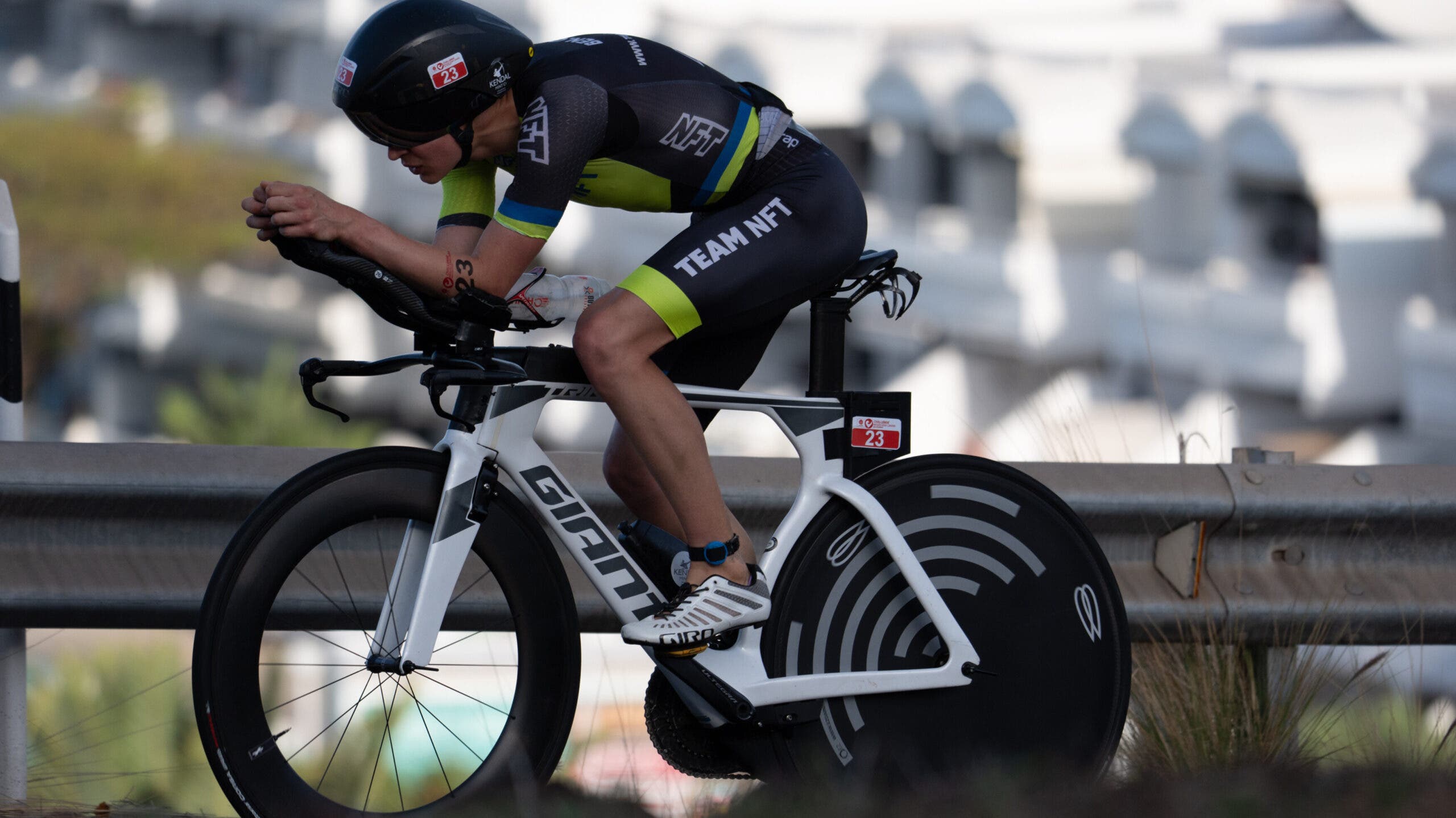 You might feel an imbalance of strength in your legs or you might fatigue on one side faster than the other, making single-leg exercises valuable. (Photo: Challenge Family)
The increased popularity of dual-sided power meters, particularly pedal-based systems, has only served to make this easier. These systems can offer valuable diagnostic insight into pedal stroke efficiency and side-to-side balance.
While most athletes will see small imbalances, larger differences or a side that fatigues faster may point to a need to work on emphasizing one leg over another.
For example, I’ve come to learn that despite my chronic left-sided hamstring/gluteal issues being under control pain-wise, that leg still has the tendency to slack off on the bike, causing me to lose overall power and overload my right leg as rides progress.
My power pedals give me real-time, quantifiable feedback that I can use to see this and consciously address it in training since my perception of balance does not always equal reality.
Sure, it sounds good in theory and with that n=1, but does single-legged cycling actually have benefits? Research backs up that it does.
Because the work is localized to one leg, single-legged cycling allows for greater muscular adaptations than its double-legged counterpart as it is not limited by central (cardiovascular) capacity, but more peripheral (muscular) fatigue. This produces increased local blood flow (research has found anywhere from 30-90% higher at matched work rates), allowing for each leg to perform more work individually with lower overall cardiovascular stress.
Additionally, single-legged cycling results in greater metabolic and oxidative benefits locally at muscles, such as improved glucose transport and oxidation. It can increase mitochondrial capacity, leading to enhanced oxygen delivery and extraction and VO2max improvements of about 7% in the trained leg.
While overall perceived exertion and total cardiovascular load during single-legged cycling are lower than in double-legged cycling, time-trial performance and double-legged VO2max have been shown to be maintained over 3-7 week timeframes of single-legged training.
So, don’t stress that you’ll lose central fitness by incorporating some single-legged training, especially as study protocols are far more extreme than adding in a few targeted rides.
How single-leg cycling exercises work
Single-legged cycling does differ a bit biomechanically from double-legged cycling. Both methods require similar quadriceps, hip extensor, and ankle work during the downstroke, but in double-legged cycling, the upstroke is more of a passive process that occurs while the opposite leg presses down on the pedal. Without this counterbalance in single-legged cycling, the upstroke becomes a more active action, requiring increased hip flexor and hamstring work.
While advanced methods such as counterweights and springs have been implemented in research to help mitigate this, simply emphasizing one leg more (at around a 3:1 ratio), instead of fully unclipping, has been found to be an easy, practical way to minimize biomechanical differences – something that dual-sided power meters can easily quantify, as well.
As triathlon season wraps up and athletes move into the off-season, all athletes can benefit from using this time to layer in some single-legged work once or twice a week, particularly those whose limiters include identified left/right power imbalances or leg muscles that tap out long before their hearts and lungs.
What’s the best way to incorporate single-legged cycling into your training? As just mentioned, emphasizing one leg while de-emphasizing the other is more biomechanically natural, particularly when you can use dual-sided power information to quantify the loads.
Interval training has also been shown to produce superior adaptations to moderate intensities when matched for total workload, and likely will feel more palatable as localized muscle fatigue sets in.
Another consideration is that after maximal efforts, increased blood flow to the working limb persists, which may blunt the response when switching to the opposite leg. This suggests that harder reps should be completed on one side before switching to the other, and the starting order should be alternated between workouts.
Single-leg workouts to isolate and strengthen the weaker leg
 Use these single-leg workouts to isolate your weaker leg to strengthen it. (Photo: Challenge Family)
Give these sets a go to emerge from winter as a stronger, more efficient, better-balanced cyclist.
Short and intense
Total Time: 30 minutes
- 3 times through:
- 1 minute HARD emphasizing one leg
- 4 minutes easy spinning with both legs
- After 3 reps, switch legs and repeat with the other leg
Single-legged VO2 intervals
Total Time: 30 minutes
- 3 times through:
- 3 minutes best sustainable effort* emphasizing one leg
- 2 minutes easy spinning with both legs
- After 3 reps, switch legs and repeat with the other leg
*The maximal effort/wattage that can be maintained across all intervals
Threshold work
Total Time: 44 minutes
- 2 times through:
- 8 minutes maintaining 80-90% effort, emphasizing one leg
- 3 minutes easy spinning with both legs
- After 2 reps, switch legs and repeat with the other leg
Long ride check-in
Using a dual-sided power meter, check left/right balance every 30 minutes. If greater than about a 5% power imbalance is present (i.e., anything beyond about a 53/47 split), spend 2-3 minutes concentrating on maintaining a 50/50 balance – think of this as similar to checking in on running cadence or swim mechanics.
Note: If using a dual-sided power source, these workouts can be quantified. Set a field on your head unit to show left/right power balance and aim to keep the contribution from the working leg at about 70-75% of the balance.
To determine power targets, consider that a single leg can produce about 20% more power during single-legged cycling than it does during double-legged cycling. Because the de-emphasized leg will still provide some contribution, aim for a total interval power around 75% of your equivalent double-legged equivalent – 1 minute max power for the first workout, VO2max power for the second, and threshold or critical power for the third. If this is too difficult, maintain the 70-75%/25-30% balance, but decrease the power.