
Far away in the universe, something surprising happened that no astronomer saw coming. NASA’s Hubble Space Telescope spotted the glowing remains of two space rocks crashing together in a nearby planetary system, a rare cosmic event that looked like a planet at first but was actually the aftermath of a massive collision of space rocks.
At first, astronomers thought they had found a dust-covered exoplanet reflecting starlight. When the planet vanished, and another bright spot appeared, the team realized it was actually glowing dust from huge crashes. Two separate collisions lit up the system, giving us a rare chance to watch planets forming as they happen.
“This is certainly the first time I’ve ever seen a point of light appear out of nowhere in an exoplanetary system,” said Paul Kalas of UC Berkeley. “It’s absent in all of our previous Hubble images, which means that we just witnessed a violent collision between two massive objects and a huge debris cloud, unlike anything in our own solar system today.”
Jason Wang of Northwestern University echoed the astonishment: “Spotting a new light source in the dust belt around a star was surprising. We did not expect that at all. Our primary hypothesis is that we saw two collisions of planetesimals, small rocky objects, like asteroids, over the last two decades.”
The first-ever afterglow of huge planetary collision captured in outer space
Collisions of planetesimals are infrequent events, and this marks the first time we have seen one outside our solar system.”
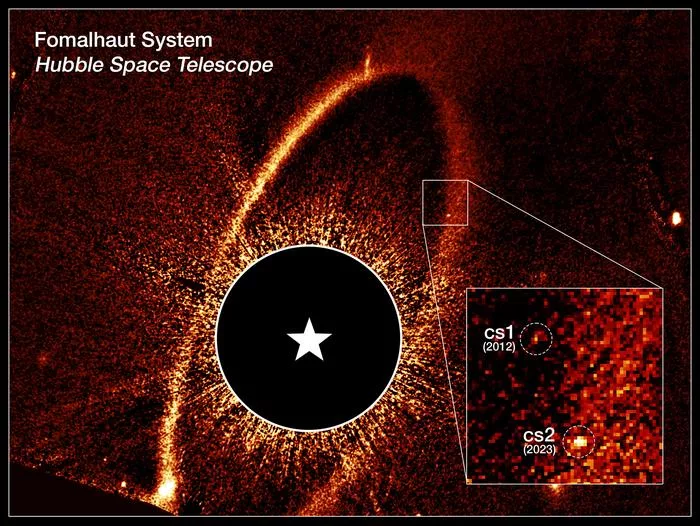 This composite Hubble Space Telescope image shows the debris ring and dust clouds cs1 and cs2 around the star Fomalhaut. For comparison, dust cloud cs1, imaged in 2012, is pictured with dust cloud cs2, imaged in 2023. The dashed circles mark the location of these clouds. When dust cloud cs2 suddenly appeared, astronomers quickly realized they had witnessed the violent collision of two massive objects. Previously thought to be a planet, cs1 is now classified as a similar debris cloud. In this image, Fomalhaut itself is masked out to allow the fainter features to be seen. Its location is marked by the white star.
Credit: NASA, ESA, Paul Kalas (UC Berkeley)
The stage for this cosmic drama is the star Fomalhaut, just 25 light-years away in the Piscis Austrinus constellation. More massive than the sun and wrapped in vast belts of dust, Fomalhaut has long intrigued astronomers.
Back in 2008, scientists discovered a bright object called Fomalhaut b. They wondered whether it was a planet or just a dust cloud. For years, there was much debate. Then, in 2023, Hubble showed that the object had vanished. Shortly after, another bright source appeared nearby.
“With these observations, our original intention was to monitor Fomalhaut b, which we initially thought was a planet,” Wang explained. “But, upon carefully comparing our new images to past images, we realized it could not be the same source. That was both exciting and caused us to scratch our heads.”
The first light, now called Fomalhaut cs1, is believed to have been a dissipating dust cloud from a collision. The second, Fomalhaut cs2, appears to be another collision remnant. Two such events in just 20 years defy expectations.
“Theory suggests that there should be one collision every 100,000 years, or longer. Here, in 20 years, we’ve seen two,” Kalas said. “If you had a movie of the last 3,000 years, and it was sped up so that every year was a fraction of a second, imagine how many flashes you’d see over that time. Fomalhaut’s planetary system would be sparkling with these collisions.”
The discovery is more than a cosmic spectacle; it’s a cautionary tale. Dust clouds can masquerade as planets, tricking even the most advanced telescopes.
“Fomalhaut cs2 looks exactly like an extrasolar planet reflecting starlight,” Kalas warned. “What we learned from studying CS1 is that a large dust cloud can masquerade as a planet for many years. This is a cautionary note for future missions that aim to detect extrasolar planets in reflected light.”
For Wang, the event also connects to planetary defense here on Earth: “Studying planetesimal collisions is important for understanding how planets form. It also can tell us about the structure of asteroids, which is important information for planetary defense programs like the Double Asteroid Redirection Test (DART).”
Though Fomalhaut cs1 has faded, the team will continue tracking cs2 with NASA’s James Webb Space Telescope (JWST). Its Near-Infrared Camera (NIRCam) can reveal details Hubble cannot, including the size and composition of dust grains, even whether they contain water or ice.
“Due to Hubble’s age, it can no longer collect reliable data on the system,” Wang said.
“Fortunately, we now have the JWST. We have an approved JWST program to follow up on this planetesimal collision to understand the new circumstellar source and the nature of its two parent planetesimals that collided.”
In essence, What began as a suspected planet turned out to be a cosmic fireworks show, two rare collisions lighting up the sky and teaching us how worlds are born.
Journal Reference:
- Pual Kalas, Jason Wang, Maxwell Millar-Blanchaer et al. A second planetesimal collision in the Fomalhaut system. Science. DOI: 10.1126/science.adu6266