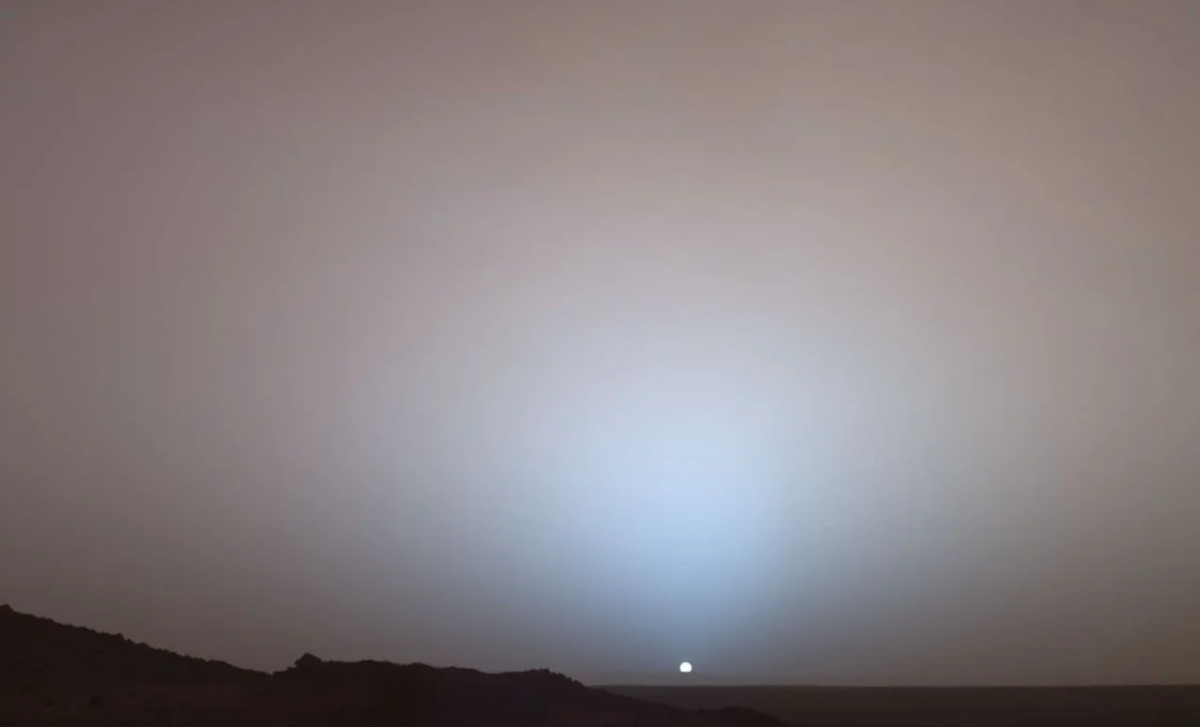
Mars continues to astonish scientists with a new set of images that reveal the Red Planet’s atmosphere in unprecedented detail. Captured by ESA’s ExoMars Trace Gas Orbiter, these high-resolution views showcase dozens of razor-thin layers glowing at twilight, highlighting the planet’s complex climate system. The full findings were published in the journal Science Advances, where researchers explain how these observations shed light on atmospheric dynamics, dust patterns, and seasonal changes across Mars.
Imaging The Martian Twilight From Orbit
On January 21, 2024, ESA’s ExoMars Trace Gas Orbiter (TGO) flew over the southern highlands of Terra Cimmeria, capturing the sunset from an altitude of about 250 miles. Using its Color and Stereo Surface Imaging System (CaSSIS), the spacecraft looked back toward the horizon, recording vertical slices of the Martian atmosphere from the planet’s shadow. This unique imaging angle, known as forward scattering enhanced the visibility of atmospheric layers, some as narrow as a few hundred meters.
Each of the five image strips, spaced roughly 124 miles apart along the orbital path, captured thin sheets stretching from about 9 to 34 miles in altitude. These slices weren’t merely aesthetic; they provided scientists with insights into the layering of dust, ice, and aerosols in the Martian sky. The phenomenon was achieved through precise coordination, as the orbiter rotated its camera to scan across the planet’s limb at a velocity of about 2 miles per second.
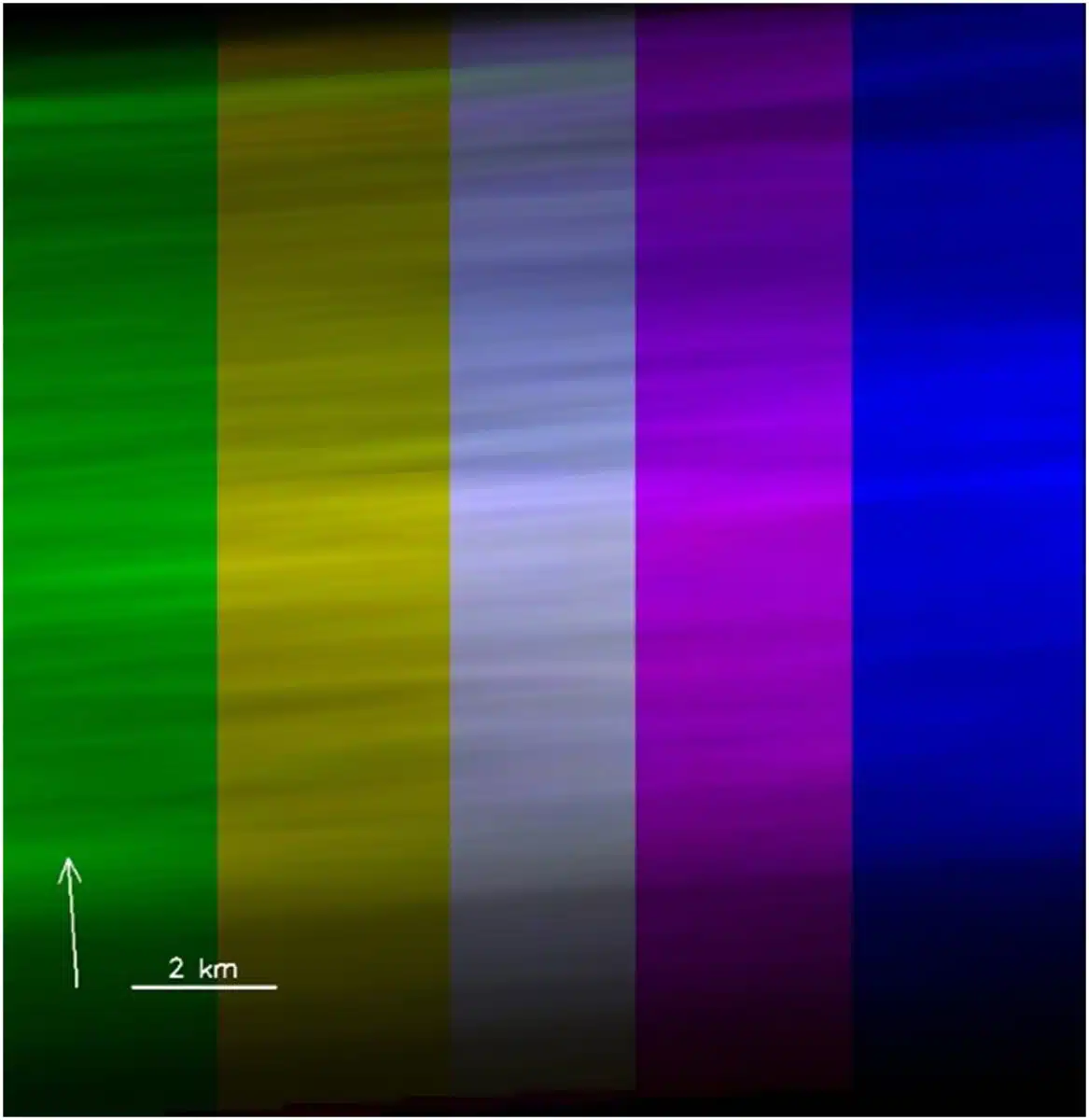 Composite of a CaSSIS 5 image sequence of the Martian limb started at 2024-01-21T07:14:45 UTC. (Science Advances)
Color Variations And Particle Secrets In The Martian Sky
As sunlight filtered through the Martian atmosphere, the CaSSIS camera picked up faint shifts in hue from blue to reddish tones. These changes revealed how particle sizes and compositions vary with altitude. Near the lower atmosphere, layers rich in dust displayed warmer tones, while higher layers showed cooler blue gradients. This aligns with previous studies, confirming that finer particles tend to dominate the upper atmosphere.
“When the blue light scatters off the dust, it stays closer to the direction of the Sun,” said Mark Lemmon, a Curiosity scientist, describing the unique light behavior during twilight. This phenomenon, known as forward scattering, explains why Martian sunsets often appear blue near the horizon, a reversal of what we see on Earth.
Above 27 miles, some layers surprisingly shift back to red, suggesting complex chemical or compositional transitions in the upper reaches of the Martian atmosphere. Scientists suspect that tiny ice grains, potentially composed of water or carbon dioxide, begin to dominate above certain thresholds, marking an intriguing transition zone that will require deeper analysis in future models.
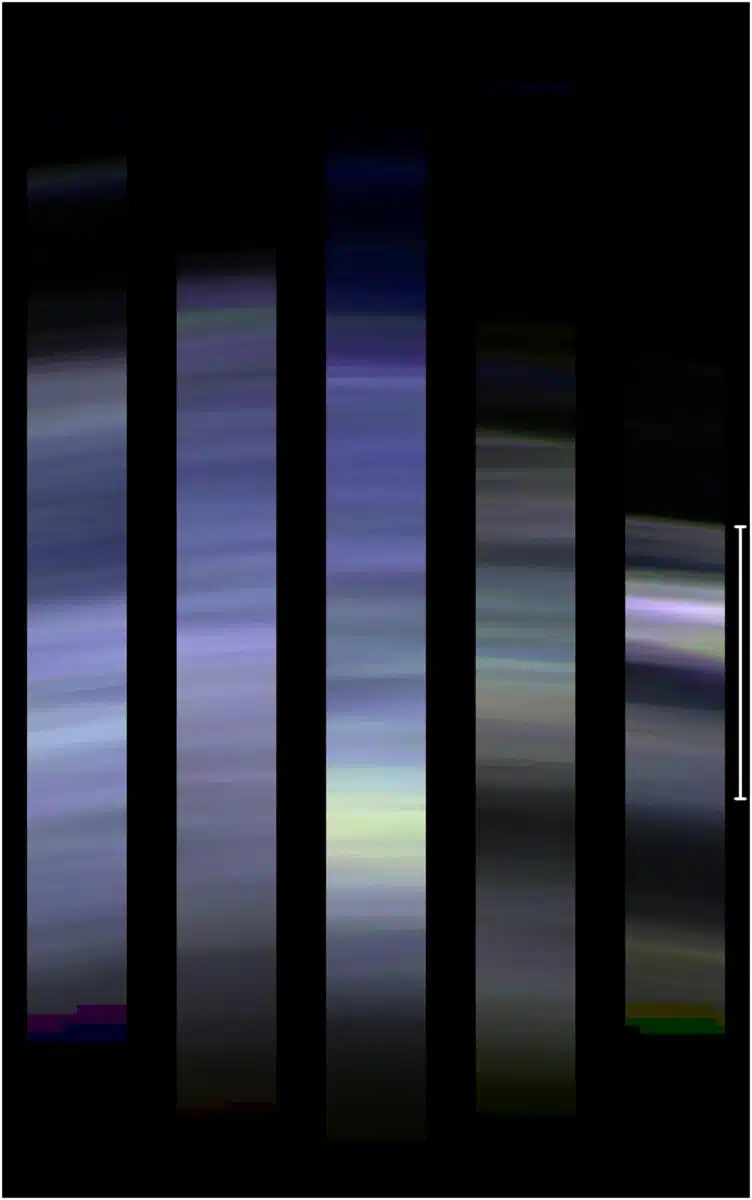 Five well-exposed datasets were obtained between 07:13:45 and 07:17:49 UTC on 21 January 2024. (Science Advances)
Climate Modeling And Seasonal Behavior
The significance of these atmospheric layers goes beyond visual beauty. As outlined in Science Advances, the vertical distribution of haze and dust layers provides crucial inputs for Martian climate models. Unlike Earth, Mars does not have a stable atmosphere; its sky changes with the seasons and responds to solar energy with remarkable variability.
The newly captured layers are believed to serve as markers for both calm periods and stormy weather patterns. In the mesosphere, between 29 and 35 miles above the surface, scientists identified isolated haze layers hovering above a distinct brightness bulge around 25 miles. These features may be linked to previously observed dust uplift mechanisms or seasonal atmospheric currents.
Below this altitude, the atmosphere appears denser with surface-lofted dust, while the upper levels may contain detached sheets of ice particles. This dual-layer behavior challenges existing models, prompting the need for updated simulations that incorporate vertical particle dynamics, size distribution, and the influence of Martian seasons.