Every two years, all 350 employees of Snøhetta, the Norwegian architecture and design company founded in 1989, are invited to come together and climb the remote Norwegian mountain that gave the firm its name. At a little over 2,260 metres, the mountain is not especially high by Norwegian standards, but it is symbolic; Vikings believed it was the paradisiacal resting place for warriors killed in battle, Valhalla. For Snøhetta’s employees — from across eight offices on four continents — this biennial climb is a way to show their respect for nature.
“This love for nature is in our DNA,” says Markus Baumann, senior architect at Snøhetta Oslo. “The dream hike for most Norwegians is to spend the day in the mountains and not meet one other person. In our design work, that translates into how our buildings let people experience nature. We want to make [it] accessible but also want to ensure that we make minimal impact possible upon it. It’s a duality that requires balance, to allow people to experience nature but not to destroy it.”
The ethos is becoming ever more apparent in the company’s work in some of the world’s coldest and most undeveloped locations. And while Snøhetta is accustomed to breaking new ground with community-focused projects — a futuristic mountain refuge for hikers in the French Pyrenees; Europe’s first underwater restaurant, in Norway; Lascaux IV, an immersive museum inspired by the French cave paintings; and concert and cultural halls from Shanghai to Prague — many of these new projects are for residential buyers.
 Every two years, Snøhetta employees climb the Norwegian mountain of the same name; it’s a way of marking their respect for nature © Bjørnar Øvrebø
 One of Snøhetta’s community-focused projects is the Refuge de Barroude, a futuristic mountain cabin for hikers in the French Pyrenees © Snøhetta
“Architecture . . . succeeds when buildings talk and respond to their environment, and that is Snøhetta’s starting point,” says Jeremy Rollason, head of Savills Ski. In the mountains, he says, buyers are increasingly looking for design that “creates a symbiosis between the buildings and their surroundings so that they can enjoy both. That feeling that while you are cosy inside, a vast glass expanse allows you to feel as though you could reach out and touch the wildlife.”
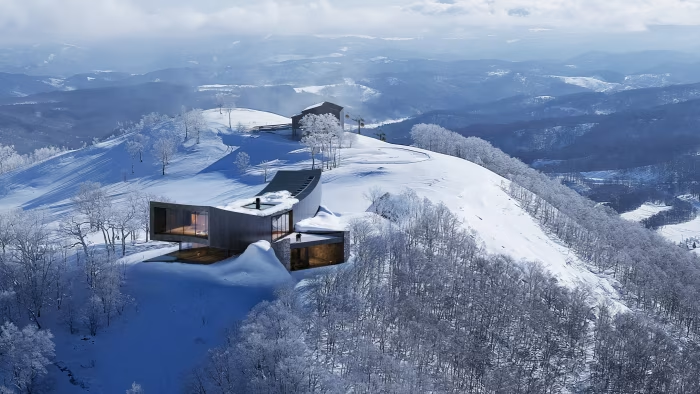
At the top of Rusutsu ski resort in Japan, a co-ownership holiday home for Japanese property company Not a Hotel throws traditional chalet tropes to the wind. Two “wings”, constructed from locally sourced wood and stone, sit on top of each other, curving softly at their midpoint as though bowing in homage to majestic Mount Yotei. Eight bedrooms, a meditation bath carved into stone and an open-air infinity pool fulfil the design promise of bringing residents into nature. Scheduled for completion in 2029, it opened for sales earlier this year — prices start at $7.6mn.
The design builds upon an earlier snowy project on the edge of Dovrefjell National Park in Norway: the Wild Reindeer Pavilion, completed in 2011. This appears the simplest of buildings, a rectangular steel frame with wooden seating shaped like eroded rock and a wall of glass to view Europe’s last wild reindeer herds.
 In Norway, The Bolder comprises four cabins that appear to hover in the side of the mountain © Bitmap/Henrik Moksnes
Further south, on Norway’s west coast, 40 minutes from Stavanger, The Bolder was commissioned by a Norwegian entrepreneur, and completed two years ago. It has four compact cabins that appear to hover mid-air, each with a glass facade overlooking the waters of Lysefjord and the pine-covered mountains. “Each cabin is 40 or 50 sq m, but the large windows make them feel more spacious,” says Baumann. “They’re constructed from locally sourced lightweight timber and each stands on a single concrete column, the only thing touching the ground. At the end of their lifespan, you remove the cabins, remove the column and the rock is as it was before.”
“Norwegians have always been closely connected to nature but traditionally, architecture was driven by function, climate and natural resources — not design: how do you shelter from the wind or hinder the snow blocking the front door?” says Cathrine Vigander, adjunct professor at Oslo School of Architecture and Design, and managing partner at architectural firm Element. “Snøhetta was a frontrunner because the company was founded with landscape as the driver, giving equal importance to landscape and architecture; architecture and interior design. For the company, humans are connected to nature, not isolated from it.”
That outlook on luxury — opulence trumped by tranquillity, a sense of wellbeing and connection to nature — is currently being transposed to Switzerland. The Alpinist is a five-star condo hotel with 164 residences launching for sale in the new year in the ski resort of Andermatt (prices from around SFr1mn/$1.25mn for a studio suite). Designed by Swiss architects Nau2 and Holzer Kobler, with interiors by Snøhetta, and currently under construction, it’s a step change in aesthetics for a resort where newly built apartments are attracting particular attention from international buyers. The first few months of the year alone drew more than 1,260 inquiries from US investors.
 A render of the Alpinist, a five-star condominium hotel with 164 residences for sale in the new year at Andermatt © Binyan Studios
“The brief was to make the spirit of The Alpinist that of a modern explorer, someone from an urban background but with a deep pull to nature,” says Snøhetta interior architect Julia Lackner. “The design had to find the balance between city refinement and bold Alpine simplicity. The entire ground floor, a huge space, is imagined as an indoor landscape divided into different zones inspired by the exterior landscape: the rocky Alpine terrain, the soft green valleys, forested slopes, gentle meadows and flowing rivers.”
A gently arching ceiling creates a sense of movement that mirrors the rise of the mountains, while the terrazzo floor is inlaid with regional stone to make a pebble-stone path. Andeer, a green stone from the canton of Graubünden, is used to mimic rugged rocks. The lack of ornamented surfaces or patterns is designed to let the natural materials dominate, says Lackner.
 The Wild Reindeer Pavilion (2011) is for viewing Europe’s last wild herds © diephotodesigner.de
 It has wooden seating shaped like eroded rock © diephotodesigner.de
The apartments are all warm timbers and soft curves. “A cabin-like refuge . . . your own bubble,” says Lackner. “The colours in the apartments are influenced by leaves in autumn, how the sun hits the mountains and how shades of green shift throughout the year.”
“Snøhetta proved it could creatively marry our aim of a landmark hotel and residences, artistic design and a meeting place for Alpine enthusiasts,” says Russell Collins, chief commercial officer at Andermatt Swiss Alps. “The spaces have been thoughtfully created to forge a community.”
Recommended

“Many people like the traditional wood-clad chalet because it’s what they’re accustomed to in places like Gstaad in the Bernese Oberland,” says Rollason. “Introducing architects like Snøhetta, whose interpretation is sympathetic to the traditional village yet pushing the design boundaries for the next generation . . . that’s clever.”
Find out about our latest stories first — follow @ft_houseandhome on Instagram