Get Starting Point
A guide through the most important stories of the morning, delivered Monday through Friday.
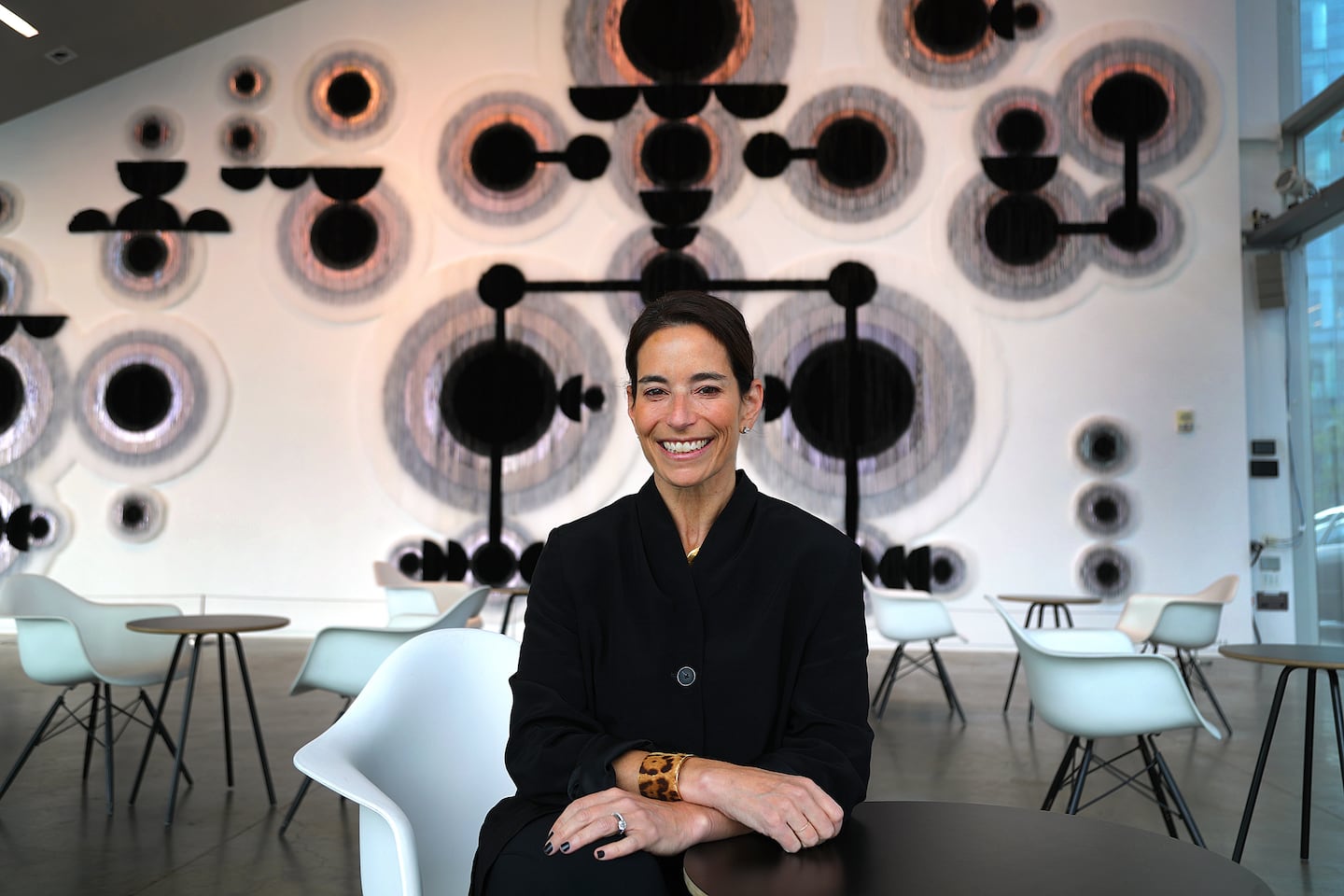
So here’s the real question facing the ICA’s new leader: How can she sustain the museum’s recent successes, while also expanding its profile as a bulwark for contemporary art in Boston and beyond?
Abrams, who arrived here from the Museum of Contemporary Art Denver, said there’s no single response to the moment. But she’s sure that any forward-looking strategy will involve collaborations with artists and other organizations.
“There are moments in time where striking out on your own makes a lot of sense, and it’s really savvy and strategic,” said Abrams, who’s settled with her family in Newton. “Then there are moments where being in partnership is also really strategic and savvy. I think we’re in one of those moments now.”
Abrams, 47, arrives in Boston at a moment of generational change across the city’s nonprofit arts sector, with new (or at least newish) leaders at the Museum of Fine Arts, Harvard Art Museums, Boch Center, Boston Ballet, and Boston Symphony Orchestra, among others.
But even by that measure, Abrams’s arrival is striking: She takes the reins from Jill Medvedow, whose quarter-century tenure at the museum still looms large today.
“She left the museum on really solid footing,” said Abrams, originally from New York. “There are certain things that we are unwavering about: the relevance we have in the field as a producer of high-caliber exhibitions and a collaborator with artists.”
That’s not to say there isn’t room for growth.
“It’s important to recognize that it is a totally different landscape” today, she said, adding that “audience behavior and expectations have shifted significantly” post-pandemic. “There are ways that we can deepen our relevance in the city.”
That was part of Abrams’s charge at the MCA Denver, where as director she oversaw an ambitious exhibition calendar, while also spearheading initiatives to cultivate a contemporary art scene and expand the museum’s influence in a city whose residents skew more outdoorsy than artsy.
At the Denver museum, where Abrams started as an adjunct curator in 2009, she produced exhibitions that featured works by well known 20th-century artists like Jean-Michel Basquiat and Keith Haring, as well as contemporary work by Tara Donovan and Dana Schutz.
Meanwhile, she launched the so-called “Octopus Initiative,” a program that commissions artworks from Denver-based artists then lends them out free to area residents. She also helped broker an innovative real estate deal for the museum to take over an old theater near downtown as a satellite space.
Sarah Kate Baie, program director at the MCA Denver, said her former boss embedded herself in the city’s culture in a way that “only someone who comes from outside of a community can.”
“Nora really saw the possibility that she could realize her vision of expanding the museum beyond its walls,” she said. Denver “was a place she not only loved, but that she wanted to champion and lift up. That includes her work with artists, and it includes her leadership here as the director” to make the museum work as “a catalyst and as a hub for creativity in the city.”
Donovan, whose artwork often transforms everyday items such as Styrofoam cups into huge amorphous sculptural forms, called working with Abrams “a career highlight.”
“I found her so smart and her enthusiasm so kind of contagious,” Donovan recalled, describing Abrams’s pitch to the established New York artist to do a show in Denver. “I felt both challenged and safe working with her.”
Those qualities are part of what impressed the ICA’s board, which voted unanimously to offer her the director job late last year.
“We were looking for somebody who would be a phenomenal collaborator and a thought leader in arts and culture,” said board member Emmett G. Price III. “The moment I saw her in person and saw how thoughtful she was, her disposition, and how passionate she was … it became an obvious choice.”
Six months in, Abrams has introduced her first initiative at the ICA: the “ICA Artist Pass,” which provides one year of free general admission to Massachusetts-based artists. But otherwise, she remains circumspect about future directions she may take the museum.
“I didn’t come in with a particular agenda, because I want to be open to what the particularities on the ground are,” she said. “The gift coming into this role at this time is that I can take time to be in conversation and really be listening with a lot of different stakeholders.”
Nevertheless, Abrams must calibrate her emerging vision for the ICA to today’s political realities. Gone are the days when the federal government supported diversity efforts writ large. Rather, President Trump is seeking to remake several high-profile arts organizations in his own image, while also promising greater scrutiny for regional groups.
As she passed through one of the ICA’s upper-floor galleries, Abrams paused briefly in front of a self-portrait by Arcmanoro Niles. The painting, “I Look Just Like My Mama With My Father’s Eyes (Can Time Heal the Guilty),” is awash in color. It presents Niles, shirtless, as he regards the viewer, his luminescent brown skin set off against his hot pink hair, beard, eyes, and nipples.
It is not, in other words, a painting that’s going to “Make America Great Again” any time soon.
But the ICA’s response to the Trump era, and, Abrams suggested, the response of the field more broadly, must be bigger than any one artwork on the wall.
“Museums are targets,” she said. “We have to be much more on offense strategically in terms of how we’re talking about what we do and what our role is in making the city a healthy, safe, vibrant place to be.”
Malcolm Gay can be reached at malcolm.gay@globe.com. Follow him @malcolmgay.